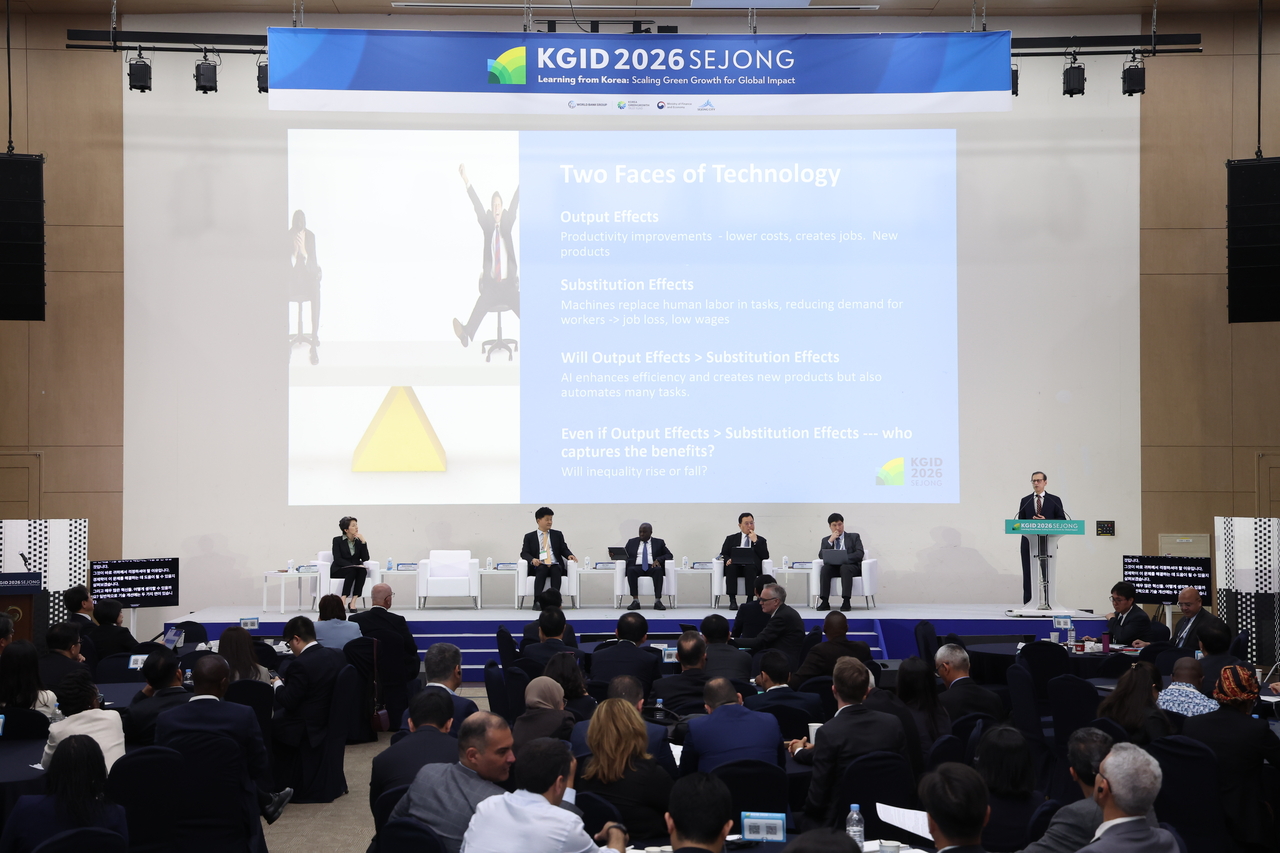
South Korea can play a bigger role in supporting green growth in emerging economies through the Korea Green Growth Trust Fund, a Korea-backed funding program operated by the World Bank Group, participants said at an event hosted by the multilateral lender on Friday.
The World Bank hosted the 15th Korea Green Innovation Days in Sejong City, the country's administrative capital, under the theme "Learning from Korea: Scaling Green Growth for Global Impact."
The three-day event brought together around 560 participants, including World Bank officials, policymakers from developing countries such as Kosovo, Kenya and Kyrgyzstan, project teams and partner institutions, featuring sessions and site visits, before concluding with a plenary session Friday.
"Korea's green growth strategy is fundamental, transformational and very meaningful for the work that we do because this is a recognition that growth itself is not sufficient,” Guangzhe Chen, World Bank vice president for planet, said during opening remarks at the plenary session.
Chen said World Bank would continue supporting the trust fund and deepen cooperation with Korean institutions.
"We also remain committed to deepening our engagement with Korean institutions and using KGGTF as a platform to showcase results, share experiences, strengthen partnerships and help shape future directions," he said.
The event highlighted KGGTF-backed projects, including a remote sensing-based digital agriculture system in Honduras designed to estimate crop areas and forecast yields.
World Bank and the KGGTF supported the Honduran government in developing the national digital agriculture planning program named Sisagro. The project features AI-based crop yield forecasting using satellite and drone data, integrated agricultural data systems and climate response mechanisms.
"Such efforts helped Honduras improve agricultural productivity and strengthen food security," Kim Kwang-soo, a professor at Seoul National University’s College of Agriculture and Life Sciences and director of the National Center for AgroMeteorology, said. Kim led the design of Sisagro.
Other initiatives introduced at the event included technical assistance for Rwanda’s industrial parks and special economic zones program aimed at supporting green industrialization, as well as Vietnam’s offshore wind power development project, digital transformation in Kosovo, and more.
"KGGTF serves as a platform to share development experience, green growth solutions and enabling technologies with the world. It strengthens Korea's role as a global development partner and deepens cooperation between Korea and the World Bank," Wang Hyoung-gun, program manager at the fund, said.
"Looking ahead, KGGTF will focus on scaling green growth — moving from knowledge to impact, from pilot projects to full-scale operations, and from partnerships to practical solutions."
During the event, World Bank project teams and officials from developing countries held meetings with Korean public institutions and companies. A separate session was also held to explain how to participate in the World Bank's international procurement market.
silverstar@heraldcorp.com