The vote on the motion to amend the Constitution was rendered invalid on Thursday after the main opposition People Power Party boycotted the National Assembly's plenary session.
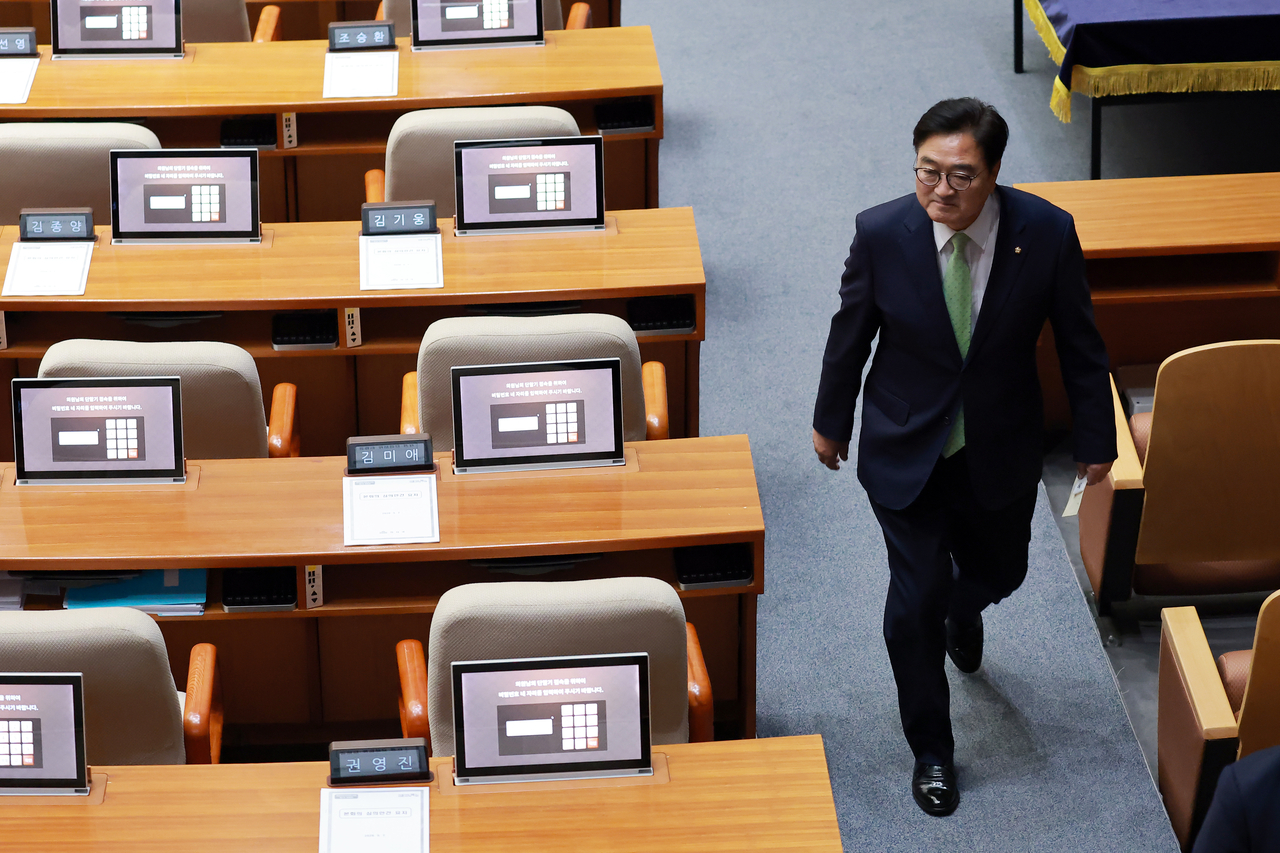
With 106 People Power Party lawmakers refusing to attend and only 178 lawmakers present, the vote was invalid. The minimal vote threshold is 191 — at least two-thirds of all 286 South Korean lawmakers.
National Assembly Speaker Rep. Woo Won-shik, who presided over the session, expressed regret over "an empty corner" in the National Assembly's main chamber, while claiming the amendment does not carry any disputable element.
"(The amendment) is about moving forward step by step, to a point we can agree on, for the sake of the people, the future and the happiness of the nation," Woo said, adding the People Power Party's boycott would be "unacceptable in the eyes of the public."
Regardless of Thursday's voting outcome, the ruling party-dominated National Assembly remains open to holding a referendum on June 3, which would coincide with South Korea's local elections and parliamentary by-elections for 14 constituencies.
Rep. Kim Han-kyu of the ruling Democratic Party of Korea told reporters Thursday before the session that there is a chance a plenary session could be convened Friday, as Sunday is the deadline for the referendum planned for June.
Kang Yu-jung, chief presidential spokesperson in Cheong Wa Dae, on Thursday expressed disappointment about the boycott and urged People Power Party lawmakers to reverse course in future revoting sessions.
The ruling Democratic Party of Korea and five minor parties — Rebuilding Korea Party, Progressive Party, Basic Income Party, Social Democratic Party and Reform Party — backed the motion tabled at the plenary session.
The drafted motion would give the National Assembly the power to approve or lift martial law. Under the current Constitution, the National Assembly may pass a resolution to invalidate martial law, but only the president has the power to lift it.
By mentioning historical movements such as the 1979 democratic protests in Busan and Masan, South Gyeongsang Province, and the 1980 Gwangju Democratic Uprising in the preamble, the proposed motion aims to uphold the pro-democracy spirit displayed throughout contemporary Korean history.
It was signed by 187 lawmakers, but eight representatives have since resigned to run in the June 3 local elections. This reduced the number of lawmakers who are not members of the People Power Party from 187 to 179, not enough to meet the threshold of 191.
Before Thursday, the last voting session on amending the Constitution was held in March 2020. It was also rendered invalid after the quorum at the National Assembly was not met. That proposal was meant to allow a referendum for an amendment to proceed based on a proposal with 1 million signatures from ordinary citizens, thus giving it the same weight as those backed by a two-thirds vote in the National Assembly.
A day before the vote, President Lee Jae Myung had also said there was "no reason to oppose" the amendment proposal. Those who were against it, he said, were "sympathizers of the unlawful martial law imposition" by his disgraced predecessor, President Yoon Suk Yeol.
The People Power Party has opposed the push from the outset. Party leader Rep. Jang Dong-hyeok said Thursday that the liberal bloc's unilateral push carries elements of a dictatorship.
"The constitutional amendment the Democratic Party intends to pass today is nothing more than a political ploy to extend Lee Jae Myung's dictatorship," Jang said in front of Cheong Wa Dae, saying Lee in the end refused his party's demand to declare that no amendment to extend his own term shall be made.
Jang visited Cheong Wa Dae to protest the ruling party's controversial legislation to grant a new special counsel the power to clear the liberal president of any criminal charges.
During the plenary session, People Power Party lawmakers' joint statement echoed that stance, urging the National Assembly to pause amendment talks and resume them after the local elections.
An expert claimed the People Power Party's resistance to the constitutional amendment is self-contradictory.
Eom Ki-hong, professor of political science at Kyungpook National University, said this is not a situation where there is a lack of agreement over the content of the amendment.
"If you look at the People Power Party's charter, the party upholds the spirit of the Gwangju Uprising, so there is no reason to oppose the (content of the amendment proposal)," he said. "Transferring the authority to impose martial law (from the president) to the National Assembly is also something they have no other choice but to support."
Eom added that it is lamentable to see even the indisputable constitutional amendment being pushed around by party interests and strategies.
"Failure to pass the motion, although a bipartisan agreement is not hard to reach, means we should start talking about changes in the procedures for a constitutional amendment," he said.
consnow@heraldcorp.com

![[Legal updates in Korea] New insurance mandate protects firefighters on the job](https://wimg.heraldcorp.com/news/cms/2026/10/01/news-p.v1.20261001.76835f19eb424f18814ac3bb65d896a9_T1.jpg?type=h&h=800)