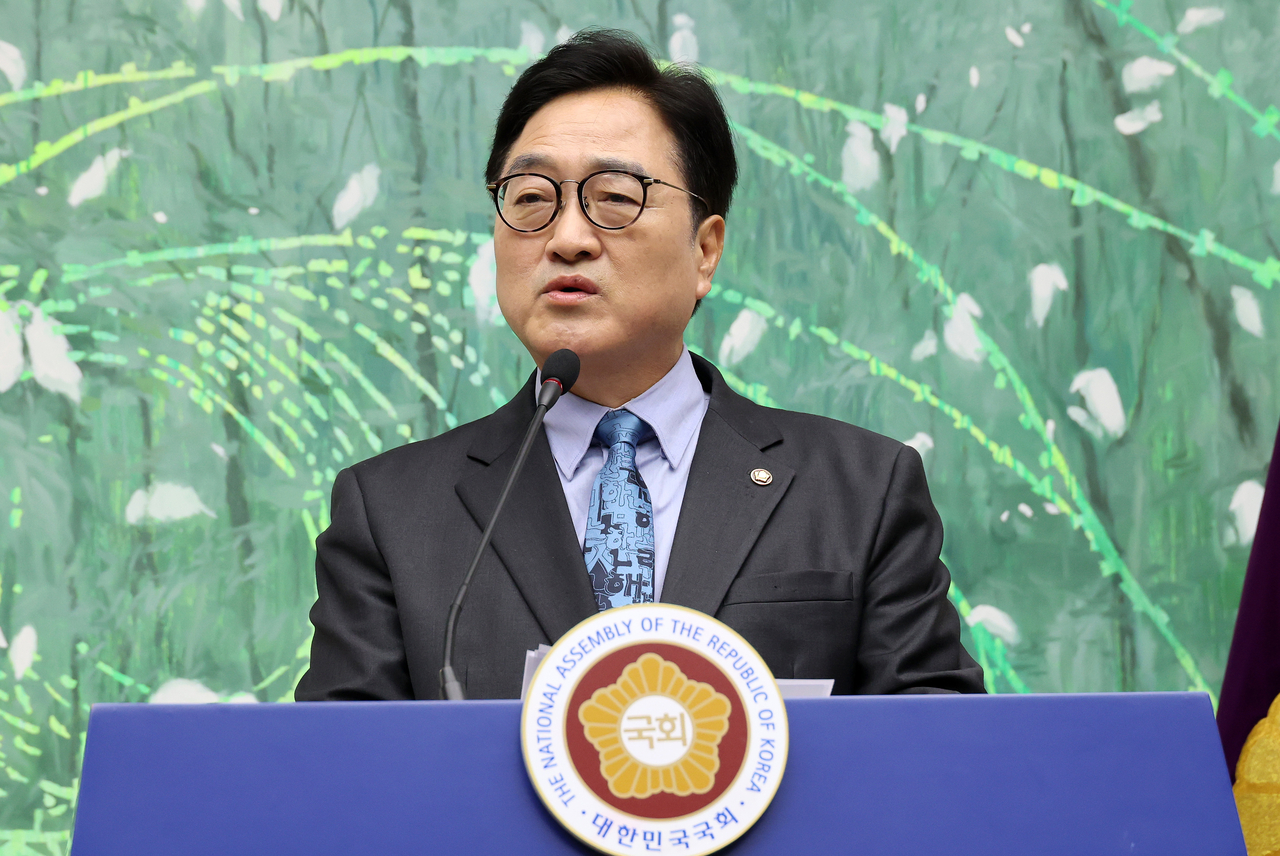
National Assembly Speaker Woo Won-shik on Monday urged the main opposition People Power Party to drop its official stance against a constitutional revision bill, arguing that the party would bear responsibility if no revision occurs.
Woo made the appeal at a news conference 10 days before the National Assembly is set to vote on the constitutional amendment bill on May 7, a mandatory step toward holding a referendum simultaneously with the June 3 local elections.
Given the current makeup of the Assembly, the bill — which requires support from at least two-thirds of all sitting lawmakers — would not pass without additional votes from the People Power Party.
"I urge the leadership and lawmakers of the People Power Party; at the very least, People Power Party lawmakers must be allowed to vote on the amendment bill in the plenary session according to their conscience and convictions," Woo said.
"If the party blocks it through an official party line and causes the constitutional revision to fail, all responsibility will also lie with the People Power Party," he added.
Woo argued that broad public support exists for the proposal.
"A large majority of the people support this," he said. "A constitutional revision backed by public sentiment must not be blocked by party discipline, nor should lawmakers be prevented from voting in its name."
The proposed amendment would update the preamble of the current Constitution, enacted in 1987. The revision would add references to include in the Constitution's preamble both the spirit of the May 18 Gwangju Democratic Movement and the 1979 Busan-Masan Democratic Movement against the Yushin dictatorship of Park Chung-hee.
The constitutional revision would also tighten restrictions on martial law powers by requiring the president to obtain National Assembly approval without delay after declaring martial law. The amendment further stipulates that the state has a duty to narrow regional disparities and promote balanced national development.
Woo noted that the People Power Party has refused even to join a special committee on constitutional revision, stressing that the amendment is limited to "the minimum set of changes on which broad public consensus has already formed."
The key hurdle to a referendum on constitutional revision is securing enough votes in the Assembly, where constitutional amendments are put to a roll-call vote.
With nine lawmakers expected to resign before June 3 to run for provincial or metropolitan offices — eight from the ruling Democratic Party of Korea and one from the People Power Party — the effective number of lawmakers would fall to 286, meaning at least 191 affirmative votes would be required.
Even if the Democratic Party, other minor progressive and conservative parties and independent lawmakers muster all 180 available votes, at least 11 lawmakers from the 106-seat People Power Party would need to break ranks and support the measure.
Woo rejected arguments that the revision could affect the incumbent president's term, calling such claims "dishonest."
"Article 128, Clause 2 of the Constitution clearly states that a constitutional amendment extending or changing a president's term does not apply to the president in office at the time it is proposed," Woo said. "President (Lee) has already answered that question."
People Power Party Chair Rep. Jang Dong-hyeok asked President Lee Jae Myung to declare that he would neither seek reelection nor serve another term before discussing a constitutional revision during their meeting at Cheong Wa Dae in early April.
Woo also said some critics have asked whether those most opposed to the constitutional revision are forces aligned with former President Yoon Suk Yeol, who was impeached and removed from office over his illicit declaration of martial law on Dec. 3, 2024.
"There are also criticisms that the People Power Party leadership remains tied to the 'Yoon Again' faction," Woo said.
Woo repeatedly asked, "What is the real reason for the opposition?"
"What does the People Power Party hope to gain by derailing a constitutional revision opportunity that has come for the first time in 39 years?"
The People Power Party has opposed holding the June local elections concurrently with a referendum on constitutional revision, calling instead for discussions on constitutional reform to proceed after the June 3 local elections.
dagyumji@heraldcorp.com


![[Legal updates in Korea] New insurance mandate protects firefighters on the job](https://wimg.heraldcorp.com/news/cms/2026/10/01/news-p.v1.20261001.76835f19eb424f18814ac3bb65d896a9_T1.jpg?type=h&h=800)