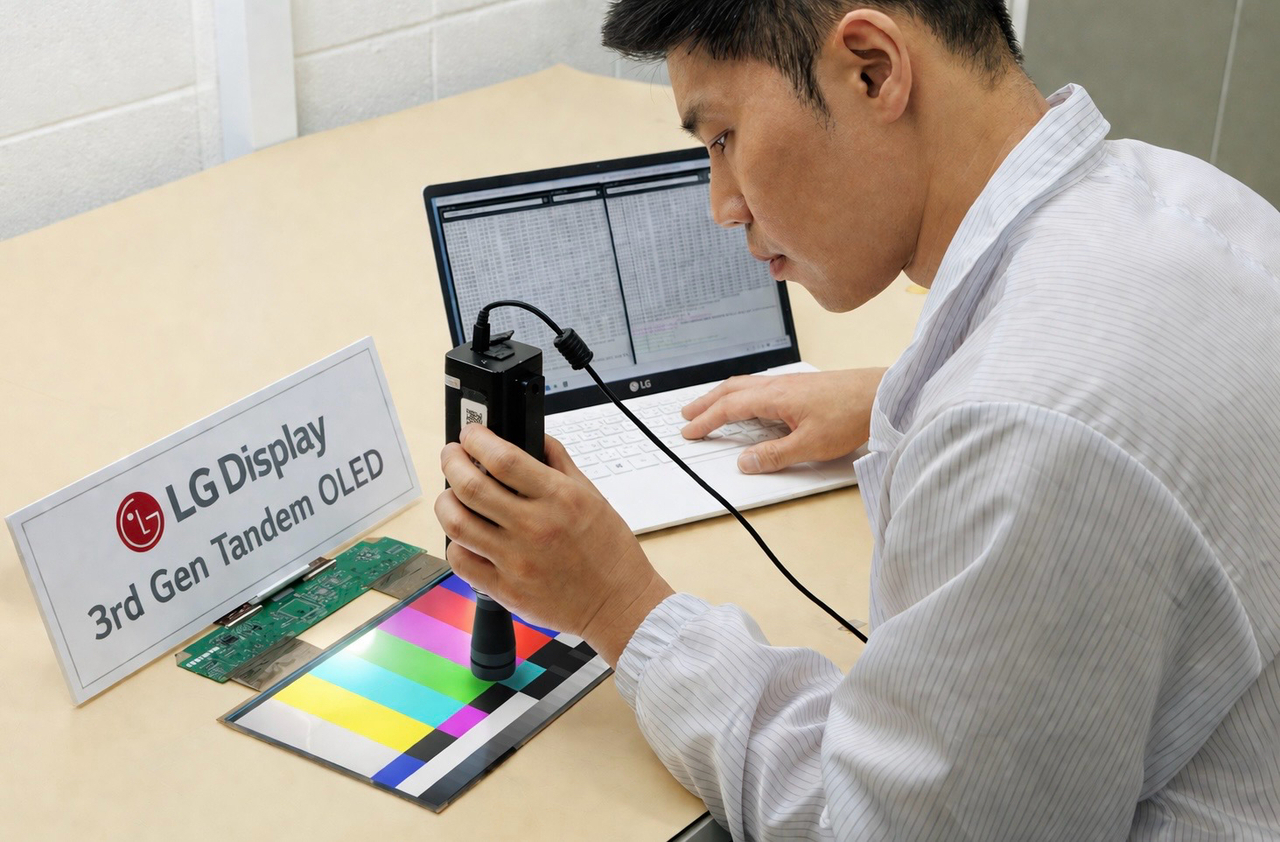
LG Display said Tuesday it is unveiling its third-generation tandem organic light-emitting diode technology for the first time at SID Display Week in Los Angeles, as the Korean panel-maker pushes deeper into automotive, robotics and other display applications for the era of artificial intelligence.
The company has opened an exhibition booth under the theme “OLED Evolution for the AI Era” at the Los Angeles Convention Center, where the annual display industry event runs through Thursday.
The booth is arranged into three zones, covering large panels, small and medium-sized displays and automotive applications.
Designed for automotive displays, the third-generation tandem OLED can maintain image quality for more than 15,000 hours at room temperature while operating at a high brightness level of 1,200 nits, according to the company. Compared to the previous model, it consumes 18 percent less power and lasts more than twice as long.
Tandem OLED stacks multiple emitting layers to improve brightness, power efficiency and durability. LG Display was the first globally to commercialize the technology in 2019, and began mass production of its second-generation tandem OLED in 2023.
In the latest version, LG Display said it has reduced degradation by improving the way charges move inside the OLED device. The use of a deep blue dopant — a high-energy organic material — also enhances color purity and reproduction.
LG Display is also introducing its plastic OLED, or P-OLED, for humanoid robots to the public for the first time.
The product applies the company’s automotive tandem OLED technology, allowing for greater design flexibility while maintaining durability across different temperatures and operating environments.
For large TVs, LG Display is showing an OLED TV panel based on its Primary RGB Tandem 2.0 technology that maximizes light efficiency through an advanced pixel structure and enhanced algorithms.
The panel offers a peak brightness of 4,500 nits and an ultralow reflectance rate of 0.3 percent, among the lowest levels in the industry.
The new lineup comes as display-makers are racing to adapt OLED panels for a wider range of devices, from premium TVs and vehicles to robots and AI-related hardware.
“Our unrivaled R&D capabilities have led the world in first-of-their-kind and best-in-class OLED innovations,” said Chief Technology Officer Choi Young-seok. “We will continue to put customers first and firmly establish our leadership as a technology-driven company that steers the future of displays.”
yeeun@heraldcorp.com


![[Graphic News] Seoul ranks 4th among Asia’s most revisited destinations](https://wimg.heraldcorp.com/news/cms/2026/10/01/news-p.v1.20261001.4ac504a054534238aa1997420394b832_T1.gif?type=h&h=800)