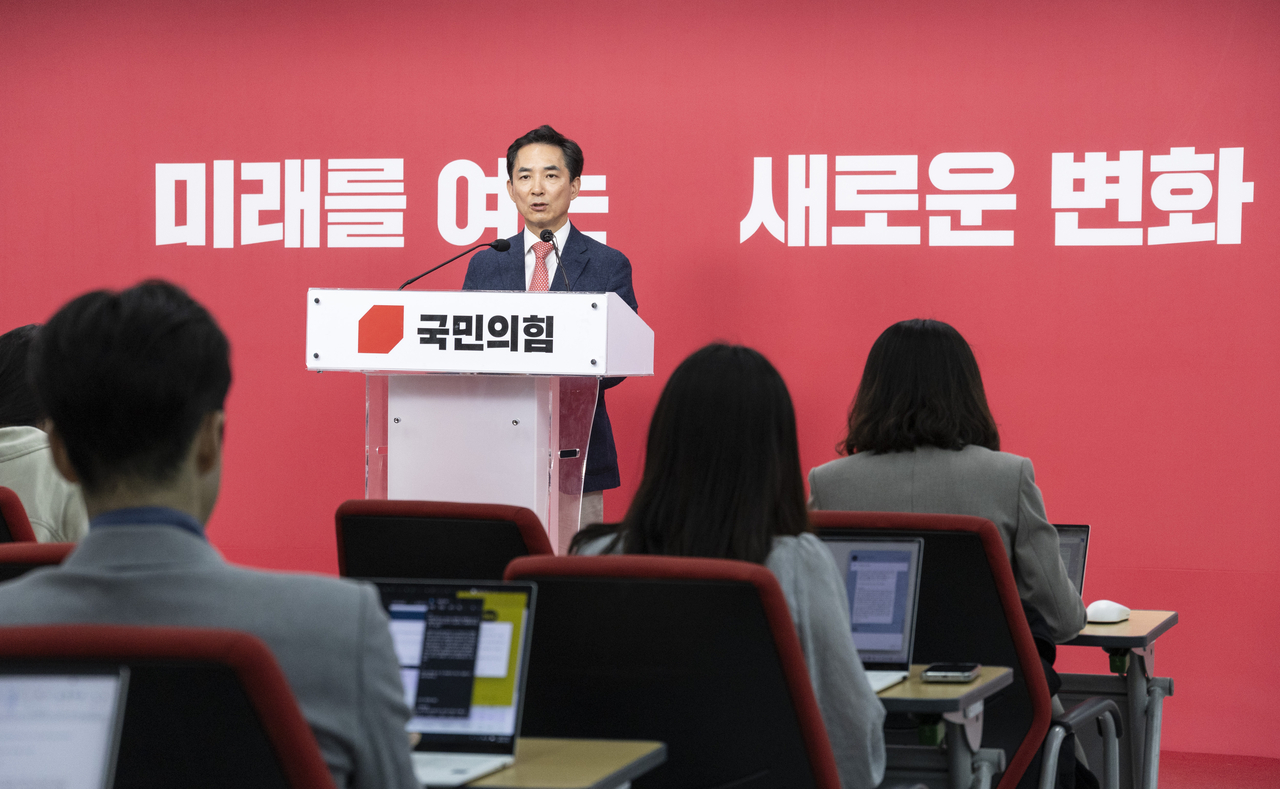
Conservatives are barreling toward a split-vote showdown in a key Busan by-election following the People Power Party's nomination of a former veterans minister that effectively locks the race into a three-way contest.
The breakdown in unity has sharpened concerns about a split conservative vote in Busan's Buk-gu A district, which is emerging as one of the most closely watched battlegrounds ahead of the June 3 elections.
Park Min-shik, who was minister of patriots and veterans affairs under the Yoon Suk Yeol administration, ruled out candidate unity with former People Power Party leader Han Dong-hoon. Han entered the race as an independent after being expelled from the party in January.
"The chances of unification are zero. Stop wishful thinking," Park said during a press briefing Tuesday at the main opposition People Power Party's headquarters in Yeouido, Seoul, hours after the party's nomination.
"Even under the broader cause of making Buk-gu the starting point of a conservative revival, such political engineering does not apply. Whether it is a two-way or three-way race, I am confident of victory."
The district's Assembly seat is up being contested following former Oceans and Fisheries Minister Chun Jae-soo's resignation. Chun, who built a solid foothold in the traditionally conservative Busan constituency through three election victories, is running to be mayor of Busan.
The ruling Democratic Party of Korea has fielded Ha Jung-woo, formerly senior presidential secretary for artificial intelligence and future planning under President Lee Jae Myung, in what is shaping up to be one of the most competitive races of the cycle.
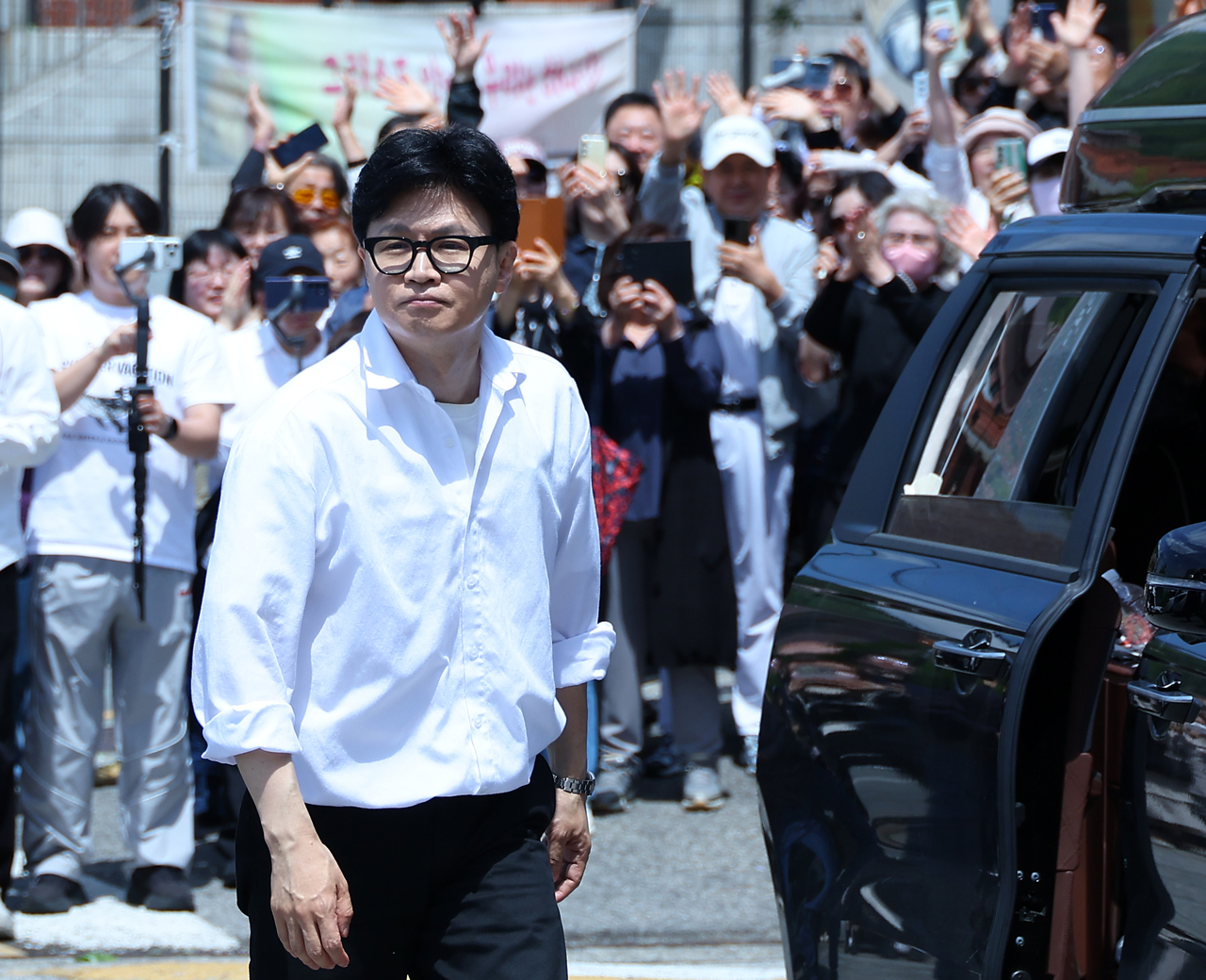
Recent polling suggests a neck-and-neck race between Ha and Han, raising the prospect of a split conservative vote. A survey commissioned by Busan MBC and conducted by Hangil Research with participation of 584 voters in Busan's Buk-gu A constituency from Friday to Sunday placed Ha at 34.3 percent and Han at 33.5 percent — within the margin of error — while Park trailed at 21.5 percent.
The dead heat between Ha and Han has fueled calls within conservative ranks to unify behind a single candidate, though no agreement has been reached.
However, People Power Party Chair Rep. Jang Dong-hyeok drew a clear line on candidate unity with Han during a press briefing Tuesday.
"Former leader Han is the person the party expelled based on principle," Jang said. "We have made clear before that solidarity with an individual who was expelled is an entirely different matter from cooperation with another party, and that position remains unchanged."
Han was expelled by the People Power Party in January over allegations that members of his family had posted messages criticizing then-President Yoon on the party's internal online bulletin board in November 2024.
Jang also suggested disciplinary action against party lawmakers who support Han.
"We will first establish the exact facts surrounding the various developments currently taking place and then take the necessary steps," Jang said when asked whether the party would take action against Rep. Han Aee-a for her on-site support of Han the previous day.
Han likewise appears to have no intention of entering talks on candidate unification, according to Rep. Park Jeong-hun of the People Power Party, a lawmaker aligned with the ousted former chief.
"As far as I know, former leader Han Dong-hoon has absolutely no intention of responding to unification discussions," Park said Monday during a radio interview with local broadcaster MBC. "That would undermine the broader picture of rebuilding conservatism."
However, Rep. Kim Dai-sik of the People Power Party, a lawmaker in Busan's Sasang-gu, underscored the need to unify candidates to win the election for the constituency.
"We must achieve candidate unification by all means necessary," Kim said during his radio interview with local broadcaster SBS on Tuesday. "I still believe that unless we move toward candidate unification, the election will be extremely difficult — and conservatives will face a tough race."
Kim went on to explain that the Buk-gu district is a constituency where Chun had won three terms, giving the Democratic Party a baseline support of about 40 percent.
"Then how can conservatives have any chance of winning with the remaining 60 percent if they are divided?" Kim said. "Elections must be viewed very coldly and realistically. Otherwise, things will become extremely difficult."
dagyumji@heraldcorp.com