Entertainment giant premieres 'The House,' a hybrid AI-human horror feature, and tries to convince everyone humans aren't going anywhere
Hollywood's flirtation with AI has gotten serious over the last few years. It started with de-aging older actors, cleaning up visual effects and fine-tuning accents in post.
Now things have moved well past that. The Russo brothers are sinking $400 million into building AI tools for filmmakers. Doug Liman is shooting a feature he claims AI trimmed from a $300 million budget down to $70 million.
So where does that leave the Korean film business?
As it happens, CJ ENM, the country's leading entertainment conglomerate behind everything from "Parasite" to "Bon Appetit, Your Majesty," has been playing around with artificial intelligence for a while.
Last year saw the launch of "Cat Biggie," a 100-percent AI-generated animation. In February, the company set up a formal industry partnership with a group of AI studios and universities.
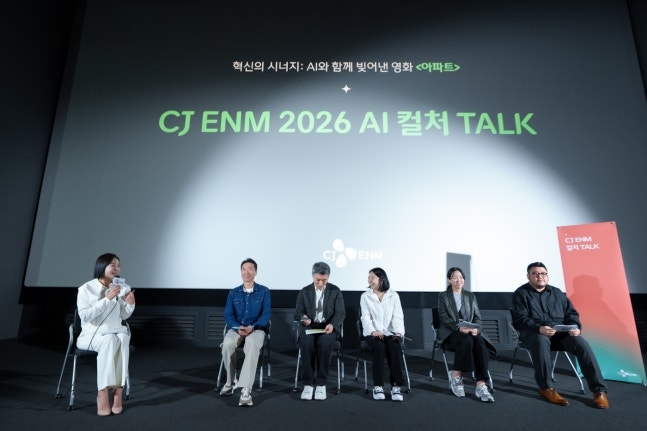
Thursday's reveal at CGV Yongsan was the next swing for the media giant. There, CJ ENM premiered "The House," a 60-minute horror piece produced with Google Cloud Korea, pitched as Korea's first hybrid AI feature in which real actors carry the performances while AI does everything around them.
The setup is familiar stuff: A young woman who can see the dead moves into a shabby apartment complex and runs afoul of a vengeful ghost with a grudge. Producer Jeong Chang-ik, head of CJ ENM's AI Studio, kept the pitch just as plain.
"We wanted to drop occult elements and creatures into a space everyone recognizes," he said.
It's not far behind your average straight-to-streaming jumpscare fare, but at the end of the day, it's just a showcase for how far AI-powered filmmaking has come.
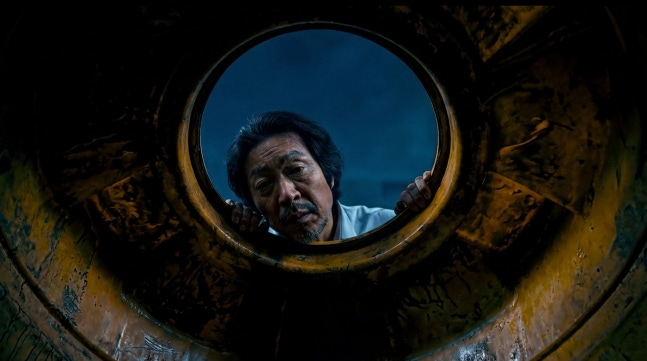
Which is to say the story is less the draw than the mechanics behind it. Actors shot indoors against green screens for a total of four days, and every background, creature, and effect was generated afterward in post using generative AI tools — Google's Imagen for image generation, Nano Banana for editing, Veo for video.
Where the AI rather unexpectedly earns its keep is in the vibes — the grimy concrete corridors, the cramped rooms with old wallpaper, that very specific feel of a run-down apartment block you'll find on the edge of any Korean city. The disaster spectacle holds up too, with the kind of CGI-heavy setpiece that would have burned serious cash on a regular shoot.

The team said they had to work around a known limitation: image models trained mostly on Western reference data have a hard time getting the local feel right.
The fix was an in-house workflow CJ ENM built specifically for narrative content, which they used to coax the models into something that actually looks like a Korean apartment.
On the money side, Jeong dropped the number everyone was waiting for: 500 million won, or roughly $337,000. To put that in perspective, a typical mid-budget production starts at around 3 billion won here.
"I'm careful not to generalize, but done the usual way it would have cost at least five times that," Jeong said. The greater the spectacle, he added, the greater the savings: "A character drinking coffee costs about the same as a character fighting a monster."
The bigger question is what comes next. AI tech is improving at breakneck speed, and every few months brings a new wave of tools that do more with fewer humans involved.
Just a few months ago, ByteDance's text-to-video model Seedance dropped clips of Tom Cruise and Brad Pitt sparring with sword-wielding zombies so convincing you couldn't tell if they were fake.
Which raises the obvious question: how long before the actors themselves are next?
Pressed on whether human actors might one day become dispensable, the panel held firm.
"AI can't replace what an actor does," said Baek Hyun-jung, head of Content Innovation at CJ ENM. "Performance is what carries the authenticity of a story. AI handles the backgrounds and the effects so the storytelling can stay intact."
"The House" streams on Tving starting May 1.
moonkihoon@heraldcorp.com


![[Legal updates in Korea] New insurance mandate protects firefighters on the job](https://wimg.heraldcorp.com/news/cms/2026/10/01/news-p.v1.20261001.76835f19eb424f18814ac3bb65d896a9_T1.jpg?type=h&h=800)