Lee pushes back against doubts over Korea’s ability to defend itself without foreign troops
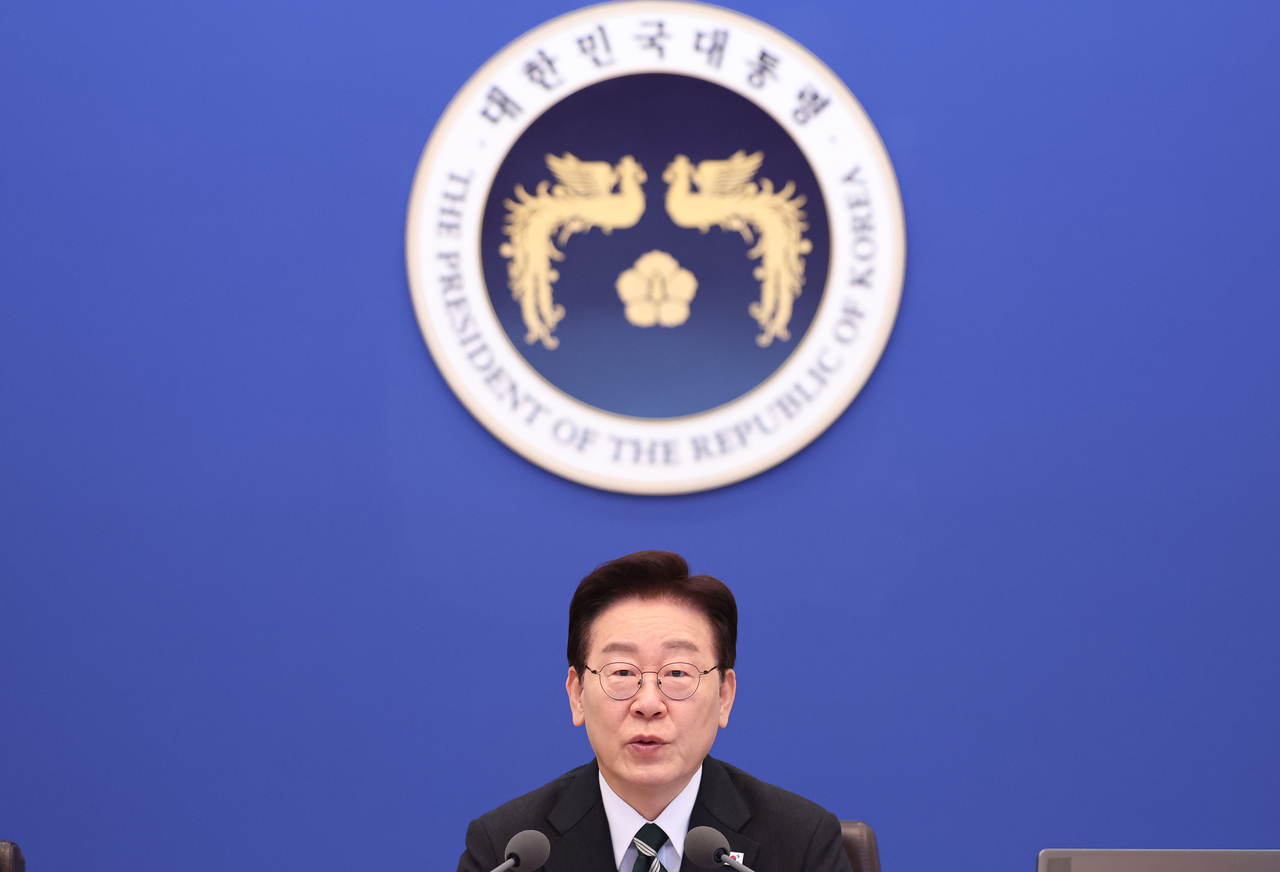
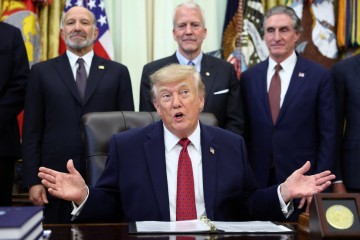
President Lee Jae Myung on Tuesday underscored the need for diplomacy conducted with the confidence of a sovereign nation and called for self-reliant defense backed by full military readiness at home.
Lee’s message of greater autonomy in diplomacy and defense came at a sensitive moment when disagreements between South Korea and the US have come to the fore.
"The structural reorganization of the global economy and security order is underway as geopolitical risks triggered by the Middle East war have expanded," Lee said during a weekly Cabinet meeting that doubled as an emergency economic review meeting at Cheong Wa Dae in Seoul.
"To secure stable engines of growth amid these waves of change, there is an urgent need for strategic, flexible and pragmatic diplomacy centered on the national interest — one that lowers excessive dependence on specific regions and steadily expands our range of options," Lee said.
He described the consolidation of South Korea’s wide-ranging cooperation with India and Vietnam through his state visits from April 19 to 24 as “a highly desirable achievement from the perspective of long-term national interest.”
“We must continue to broaden our diplomatic horizons with the Global South from the perspective of strategic national-interest diplomacy,” Lee said.
Lee said South Korea “must also, of course, further develop cooperation with its traditional allies.”
“In particular, we need the wisdom to resolve pending issues based on mutual respect, common sense and principle, while building healthy and future-oriented relations,” Lee said. “We will focus on diplomacy that builds genuine friendships with friendly nations, with the confident posture befitting a sovereign state."
Although Lee did not directly name the US, his call for sovereign diplomacy appeared to carry added weight amid a series of recent frictions with Washington.
One dispute centers on whether Unification Minister Chung Dong-young’s disclosure of North Korea’s uranium-enrichment facilities in Kusong involved confidential information shared by the United States.
Seoul maintains that Chung’s remarks during a National Assembly session in March did not disclose US-shared intelligence and were based on open sources, including remarks by IAEA Director General Rafael Mariano Grossi. Washington, however, views the remarks as a leak of shared information.
Furthermore, security negotiations tied to the bilateral Joint Fact Sheet have also stalled, with Washington setting the personal legal safety of Coupang founder and Chair Kim Bom-suk as a precondition for kickstarting working-level talks.
South Korea maintains that it is undesirable to link a Korean investigation into Coupang's massive personal data leak to broader alliance talks. Seoul explains that security negotiations form a comprehensive package built on reciprocal steps by both sides.
Lee defends Korea’s self-defense capacity
During the Cabinet meeting, Lee also underscored the importance of defense capabilities that do not rely on assistance from allies.
Lee pointed out that international assessments rank South Korea’s overall military power fifth in the world, apparently referring to a 2026 Military Strength Ranking released by Global Firepower in January.
“But why do we keep feeling this sense of anxiety — as if, without foreign military presence, we would be incapable of defending ourselves on our own?” Lee said, in an apparent reference to the stationing of US Forces Korea.
Lee’s remarks came as the main opposition People Power Party stepped up criticism of the Lee administration’s push to regain wartime operational control from the US.
The People Power Party has ratcheted up pressure following remarks by Xavier Brunson, commander of US Forces Korea, during an April 21 hearing of the US Senate Armed Services Committee in Washington. Brunson underscored the need to “continue to work to ensure that political expediency doesn't outpace the conditions” for the wartime OPCON transfer.
During the Cabinet meeting, Lee called on Defense Minister Ahn Gyu-back to inform the public of the South Korean military’s capabilities to defend itself, to ease concerns about the country’s self-defense capacity.
Lee also repeatedly pressed Ahn on whether the military was ready for self-defense, asking about its current readiness.
"Shouldn’t we be fully prepared to defend ourselves, conduct operations on our own and draw up strategic operational plans ourselves?" Lee said.
"We must be prepared in terms of tactics and strategy, and be fully capable of doing it on our own."
Ahn replied, "In that sense, we have secured various tangible and intangible assets ... and strategic systems that could allow us to move up the transfer of wartime operational control."
dagyumji@heraldcorp.com
![[Legal updates in Korea] New insurance mandate protects firefighters on the job](https://wimg.heraldcorp.com/news/cms/2026/10/01/news-p.v1.20261001.76835f19eb424f18814ac3bb65d896a9_T1.jpg?type=h&h=800)