The Austrian conductor and concertmaster Ji Sung-ho reflect on an orchestra in transition
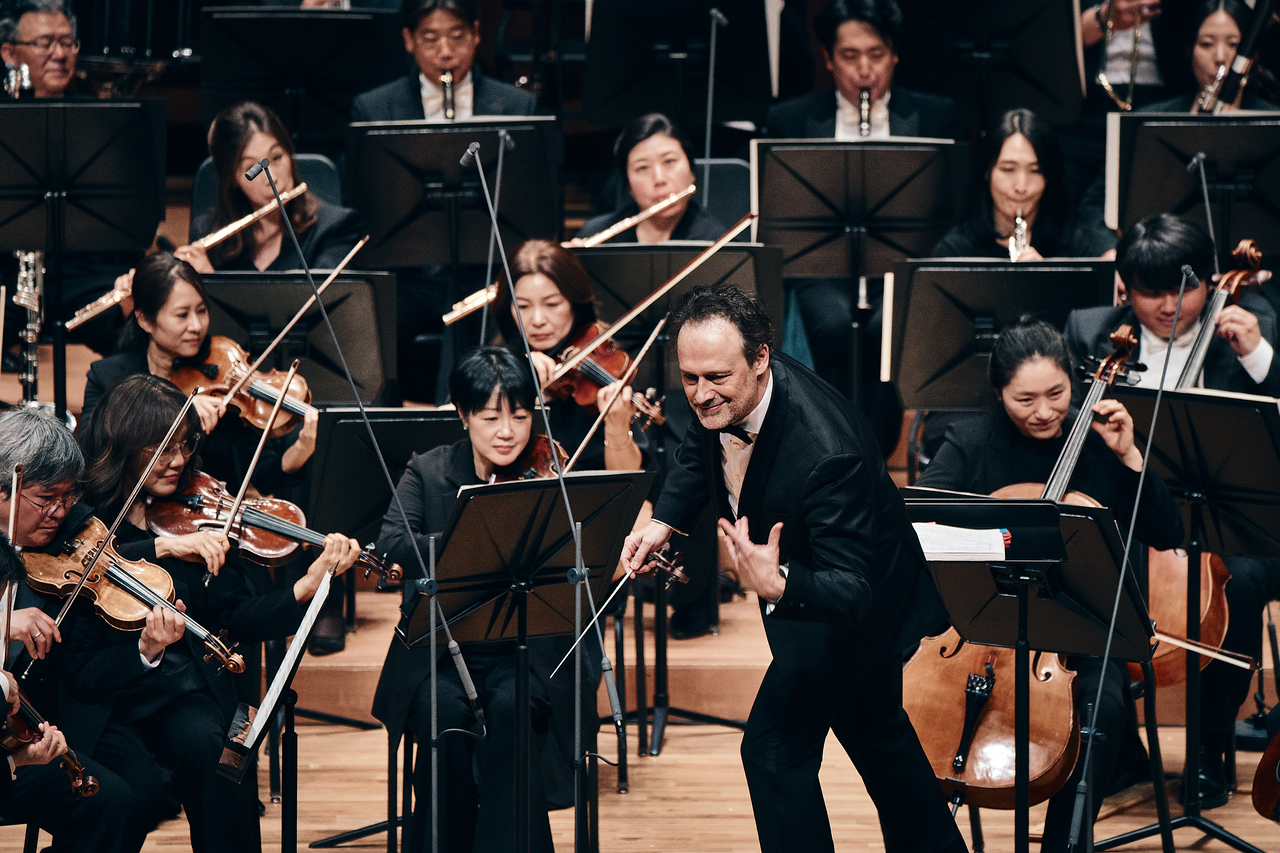
When Austrian conductor Sascha Goetzel was named recipient of the 2026 BBC Music Magazine Award for Orchestral Recording on Wednesday London time, he wasn't in Europe to collect it.
The 55-year-old maestro heard the news in Seoul, where he was preparing a performance with the Ulsan Philharmonic Orchestra — the finale of this year's Orchestra Festival organized by the Seoul Arts Center.
The winning album, recorded with the Orchestre National des Pays de la Loire on the BIS label, brings together three Austrian composers — Franz Schreker, Erich Wolfgang Korngold and Ernst Krenek — whose music was banned by the dictatorships of the 1930s and then faded from concert halls for decades.
Goetzel describes it as the first installment of a three-part series built "from the shadows of the Vienna circle," tracing European art between 1880 and 1938. Volume two, to be recorded this summer, turns to Paris between 1917 and 1924. The final disc will confront the apocalypse itself.

Goetzel deeply appreciates that the BBC prize is different, with critics drawing up the shortlist and the winner being chosen entirely by audience vote. His recording beat Simon Rattle and the Bavarian Radio Symphony Orchestra's Mahler Seventh.
"When I heard the news, I said, 'It's not possible,'" he told The Korea Herald ahead of Thursday's rehearsal.
"And now I can't wait that, with Ulsan, we also start to make our journey and arriving somewhere with a repertoire we like and a repertoire we identify with, to also go for the next big journey here in Korea," he said.
Thursday's concert marked the Ulsan Philharmonic's return to the Seoul festival after seven years — a gap that concertmaster Ji Sung-ho, with the orchestra since 2011, said felt strange to the players themselves.

"We weren't hiding somewhere in retreat," Ji said during the same interview. "We worked very hard with many international guest conductors, and lately, with Maestro Goetzel's arrival, a new energy has been rising."
Goetzel has led the orchestra since January 2025, a job he took on in a city best known internationally as the heartland of Hyundai Motor and Hyundai Heavy Industries — home to roughly 1.12 million residents whose economic life is bound up with shipbuilding, automobiles and petrochemicals.
Asked what he is trying to build in Ulsan, Goetzel rejected quick-fix vocabulary. Conductors, he said, work in two modes: guests who deliver a spectacular performance, or music directors who "nourish a process of development."
Thursday's concert was the 19th project of his collaboration with the orchestra. Based on his experience in France and in Istanbul — where he spent 11 years as artistic director of the Borusan Istanbul Philharmonic, taking the ensemble to the Salzburg Festival and the BBC Proms — the decisive leap in an orchestra's sound comes only after 15 to 20 projects, he said, and full international recognition after five to eight years.
Ji said the change is already visible. He described Goetzel leaping around the podium to demonstrate how a Viennese polka should be danced, not just played. "We've played polkas for decades. But like a foreigner who doesn't know a Korean folk song, we didn't know the origin. Seeing it right in front of us, it really sinks in. The musicians' expressions have become much more open, and naturally that comes out in the music."
In rehearsal, Ji said, the orchestra has learned to recognize one signal: "He has a sound in mind, we play it several times, and at the end he says, 'This is the Ulsan sound.'"
What drew him to Ulsan in the first place was the city's commitment, Goetzel said. City officials convinced him they genuinely wanted to grow the orchestra. This year, 10 new player positions will open, with auditions beginning in the summer.
He is also on familiar terrain. His first official conducting post, at age 24, was with the Austrian-Korean Philharmonic in Vienna, a student ensemble drawing players from both countries. "The Korean culture, the way of making music, has accompanied my life from the beginning," he said.
"We have old Beethoven symphonies recorded 200 times. Even if you make a great recording, does it give an identity to an orchestra?" he said. "Now is the time to really conceptualize the path for Ulsan to develop an artistic identity."
His contract runs through 2028. Ulsan is in year two.
"I believe in the process," he said. "When one day I go, it will be remembered by them and by me. It becomes part of your life."
gypark@heraldcorp.com