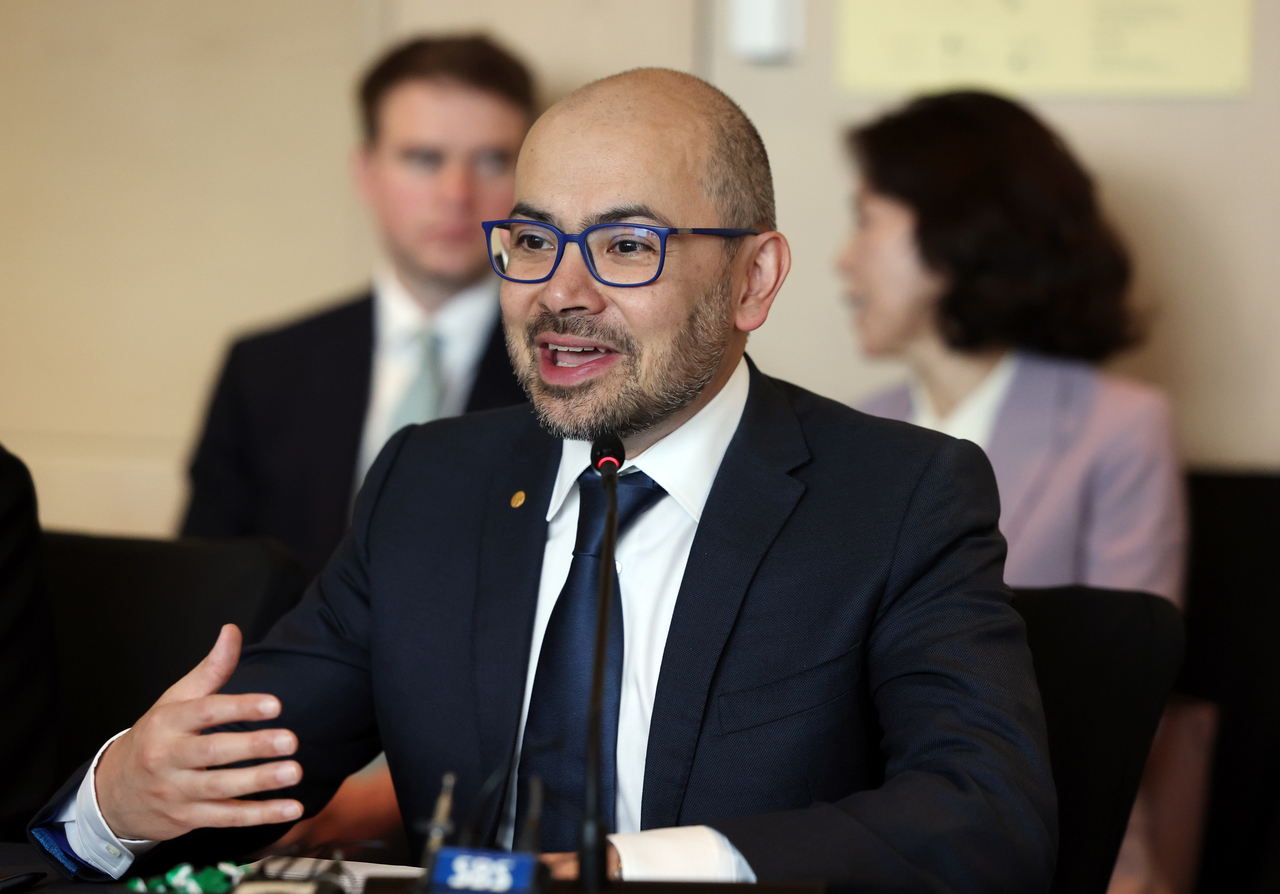
Demis Hassabis, the Google DeepMind co-founder and CEO known as the architect behind AlphaGo, will meet senior executives from Korean companies including Samsung Electronics, SK hynix, Hyundai Motor during his visit to Seoul.
"We hope to be a big area of collaboration for us going forward on the industrial side and commercial side. We already have very deep partnerships with many of the world-class companies here from Samsung Electronics, SK hynix, Hyundi Motor through Boston Dynamics and LG Electronics," Hassabis said during a memorandum of understanding signing ceremony with the Ministry of Science and ICT in Seoul on Monday.
"I will be meeting with the companies tomorrow and we hope to deepen even further our partnerships and to instigate new joint projects."
Industry sources forecast the Google DeepMind chief could sit down with chairs or other top executives to discuss broader AI cooperation. However, Hassabis declined to comment when asked by The Korea Herald after the singing event.
At Monday’s MOU ceremony, Google DeepMind said it would establish the world’s first Google AI Campus in Seoul this year, and pledged to work with the ministry across a range of science and technology fields.
Earlier in the day, Hassabis met President Lee Jae Myung to discuss the prospects of artificial intelligence, including global guardrails and basic income for a society increasingly reshaped by AI.
“The two sides held in-depth discussions on the rapid recent advances in AI technology, the direction of future developments, the responsible use of AI and ways to strengthen global cooperation,” Kim Yong-beom, presidential chief of staff for policy, said during a press briefing.
Lee and Hassabis also "discussed basic income at length," according to Kim, as well as the Lee administration's "K-moonshot" project.
The Google AI campus, to be set up in a 1,980-square-meter space in Gangnam-gu, southern Seoul, is expected to serve as a base for the project, linking Google DeepMind with Korean startups and researchers.
K-Moonshot is a national project that aims to combine AI with science and technology to address key national challenges and improve research productivity. The government hopes to double AI-powered research productivity in science and technology by 2030 and resolve 12 national missions across eight strategic sectors by 2035, including advanced bio, materials, future energy, physical AI, space, semiconductors and quantum technologies.
Through the MOU, the two sides agreed to cooperate in key areas, including joint AI research, AI talent development and the responsible use of AI.
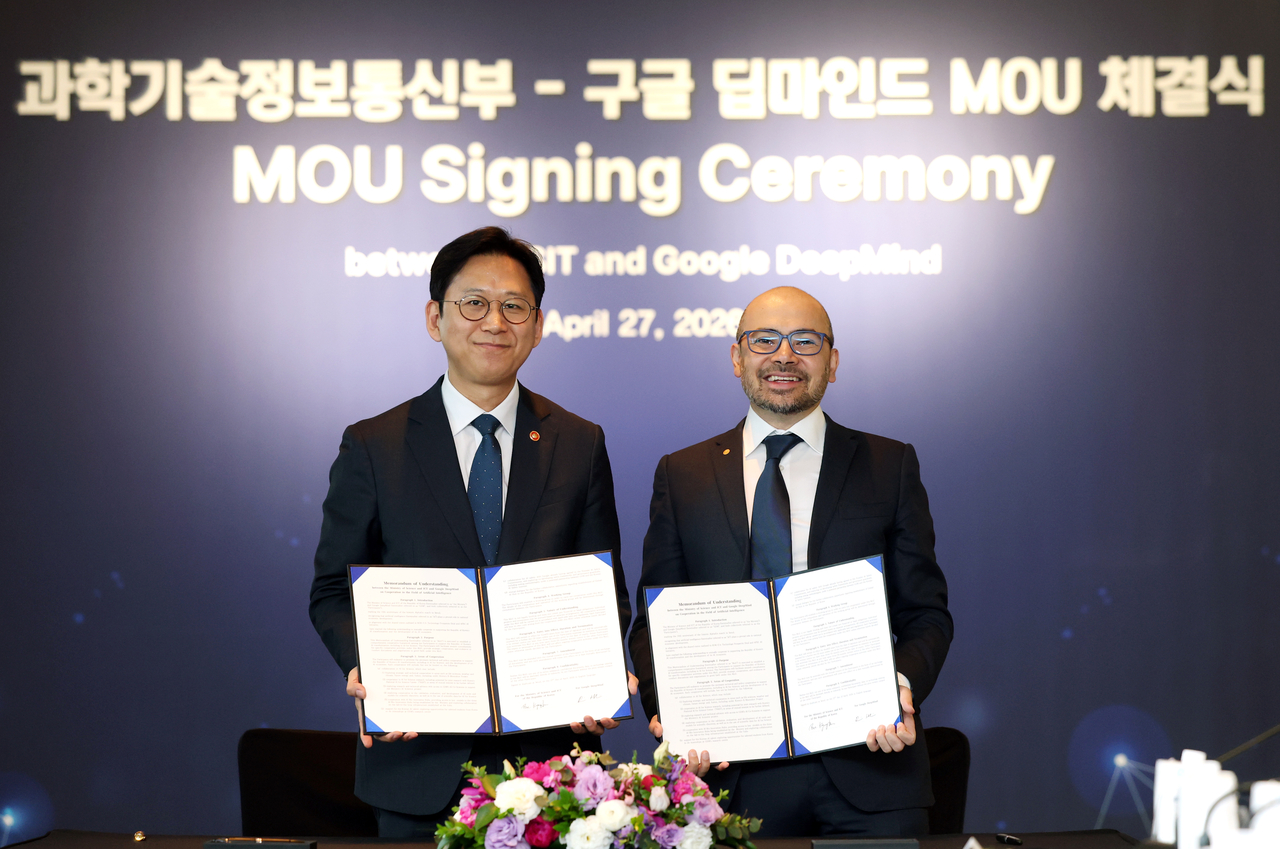
Hassabis said the partnership would focus on expanding AI research exchanges to support scientific progress, fostering the next generation of AI talent, and jointly addressing international standards and procedures related to AI safety.
Under the agreement, the ministry and Google DeepMind will explore cooperation in areas such as life sciences, weather and climate, and AI systems designed to support scientific discovery.
The National Science AI Research Center, to begin operations next month, will serve as one of the main platforms for the work. The two sides plan to promote joint research and researcher exchanges, while also looking at the development and validation of AI models and tools, the use of scientific data, and cooperation around AI-driven bio innovation research hubs.
The two sides will also seek internship opportunities for promising Korean AI researchers, giving them a chance to experience Google DeepMind’s research environment.
The agreement includes cooperation on AI safety and governance. The ministry and Google DeepMind intend to conduct joint research on safety frameworks and safeguards for AI models and to continue discussions on testing methods and safety frameworks in connection with Korea’s AI Safety Institute.
The two sides will also set up a joint working group to follow up on the agreement. They plan to hold quarterly video meetings and annual in-person meetings to discuss specific projects and implementation plans.
Monday's signing was held at Four Seasons Hotel Seoul, where Google DeepMind’s AlphaGo faced Korean Go master Lee Se-dol in 2016 in a match that became a defining moment in public perceptions of AI.
The ministry said the latest agreement is meaningful as it comes ahead of the 10th anniversary of the AlphaGo match and seeks to build on that legacy through cooperation in science and technology.
“If AlphaGo opened the curtain on the AI era 10 years ago, we are now moving into a stage where AI solves complex scientific challenges and has a tangible impact on people's lives,” Deputy Prime Minister and ICT Minister Bae Kyung-hoon said.
“The MOU signed today will serve as a pivotal milestone for Korea to accelerate AI innovation centered on K-Moonshot, while fostering collaboration between the two institutions to advance best practices and research for safe and responsible AI,” he added.
Hassabis said, “We’re proud of our long-standing connection with Korea as the home of the historic AlphaGo match — the moment that kick-started the modern AI era. Our new partnership builds on that legacy to push the boundaries of bio innovation and weather prediction, while also exploring the guardrails needed to guide the responsible development of AI.”
yeeun@heraldcorp.com