Chipmaker smashes Q1 records, upbeat on memory upcycle outlook
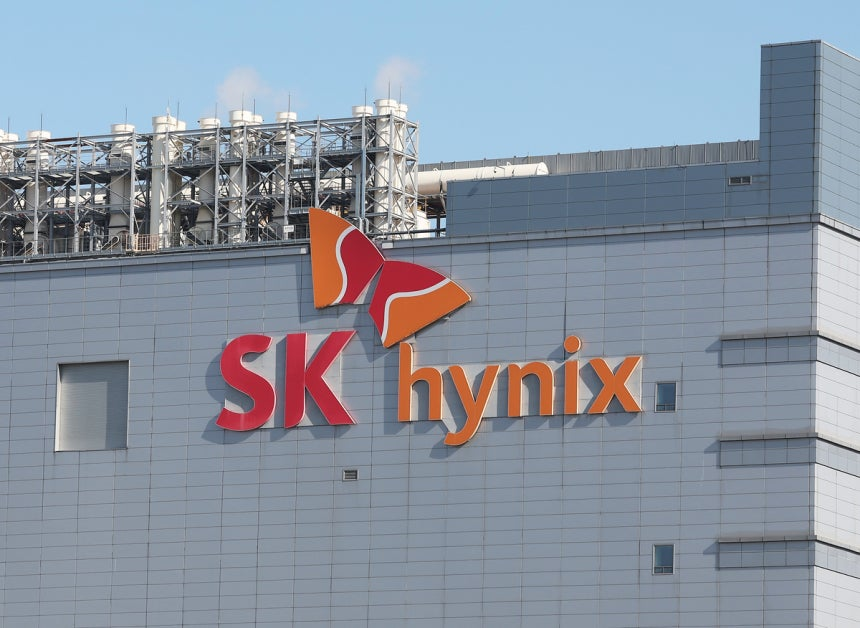
SK hynix said Thursday demand for high bandwidth memory (HBM) would outpace supply for at least the next three years, as it pledged to meet orders on time following record-breaking quarterly results.
The chipmaker added that the current upcycle in memory prices is likely to continue, driven by strong demand for HBM, server DRAM and enterprise solid state drives alongside persistent supply constraints.
“As this supply-demand imbalance persists, customers are prioritizing volume over price, and the growing importance of memory in AI computing is being reflected in pricing,” Park Joon-deok, vice president leading Dram marketing at SK hynix said during an earnings call for Q1. “Favorable pricing conditions are expected to continue for the time being.”
Earlier in the day, the memory chip maker reported its sales posted an all-time high of 52.6 trillion won ($39 billion) in the January-March period, while its operating profit jumped 405 percent to 37.6 trillion won, marking a fourth straight quarter of record results.
Revenue topped 50 trillion won for the first time in a single quarter, while operating margin nearly doubled on-quarter to reach 72 percent — up 14 percentage points from 58 percent in the fourth quarter. In the fourth quarter of 2025, SK hynix reported revenue of 32.8 trillion won and operating profit of 19.2 trillion won.

"Despite the fact that first quarter is typically a seasonal downturn, strong demand persisted due to expanded investments in AI infrastructure," Kim Woo-hyun, chief financial officer at SK hynix said.
Explaining that AI is evolving from large-scale model training to agentic systems that perform repeated real-time inferences in diverse environments, Kim said the demand base for memory was set to broaden across both DRAM and NAND flash.
On rising requests for long-term supply agreements, SK hynix broader adoption could help stabilize the market.
"Supply constraints limit our ability to meet all requests for now. But wider adoption of multi-year LTAs could improve demand visibility and support more stable earnings, enhancing investment efficiency," Park said. "This could help the cyclical volatility that has historically defined the memory industry."
Advancing next-generation products, the company said it plans to deliver HBM4E samples in the second half of this year, and start mass production in 2027.
HBM4E will adopt the company's sixth-generation 10-nanometer-class (1c) DRAM process, an upgrade from the 1b-based HBM4. The finer process is expected to improve data processing speeds and power efficiency.
"The 1c process has already reached stable mass production and yield levels," said Kim Ki-tae, head of HBM sales and marketing said.
In DRAM, the company said it would ramp up shipments of LPDDR6, built on the 1c process, alongside the 192GB SOCAMM2 module based on the same node, which entered mass production this month.
In NAND, the company said it will target AI-driven demand with its 321-layer quad level cell-based cSSD, PQC21, alongside a lineup of high-performance triple layer and high-capacity QLC solid state drives.
For future technologies, the chipmaker is exploring high bandwidth flash, a 3D-stacked NAND architecture, and is working with SanDisk to drive global standardization.
The company will be increasing investment significantly compared to the previous year, focusing on ramp-up of M15X, infrastructure preparation on the Yongin cluster, and securing key equipment such as extreme ultraviolet lithography systems.
The chipmaker has pulled forward the opening of its first Yongin fab by three months to February next year to address mid- to long-term customer demand.
On concerns over potential shortages of key chipmaking materials from the Middle East — including helium, bromine and natural gas— SK hynix said the impact would be limited, citing diversified supply channels.
While some have pointed to SRAM-based LPUs as substitutes for conventional memory, SK hynix said their limited capacity means they will complement, not replace, current architectures.
"A hybrid model is highly likely, with LPUs handling latency-sensitive tasks and GPUs paired with HBM managing more complex workloads, reinforcing demand for high-performance memory," Song Chang-seok, head of NAND marketing at SK hynix said during the earnings call.
Song also dismissed concerns that recent advances in cache optimization — including Google’s TurboQuant — could dampen memory demand.
“These technologies are not about using less memory, but about using the same memory more efficiently to enable a wider range of AI services,” he said. “Handling longer context and higher levels of concurrent inference will ultimately require more memory.”
herim@heraldcorp.com