Critics decry 'patronage, celebrity and closed-door' picks as protests call for transparency
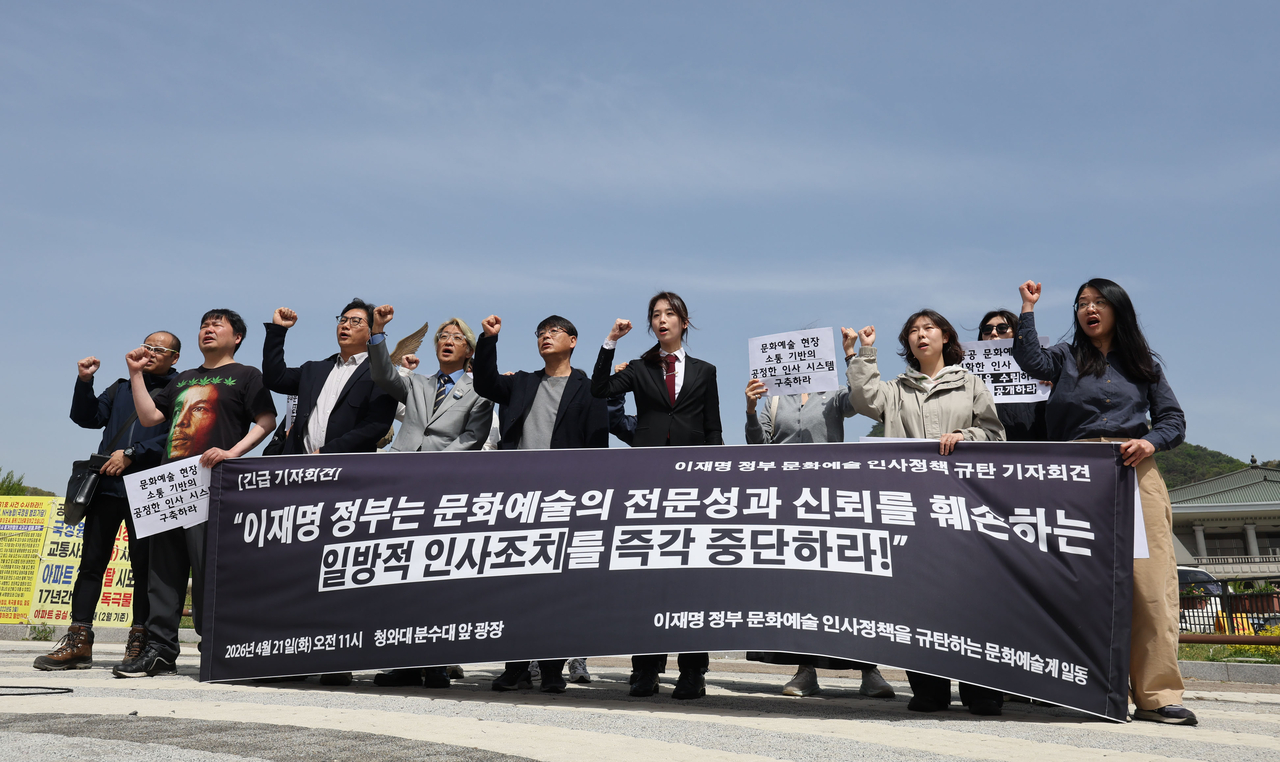
A series of recent appointments to public cultural institutions has fueled growing dissatisfaction among cultural experts, prompting protests and calls for answers from the presidential office on Tuesday.
A group of cultural and arts professionals gathered in front of Cheong Wa Dae to criticize the appointments as examples of patronage-driven and opaque decision-making.
"Though the recent appointments of Seo Seung-man as head of the National Jeongdong Theater and Hwang Gyo-ik (as president of the Korea Culture and Tourism Institute) are seen as the immediate trigger for the backlash, nearly all appointments to public cultural institutions under the current administration have raised issues,” Lee Won-jae, a cultural activist who leads Cultural Action, told reporters.
President Lee Jae Myung's administration has recently moved to fill a number of long-vacant leadership positions at public cultural institutions. Many of the selections have come as a surprise to industry insiders, beginning with the appointment of Chae Hwi-young, a businessman, as minister of Culture, Sports and Tourism.
While some observers had already raised concerns over a string of unexpected appointments, the latest two appear to have intensified the backlash.
Comedian-turned-politian Seo Seung-man was appointed head of the National Jeongdong Theater on April 10, followed by food critic Hwang Gyo-ik’s appointment as president of the Korea Culture and Tourism Institute on April 17.
Criticism has centered on what observers describe as a pattern of unexpected and non-specialist appointments. “The cultural and arts sector is not sustained by name recognition alone,” critics said, arguing that leadership roles in the field require long-term experience and a deep understanding of its social, historical and artistic responsibilities.
Experts have also emphasized the importance of fairness and credibility in the appointment process. Chung Yong-chul, a professor at Sogang University’s Graduate School of Education, said that in fields such as sports psychology — which he has studied throughout his career — selecting the most qualified individual is key to achieving optimal outcomes, and that such decisions must be grounded in rules that ensure fairness and trust.
At the press conference, participants called for an end to current appointment practices, a direct apology from the president or chief of staff, an immediate investigation into what they described as irregular appointments, and the establishment of clearer criteria. Organizers said they would submit a formal request for talks with the presidential office.
Tuesday’s press conference was accompanied by a petition that drew support from 65 organizations and 794 individuals within three days.
Separate statements have also emerged from within academia and the arts community. On Sunday, a declaration led by former researchers at the Korea Culture and Tourism Institute and scholars called for an end to what they described as “irregular appointments” of heads of public cultural institutions. As of Tuesday, the statement had been signed by eight organizations — including the Korea Arts Management Association and the Korean Society of Musical Theatre — along with 529 individuals.
On the same day, another statement titled “Artists on the ground ask: Is there a future for the arts?” gathered 620 signatures from practitioners across theater, music and dance, including artists and producers.
gypark@heraldcorp.com