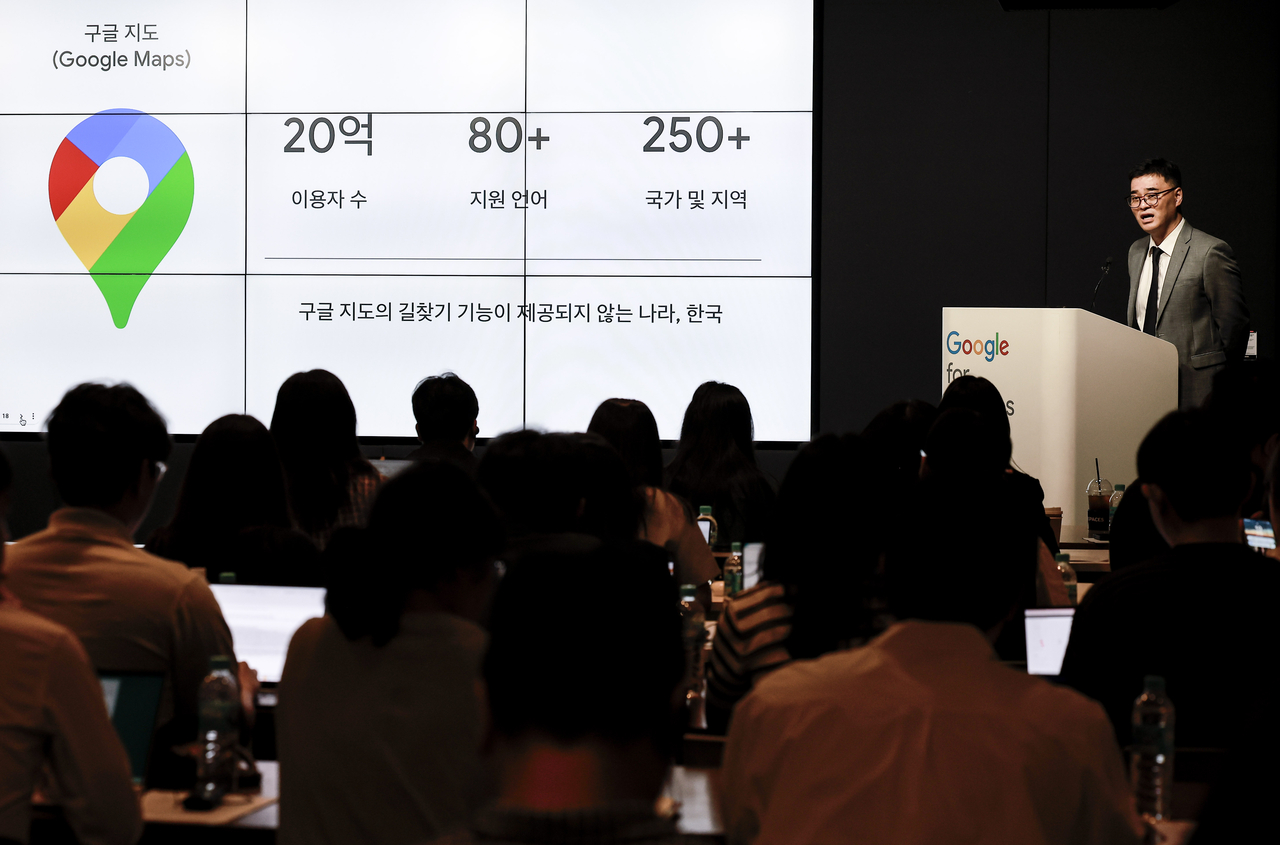
Negotiations between South Korea's government and Google over the cross-border transfer of detailed map data have lost momentum, with no follow-up meeting held since Feb. 27, when an inter-agency panel granted conditional approval after a 19-year standoff.
According to the Ministry of Land, Infrastructure and Transport and industry officials on Sunday, the two sides remain divided on how the data will be stored, transferred and processed. The ministry is demanding written implementation plans covering the blurring of military and security sites, data update procedures and mechanisms for revoking access, and says it will reconvene the review body only after Google submits documentation showing the conditions have been met.
"The export of high-precision maps was approved on a conditional basis, so it can only proceed once Google fulfills the terms we've laid out," a ministry official said.
Google, for its part, is still working to reconcile Seoul's technical requirements with the architecture of a service used by two billion people worldwide, according to people familiar with the discussions.
A visit by a senior Google executive to Seoul is reportedly under consideration, though the land ministry has signaled it will not act before the company files its compliance paperwork.
The delay reflects a split within the Korean government. The trade and tourism ministries, focused on US trade ties and inbound tourism, favor swift progress. The land ministry is moving cautiously, mindful of the impact on domestic mapping platforms. Naver Map drew 31.2 million monthly users in October, according to WiseApp, well ahead of KakaoMap at 13.8 million, TMap at 11.9 million and Google Maps at 11.8 million.
Google currently offers no turn-by-turn navigation in Korea. The company argues the 1:5,000 base map is needed to enable it, a claim domestic experts contest.
February's approval was widely read as a concession to Washington rather than a shift in Korea's security posture. The government had denied Google's earlier requests in 2007 and 2016 on national security grounds tied to the unresolved armistice with North Korea. Seoul's reversal came under sustained US trade pressure, with Washington citing the restriction as a nontariff barrier and a November 2025 joint statement with the Trump administration pledging smoother cross-border data flows.
That pressure has since widened. The US Trade Representative's 2026 National Trade Estimate report, released March 31, expanded Korea-specific concerns from nine items to 12 and flagged the Science Ministry's artificial intelligence and cloud procurement practices as new digital trade barriers.
mjh@heraldcorp.com