South Korean benchmark outperforms global peers, beating S&P 500, Nasdaq
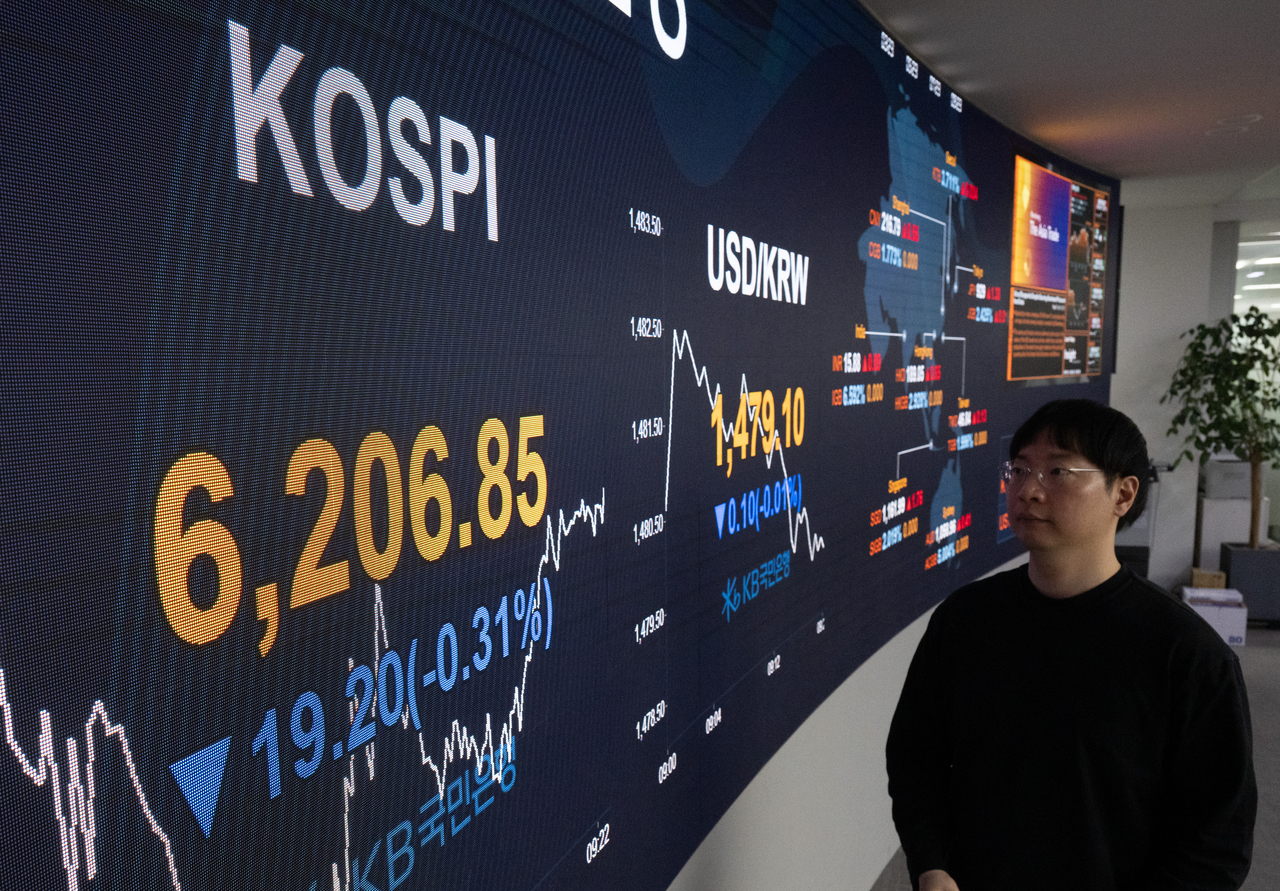
South Korea’s benchmark Kospi has nearly climbed back toward its pre-conflict level, heading toward a record high as easing Middle East tensions lift investor sentiment.
On expectations of progress in US-Iran talks, the index rose 5.68 percent over the week, gaining over 300 points from 5,858.87 to 6,191.92. It reclaimed the 6,000 mark in intraday trading Tuesday, and extended gains to as high as 6,231.03 on Thursday.
Over the same period, the country's secondary bourse Kosdaq rose 6.99 percent, climbing from 1,093.63 to 1,170.04. The index extended its winning streak to six consecutive sessions starting April 10.
The latest rally has put the Kospi within reach of its previous peak. The previous intraday high was 6,347.41 points on Feb. 27, just before the outbreak of the war. On a closing basis, its high stands at 6,307.27 from the prior session.
According to sector indices for both the main and secondary bourses compiled by the Korea Exchange, information technology led the gains with an 8.36 percent increase, followed by machinery and equipment at 6.42 percent, semiconductors at 6.38 percent, K-content at 6.1 percent and automobiles at 5.35 percent
"The recent revival in risk appetite stems from growing confidence that the war can be treated as a constant variable," Shin Eol, an analyst at Sangsangin Securities, said.
"The market is shifting into a phase where volatility is seen as an opportunity, supported by expectations of strong earnings performance, particularly from tech and growth stocks."
On a monthly basis, the Kospi's surge is sharper. It gained 22.55 percent this month up to Friday, making it the only major global index to post gains exceeding 20 percent, according to data provided by Koscom.
Taiwan’s Taiex ranked second with a 16.02 percent increase, followed by Japan’s Nikkei 225 at 14.52 percent, the US Nasdaq Composite at 13.33 percent and the Kosdaq at 11.18 percent.
They were followed by the US' S&P 500 at 9.15 percent, the Dow Jones Industrial Average at 6.70 percent, Hong Kong’s Hang Seng Index at 5.54 percent and China’s Shanghai Composite Index at 4.1 percent.
Given that the Kospi had plunged 19.08 percent last month, reacting more sharply than its global peers to the Middle East tensions, the recent rebound appears largely in line with the scale of its earlier decline.
Amid the rally, the number of companies with a market capitalization exceeding 1 trillion won ($680 million) has also rebounded to pre-conflict levels.
As of Friday, 377 companies were valued at over 1 trillion won on the local stock market, returning to levels seen at end-February. The recovery follows a drop to 331 on March 4, when the Kospi plunged 12 percent in a single trading session.
The number of companies with a market capitalization exceeding 10 trillion won has also returned to near pre-conflict levels.
As of Friday, 76 companies were valued above the threshold, rebounding from a low of 72 on March 4, though still slightly below the 78 recorded before the outbreak of the war.
silverstar@heraldcorp.com