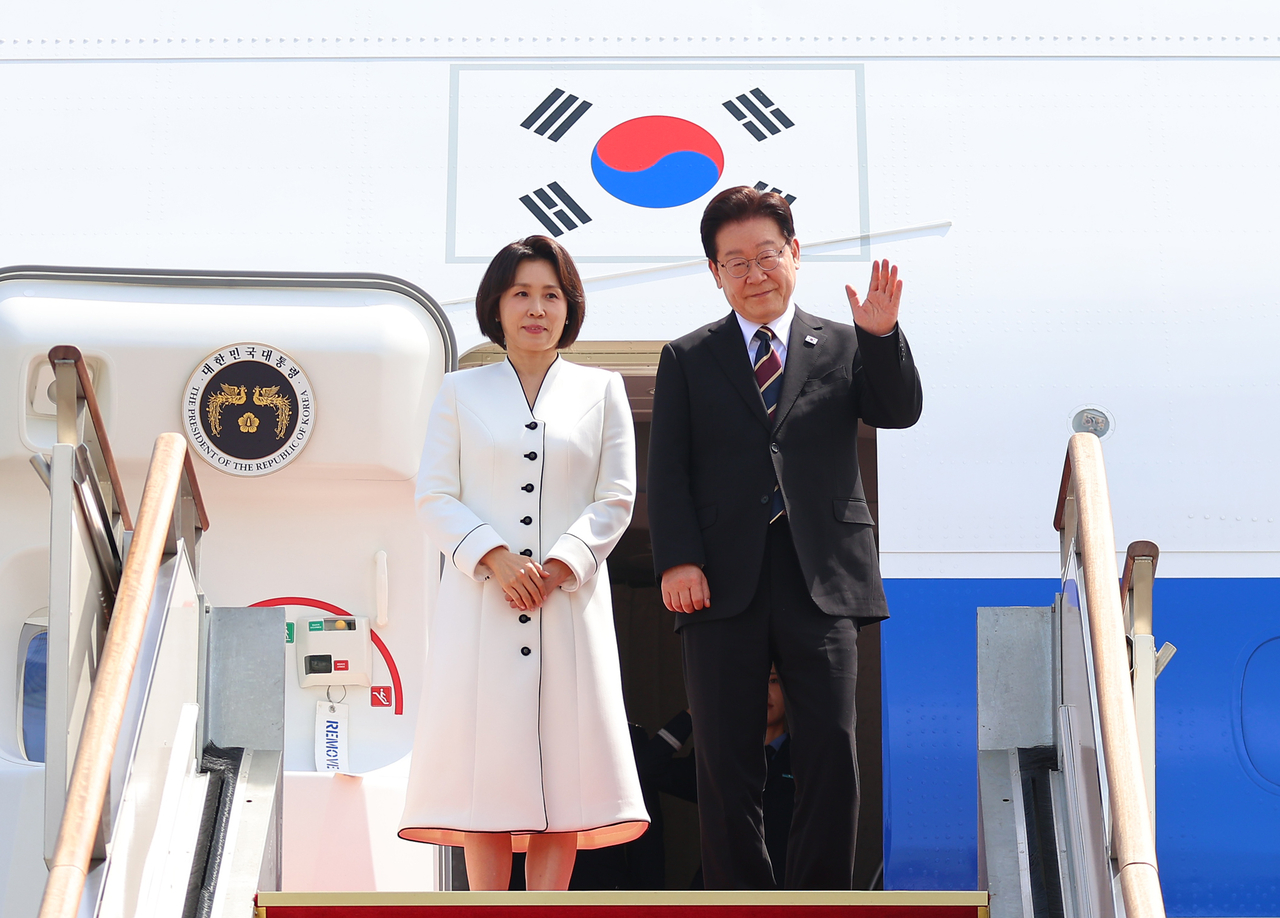
President Lee Jae Myung departed Seoul on Sunday for a state visit to India, seeking to deepen economic cooperation and accelerate Seoul’s Global South diplomacy.
However, the Iran war and the renewed closure of the Strait of Hormuz have added a new layer of urgency, sending ripples through the economies of both countries, which are heavily dependent on oil and gas imports.
Lee is expected to strengthen strategic coordination with New Delhi on energy, supply chains and stability in the Indo-Pacific and beyond during his three-day state visit, which runs until Tuesday.
Lee will hold talks with Prime Minister Narendra Modi in New Delhi on Monday, which will be the first standalone bilateral summit between the two leaders outside a multilateral gathering. The two leaders met twice on the sidelines of the Group of Seven summit in Kananaskis, Canada, in June 2025 and the Group of 20 summit in South Africa in November 2025.
For both Seoul and New Delhi, freedom of navigation through the Strait of Hormuz are vital. According to Cheong Wa Dae, 61 percent of South Korea’s crude oil imports and 54 percent of its naphtha imports last year came through the strait.
India is also highly exposed to any disruption in the strait. India's Ministry of Petroleum and Natural Gas said about 90 percent of LPG imports — supplying roughly 60 percent of domestic demand — transit the strait. Diversification efforts, however, have raised the share of crude imports arriving via routes outside Hormuz to 70 percent, from about 55 percent earlier.
National security adviser Wi Sung-lac previously underlined that “the two leaders are expected to enhance cooperation on energy and supply chains amid a rapidly changing international landscape, including developments in the Middle East.”
Lee and Modi are also expected to “reaffirm their mutual commitment to continuing constructive cooperation for peace on the Korean Peninsula and across the region” Wi said during a press briefing Thursday.
C. Raja Mohan, Korea chair at the Council for Strategic and Defence Research, said Lee’s visit would offer an “opportunity to open a serious Asian conversation on Hormuz.”
“For India and South Korea, the Gulf war presents an opportunity to inject real political content into a relationship long described as ‘strategic’ but driven largely by commerce,” Mohan said in his contribution to the Indian Express on Wednesday.
Mohan cited maritime security and energy security as immediate areas ripe for deeper India-Korea engagement, while also pointing to nuclear energy — particularly South Korea’s small modular reactor technology — as a promising field for future energy cooperation.
New momentum
That strategic urgency is also expected to spill into the economic agenda.
Wi said Seoul hopes to create new momentum in bilateral ties through fresh cooperation projects in strategic sectors — including shipbuilding and maritime industries, finance, AI and defense — where South Korea has competitive strengths.
Wi added that Lee’s state visit wasalso intended to pave the way for more South Korean small and medium-sized firms to enter India.
While earlier waves of investment were led mainly by major conglomerates, in recent years a growing number of small- and mid-sized Korean suppliers have followed them into the Indian market. Their expansion has been driven by New Delhi’s "Make in India" manufacturing push and India’s flagship Production Linked Incentive program.
The Korea-India business dialogue and Korea-India business forum following the Lee-Modi summit are expected to serve as a barometer of the business partnership between Seoul and New Delhi.
South Korea’s high-profile and large-scale business delegation, organized by the Federation of Korean Industries and accompanying Lee to India, is expected to include Samsung Chair Lee Jae-yong, Hyundai Motor Group Executive Chair Chung Euisun, LG Chair Koo Kwang-mo and Hyosung Group Chair Cho Hyun-joon.
Anant Goenka, president of the Federation of Indian Chambers of Commerce and Industry, said Lee’s visit to India “signals an important turning point” in bilateral ties in a contribution published in Dainik Jagran, one of India’s leading Hindi-language newspapers.
“It will strengthen bilateral ties in defense and energy, while also advancing investment and supply chain coordination between the two countries,” Goenka said. “Shifts in the global economic environment are forcing nations to reassess their partnerships, supply chains and strategic priorities.”
Goenka underscored that “Korea-India cooperation is entering a phase of expansion and has the potential to move toward a deeper level of collaboration by addressing structural challenges.”
“If the past 20 years were a period of building trust, the years ahead would be a stage of translating that foundation into tangible outcomes,” Goenka noted.
After his state visit to India, Lee will travel to Hanoi from Tuesday to Friday for a state visit hosted by Communist Party General Secretary and President To Lam.
dagyumji@heraldcorp.com