Fairness concerns raised as Education Ministry unveils scaled-back version of Lee Jae Myung’s ‘10 Seoul National Universities’ initiative
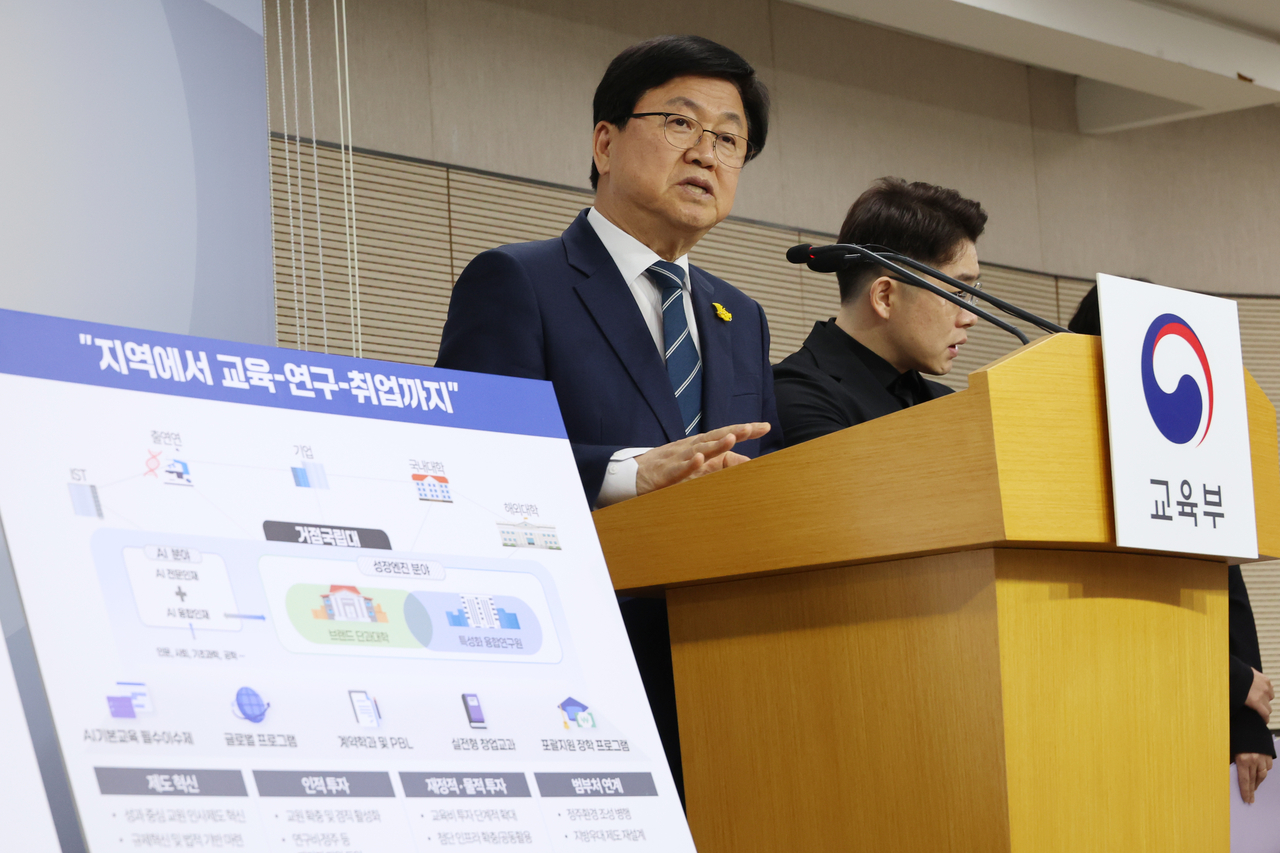
The Education Ministry said Wednesday it would select three flagship national universities to develop into hubs for education in strategic industries and artificial intelligence, providing each with up to 100 billion won ($68 million) in additional funding over five years.
The funding forms part of what the ministry described as an unprecedented support package under the Lee Jae Myung administration’s “10 Seoul National Universities” initiative.
The move marks a scaled-back version of the original plan, which sought to support all nine regional flagship national universities. This was narrowed to three during interministerial consultations to deliver faster results with limited resources, the ministry said.
“Beyond narrowing the gap between universities in and outside the capital region, we will lay the groundwork for local talent to become a core driver of national growth,” Education Minister Choi Kyo-jin said.
Focus on three universities
Under the plan, the three selected universities will establish “brand colleges” as newly created academic units designed to cultivate talent in industries central to each region, including semiconductors, batteries, biotechnology and future mobility.
Undergraduate, graduate and research programs will be supported as a single package. This includes the creation of specialized convergence research institutes, where universities will collaborate with companies, government-funded research institutes, institutes of science and technology, Seoul National University, and other domestic and overseas universities.
These jointly operated centers will integrate the full cycle from technology development to commercialization in one location.
The three universities will also be designated as regional hubs for artificial intelligence education and research. Each will establish a dedicated organization under the university president to oversee AI-related education and research, while expanding interdisciplinary AI programs that allow students from nontechnical fields to combine their major with AI applications.
Students in selected departments will receive extensive support. Undergraduate students will be eligible for tuition, living expenses and dormitory housing assistance, while graduate students will receive monthly stipends of 2 million won to 3 million won, comparable to compensation for junior researchers at government-funded institutes.
The number of beneficiaries is expected to reach about 1,500 annually. The plan also allows researchers from companies and public research institutes to hold concurrent university professorships.
Officials also indicated that research funding for faculty involved in the specialized programs would be provided with exceptional flexibility, in some cases without preset limits, to attract top-tier researchers.
Concerns over fairness
Concerns over fairness and regional disparities are expected, as only three of the nine flagship national universities will receive the support.
The remaining six universities will each receive an additional 30 billion won, the ministry said, as part of broader efforts to ensure balanced regional development.
The total budget for all nine universities will amount to 544.8 billion won. Of that, 120 billion won will be allocated to a regional “shared university” program, under which institutions within the same region will share classrooms, research equipment and startup support programs.
As funding expands, the ministry said it will strengthen performance-based evaluation. Standards for faculty promotion and tenure will be raised to levels comparable to those at major private universities in the Seoul metropolitan area, while education spending per student at flagship national universities will be increased to 44 million won by 2030, or about 70 percent of the level at Seoul National University.
Selection of the three universities is expected in the third quarter of this year, after the Ministry of Trade, Industry and Resources finalizes the regional strategic industries that will serve as growth engines.
The ministry said it planned to announce selection criteria in the first half of the year, though the timeline could shift depending on interministerial coordination. Regional balance is expected to be a key factor in the selection process.
The government aims for the selected universities to rank within the global top 200 in their specialized fields by around 2030, as part of broader efforts to shift from a capital-centered system to a more regionally distributed growth model.
“This is not a retreat from the original plan,” Choi said. “Through this policy, we aim to achieve balanced growth and enable regional talent and companies to drive local revitalization.”
seungku99@heraldcorp.com