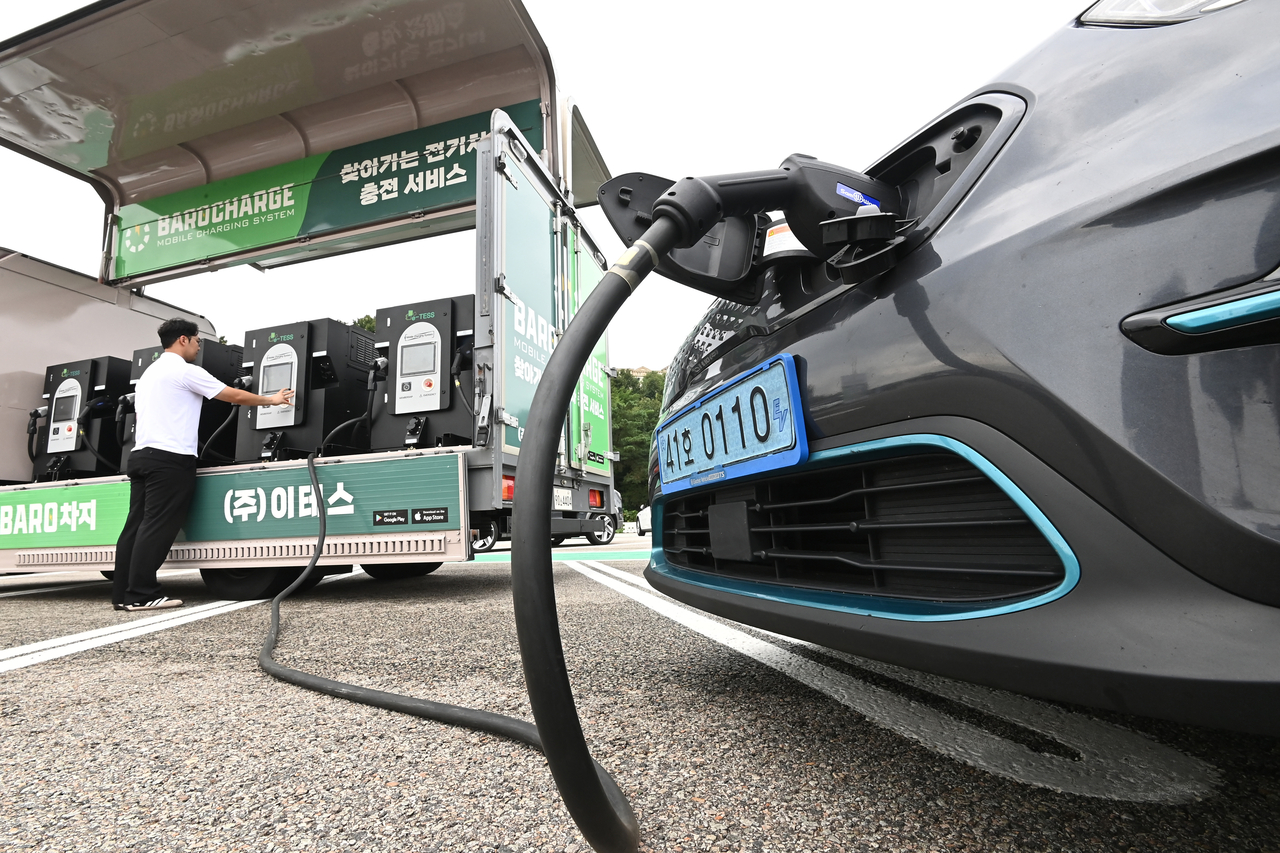
South Korea will cut electricity tariffs for electric vehicle charging in the middle of the day on weekends and holidays starting this week, as the government moves to better match power demand with abundant renewable supply.
The Ministry of Climate, Energy and Environment and Korea Electric Power Corp. said the revised seasonal, time-of-use pricing system will take effect from Thursday. Under the plan, EV charging between 11 a.m. and 2 p.m. on weekends and public holidays in spring and fall will be discounted by about 12 to 15 percent.
The policy applies to roughly 94,000 privately owned chargers and about 13,000 public fast chargers operated by the ministry and Kepco. Charging rates will be reduced by about 48.6 won per kilowatt-hour on Saturdays and 42.7 won on Sundays and holidays at those facilities.
While the government will halve the energy component of electricity charges during the designated period, that portion accounts for only about 35 percent of the total charging fee, limiting the overall discount.
Officials said the measure is designed to absorb excess renewable generation typically seen in milder seasons, rather than encourage unnecessary consumption. “The goal is to utilize surplus power efficiently and reduce reliance on generation from other fuels,” the ministry said.
The discounts will not apply to most chargers run by private operators, though the ministry said some providers are expected to join the program. Users of private charging networks will receive the discount only when accessing Kepco or government-operated fast chargers via roaming services, while the reverse arrangement will not qualify.
Separately, the government will roll out revised tariffs for industrial electricity users from the same date, lowering daytime rates and raising off-peak prices at night. The changes target customers with contracted demand of 300 kilowatts or more, including large manufacturers.
Under the revised structure, average rates for industrial users will fall by 15.4 won per kilowatt-hour, with seasonal adjustments of 16.9 won in summer and winter and 13.2 won in spring and fall. Off-peak tariffs, typically applied from 10 p.m. to 8 a.m., will rise by 5.1 won per kilowatt-hour, reinforcing a shift toward higher evening pricing.
This article was produced with the assistance of AI -- Ed.
hnpark@heraldcorp.com











