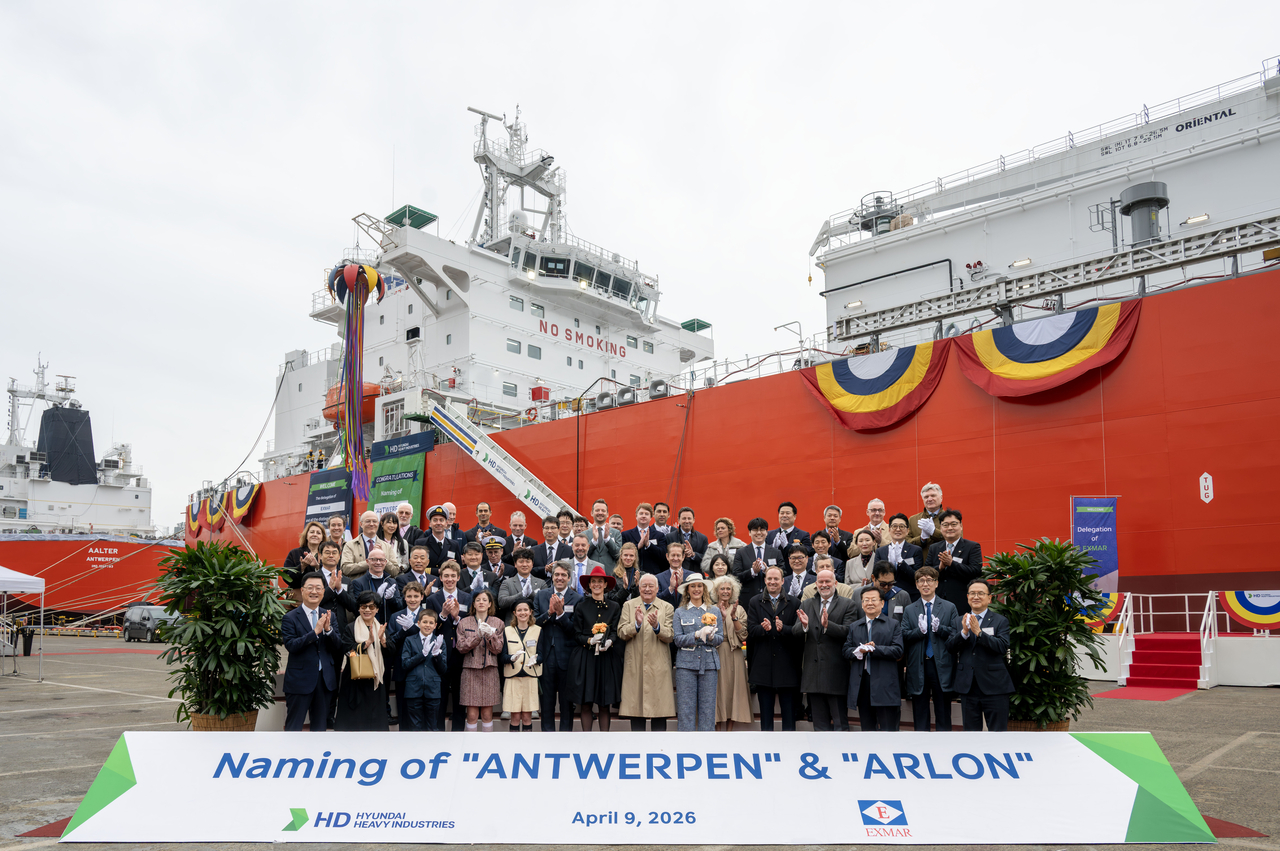
HD Hyundai Heavy Industries said Thursday it has built the world’s first ammonia-fueled vessel, holding a naming ceremony for two 46,000-cubic-meter medium-sized gas carriers at its Ulsan shipyard.
The ceremony was attended by company executives including Joo Won-ho, chief operating officer of the naval and special ship business unit, Exmar Chairman Nicolas Saverys and Belgian Ambassador to Korea Bruno Jans.
The vessels are the first two of four ammonia-fueled carriers ordered by Exmar LPG France in 2023 and 2024. Named Antwerp and Arlon after Belgian cities, they are scheduled for delivery in May and late July.
Each vessel measures 190 meters in length, 30.4 meters in width and 18.8 meters in height, and is equipped with dual-fuel engines capable of operating on ammonia. The ships feature three cargo tanks developed in-house, enabling stable transport of liquefied gases such as ammonia and LPG.
They are also fitted with safety systems, including an ammonia purge recovery unit and real-time gas detection to prevent leaks.
“It is meaningful to build the world’s first ammonia-powered vessel,” Joo said. “We will continue to strengthen our leadership in eco-friendly shipbuilding through technological innovation.”
Ammonia is considered a carbon-free fuel that can be stored without cryogenic systems, making it a promising option for maritime decarbonization. According to the International Energy Agency, ammonia is expected to account for 46 percent of shipping fuel demand by 2050, up from 8 percent in 2030.
stlee0329@heraldcorp.com

![[Survive&Thrive] Tips for getting around Seoul by subway (2)](https://wimg.heraldcorp.com/news/cms/2026/10/08/news-p.v1.20261006.1e7dee51d7f64cdba1a20b897d88cee6_T1.jpg?type=h&h=800)