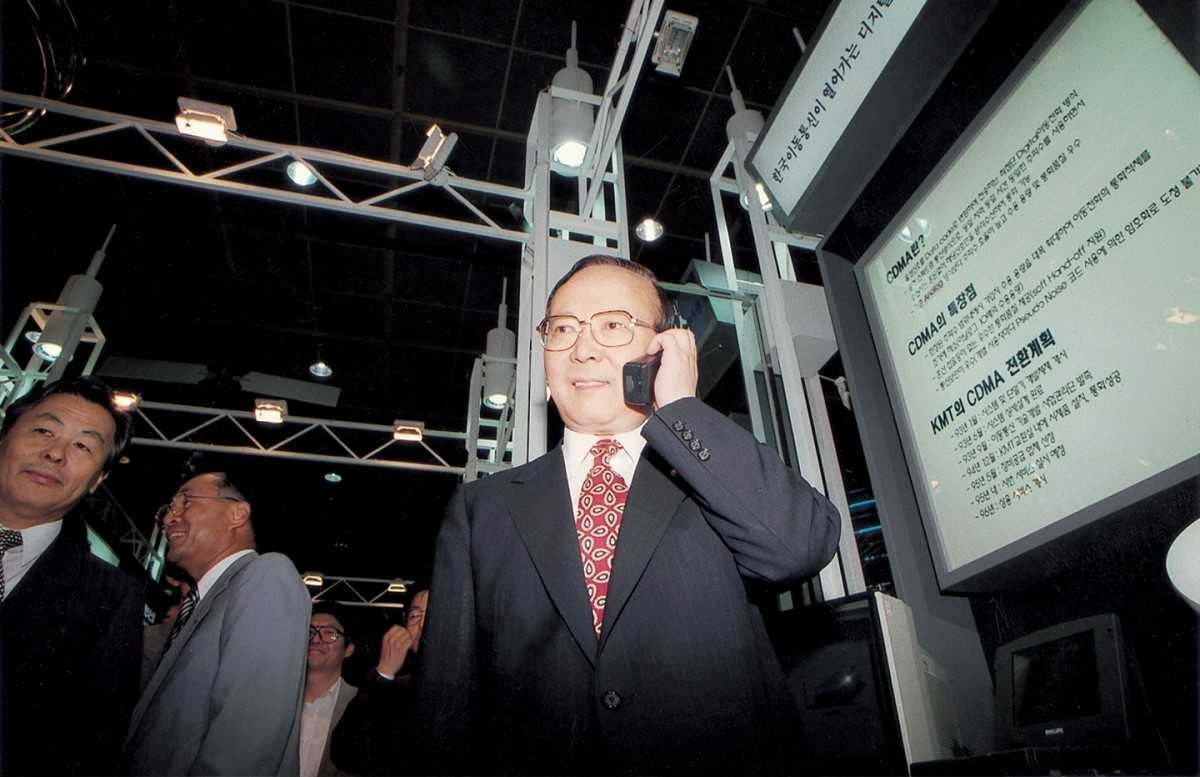
South Korea marked 30 years since becoming the first country to commercialize code division multiple access -- more commonly known as CDMA -- mobile communications, a breakthrough that laid the foundation for its rise as a global information and communication technology powerhouse.
SK Telecom said Thursday the milestone underscores how early technological leadership and public-private coordination transformed the nation’s telecom industry and accelerated digital adoption.
Samsung Electronics launched its CDMA handset, the SCH-100, while Korea Mobile Telecommunications — the predecessor of SK Telecom — began commercial services in Seoul and surrounding areas on April 12, 1996. The rollout made Korea the first country to commercialize digital mobile communications.
Nationwide coverage was completed within nine months, rapidly expanding mobile connectivity into a core national infrastructure.
CDMA, a key second-generation mobile technology, enabled multiple users to share a single frequency through unique codes, offering higher capacity than the then-dominant time division multiple access standard.
The economic impact has been significant. The ICT sector’s share of gross domestic product rose from 2.2 percent in 1996 to 13.1 percent in 2025, while industry output expanded to 304 trillion won ($205 billion) from 17.8 trillion won. IT exports surged more than sixfold over the same period.
The breakthrough was driven by a strategic decision to adopt CDMA as a single national standard, backed by close collaboration among the Electronics and Telecommunications Research Institute and companies such as Samsung Electronics and LG Electronics.
The achievement was recognized in 2024 by the Institute of Electrical and Electronics Engineers, a global engineering and technology standards body, as a milestone comparable to the invention of the transistor and the birth of the internet.
Industry experts say Korea must now replicate the CDMA playbook in artificial intelligence, calling for the development of “AI infrastructure” to sustain competitiveness.
“As CDMA marked the starting point of Korea’s ICT rise, AI infrastructure will define the country’s competitiveness over the next 30 years,” said Lee Nae-chan, an economics professor at Hansung University.
SK Telecom officials added that networks are evolving into “intelligent infrastructure” in the AI era, underpinning innovation across industries from manufacturing to finance.
yeeun@heraldcorp.com