The government will submit details of its planned supplementary budget to the National Assembly on March 31, with the focus on supporting underprivileged groups.
The "war supplementary budget" is to be a 25 trillion won ($16.6 billion) injection aimed at mitigating the impact from the Middle East conflict. Measures under discussion include various vouchers for select groups and those designed to stabilize petrochemical prices.
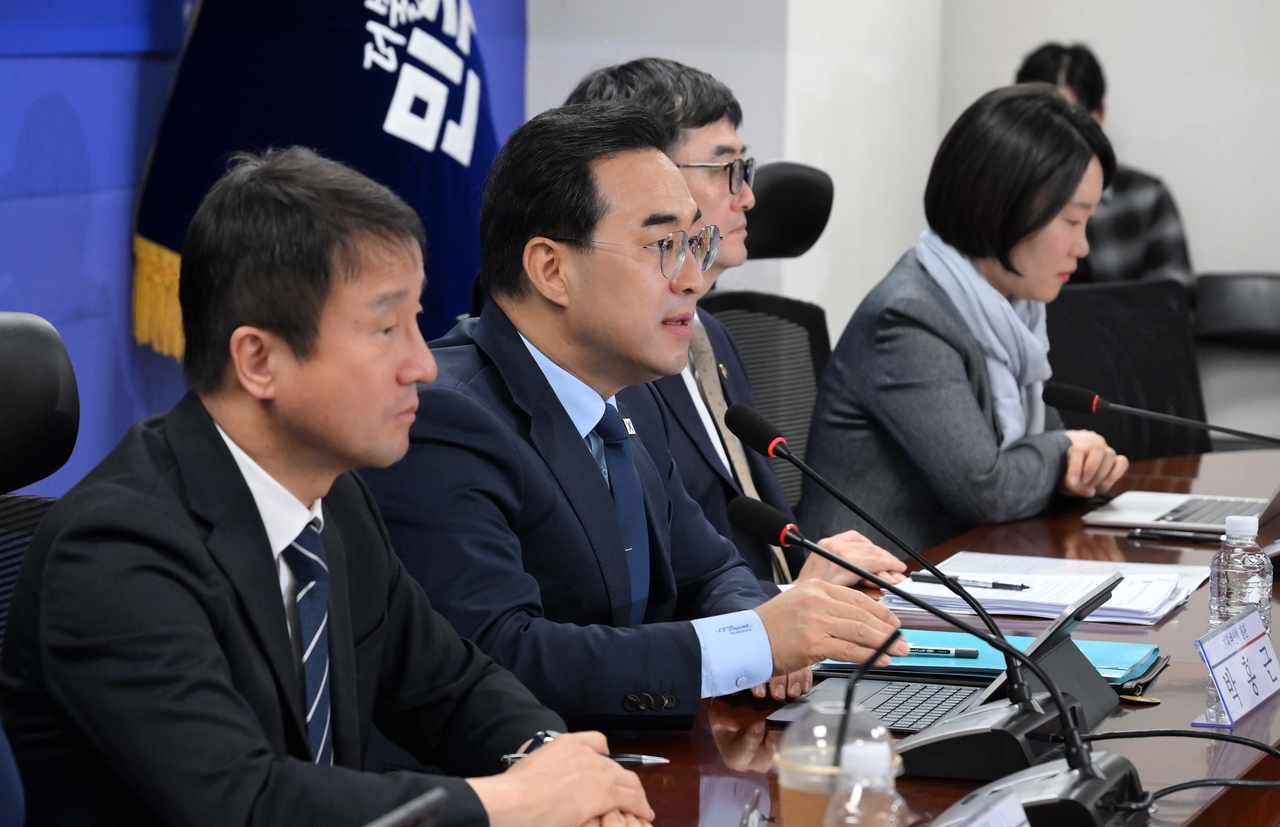
Budget Minister Park Hong-keun said Thursday the budget bill will be focused on not only mitigating the impact on the domestic industry, but also addressing the underprivileged.
"We will expand support for vulnerable groups, including small-business owners and the youth, to stabilize the consumer economy," Park said during high-level talks of the government and the ruling party at the National Assembly.
"We will address blind spots in terms of welfare," added Park, who took office Wednesday.
After the closed-door meeting of the government and the ruling Democratic Party of Korea, Rep. Han Jeoung-ae told reporters the supplementary budget will be in part used to expand discounts on agricultural, livestock and fishery products, issue energy vouchers for marginalized people, provide subsidies to make up for the cost increase of mineral fertilizers and launch a public-sector program to create jobs for the youth.
Han hinted that the liberal administration could use the extra budget to provide cash voucher handouts selectively to vulnerable groups, without elaborating.
"Although not yet finalized, there was a consensus that (a cash voucher handout) is necessary, focusing on those who had suffered the most," Han said.
This came amid media speculation that those in the lower 50 percent income bracket could be eligible for 150,000 won voucher handouts for each individual. Since President Lee Jae Myung's inauguration last year, the liberal administration has opted for cash handouts to boost consumption and revive the economy affected by the political crisis due to former President Yoon Suk Yeol's martial law.
"There is a principle for a cash voucher program to boost the local economy, which is we provide support to those who suffered greatly," Han said, adding that those who live in remote areas and who are worse-off would likely be prioritized.
Rep. Lee So-young of the Democratic Party also said, "Regarding the bottom percentile (eligible for support) and the amount (of government spending in the cash voucher program), we cannot confirm until the government makes its final proposal (on Tuesday). We cannot confirm today."
consnow@heraldcorp.com