President Lee Jae Myung underscored the importance of a national defense that was not reliant on external help as he chaired a meeting focused on strengthening South Korea’s ability to counter a range of security contingencies.
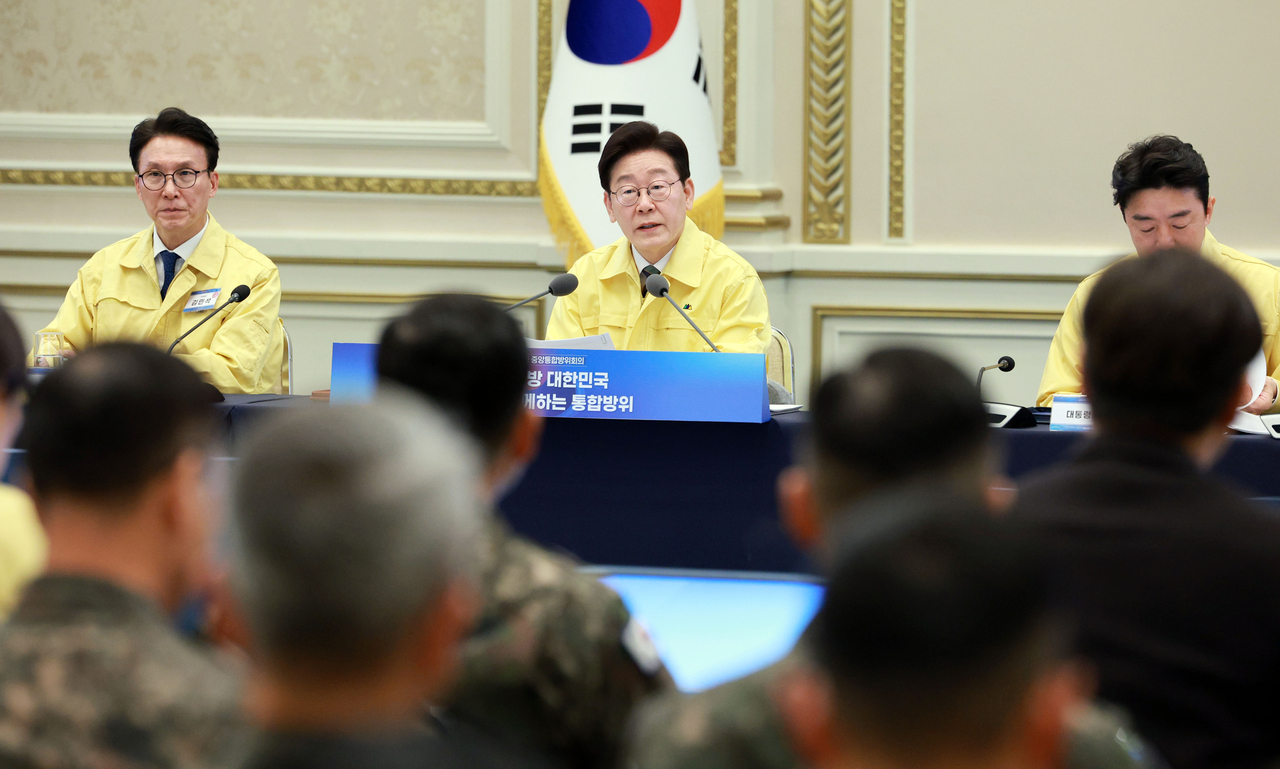
Lee presided over the 59th Central Integrated Defense Council at Yeongbingwan, the state guest house at Cheong Wa Dae, on Monday afternoon, marking his first time chairing the body since taking office. About 170 attendees included military, police, fire, government and civilian officials.
“The most critical element of national security ultimately lies in integrated defense capability, and among that, the most important thing is, after all, national defense,” Lee said in his opening remarks at the meeting.
Lee underscored that “That is, I believe self-reliant national defense is the most important core of integrated defense.”
“National defense is not something we can entrust to others; it is a core responsibility that we ourselves must ultimately and fully take on,” Lee said.
“We must ensure that, under any circumstances, we can defend ourselves without relying on external assistance,” added Lee, stressing that South Korea is more than able to do so.
Lee underlined that “This is the time to have firm confidence in ourselves.”
Lee noted that South Korea’s defense strength overwhelmingly surpasses North Korea’s, citing estimates that the South's annual military spending amounts to roughly 1.4 times the North’s entire gross domestic product.
The country ranks fifth in the world in military power, said Lee, apparently referring to the 2026 Military Strength Ranking released by Global Firepower in January. South Korea placed fifth in conventional military strength for a third consecutive year, behind only the United States, Russia, China and India.
According to Lee, the country’s defense industry has become strong enough to draw envy around the world.
Regarding the meeting itself, Lee said that “the Central Integrated Defense Council has played a key role in establishing and reviewing South Korea’s integrated defense posture since it was first convened in 1968.”
“The current international situation is very complex and fluid. At times like this, a state-level integrated defense system is more important than ever," Lee said. "Discussions on integrated defense for security are about effectively utilizing all of a nation’s defense capabilities to protect the country and its people.”
Presidential spokesperson Kang Yu-jung explaineed that “Today’s meeting was convened to protect the lives and property of the people from all-around security threats and to realize a safe Republic of Korea,” using South Korea’s official name, in a separate statement after the meeting.
Kang added that the meeting also “focused on establishing an all-out security posture that brings together all elements of national defense capability into a single, unified system.”
The Joint Chiefs of Staff presented an assessment of the integrated defense posture and its future direction, followed by the Ministry of the Interior and Safety on civil defense readiness and policy priorities, and the National Intelligence Service on this year’s outlook for North Korea.
This was followed by a discussion on contingency response measures in the event of large explosions at gas and oil refining facilities that could result in significant human and material damage.
The council meeting is held under the enforcement decree of the Unified Defense Act, which mandates that the council be convened at least once a year to assess progress and reinforce coordination.
Under current law, the prime minister typically chairs the council, but the President may preside depending on the circumstances. In the previous administration, then-President Yoon Suk Yeol presided over the meetings in 2023 and 2024.
Attendees included Prime Minister Kim Min-seok, Cabinet members including ministers and vice ministers and head of Korea Communications Commission Kim Jong-cheol.
Military officials attending included Chairman of the Joint Chiefs of Staff Gen. Jin Yong-sung, the chiefs of staff of the Army, Navy and Air Force, and Deputy Commander of the Korea-US Combined Forces Command Gen. Kim Sung-min. National Intelligence Service Director Lee Jong-seok was also present.
Acting National Police Agency Commissioner General Yoo Jae-seong, acting commissioner of the Korea Coast Guard Chang In-sik and the National Fire Agency commissioner Kim Seung-ryong took part in the meeting.
Local governments were represented by the North Jeolla and Jeju governors, acting heads from several regions, and vice mayors or vice governors from other major cities and provinces. Civilian participants included head of the Korea Veterans Association Shin Sang-tae and representatives from key state-run entities such as Korea Gas Corp.
dagyumji@heraldcorp.com