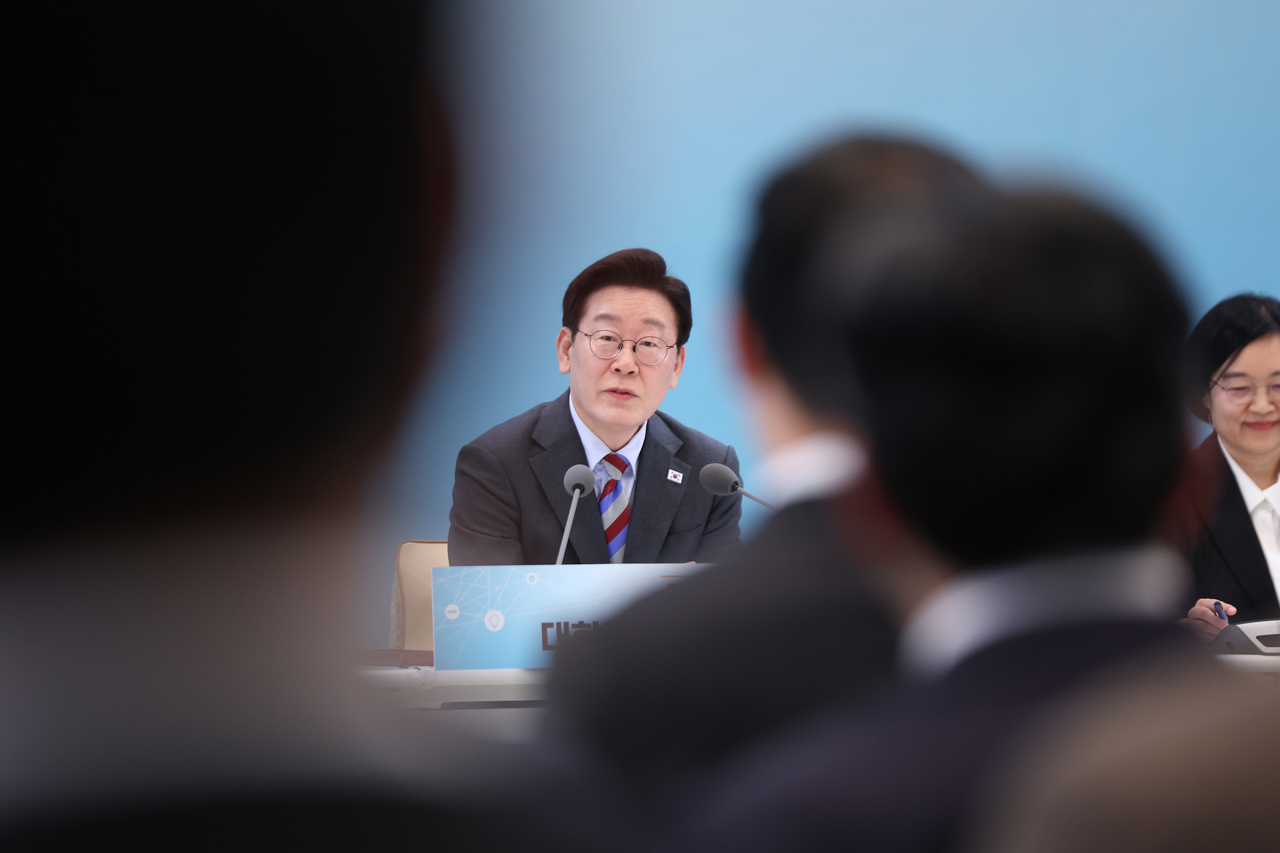
President Lee Jae Myung on Friday called for dismantling the “exploitative structure” in which large corporations squeeze small and medium-sized enterprises, underscoring that South Korea’s next growth phase depends on revitalizing SMEs.
“There is a somewhat unique element in South Korea — what is known as an exploitative structure. For example, small and medium-sized enterprises often fall victim to practices such as the misappropriation of technology and business achievements,” Lee said during a meeting with SME business leaders at Cheong Wa Dae.
Lee warned that when SMEs believe the gains from improving management will be eroded by malpractices such as price cuts imposed by large companies, they are more likely to lobby those clients rather than invest in innovation, management upgrades or market expansion.
“In the end, this seems to be one factor that undermines the competitiveness of society as a whole,” Lee said. “So we aim to create a rational socio-economic culture in which it becomes impossible to obtain unjust profits through unfair competition, even in the corporate sector.”
During the meeting, Lee also said outdated views that treat labor unions or workers as adversaries are counterproductive, invoking his own background as a former worker.
“There was a time when labor unions or workers were often branded as ‘communists’ and even subjected to suppression. But I believe that kind of approach will do little to enhance corporate competitiveness going forward,” Lee said.
Lee underscored the need to balance the interests of businesses and workers rationally.
“There needs to be candid dialogue and cooperation within a relationship of balanced power so that neither side suffers unreasonable harm,” Lee said.
Lee also called for more proactive government-level coordination of disputes. Addressing the labor and SMEs ministers present at the meeting, he made a pointed joke about the need for open policy clashes within the government.
“People say ministers fight because they have different positions, but I tell them to fight more,” Lee said. “Only when ministers fight fiercely and coordinate interests well will workers and business owners not have to fight in the field.”
Lee also highlighted the outsized role of smaller firms in the economy, noting that SMEs account for 99 percent of all businesses and about 80 percent of employment in South Korea.
“Innovation-led growth, balanced development and a fair economy — all of which will drive the Republic of Korea’s next great leap forward — are possible through the revitalization of small and medium-sized enterprises,” Lee said, referring to South Korea by its official name.
Lee also recalled an exchange with US President Donald Trump during a meeting last year. According to Lee, when he mentioned that the South Korean economy had even posted negative growth, Trump pushed back, saying, “How could that be, when South Korea has so many great companies?”
Lee said South Korea’s global image is largely shaped by a handful of highly visible conglomerates, but the real foundation of the economy lies elsewhere.
“It is a clear fact that the many small and medium-sized business owners who are not readily visible shoulder most of the country’s employment, bear an important part of the national economy and support the South Korean economy,” Lee said. “But from the outside, they do not seem to be very visible.”
dagyumji@heraldcorp.com