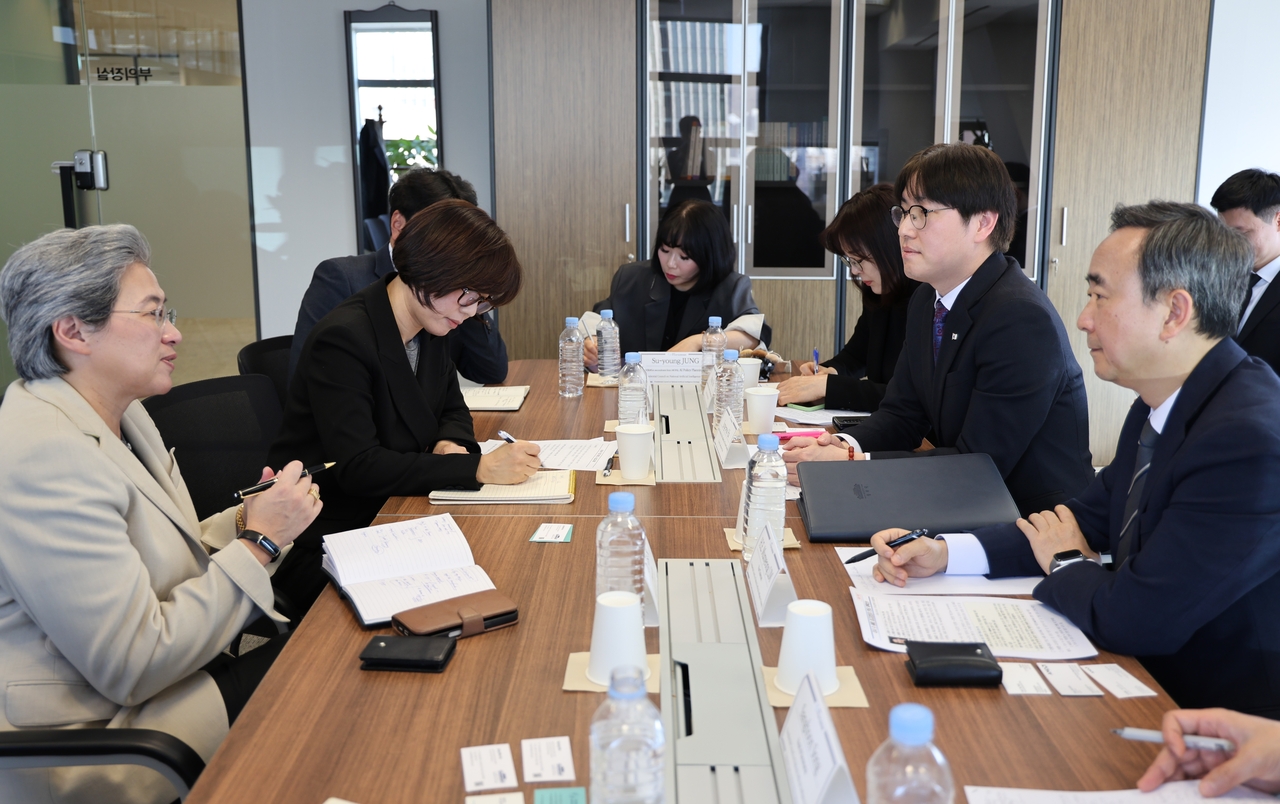
South Korea’s presidential office and Advanced Micro Devices Chief Executive Lisa Su agreed to expand cooperation to bring artificial intelligence into regional industries, as Seoul steps up efforts to spread the gains of its AI drive beyond the capital.
Im Moon-young, vice chair of the Presidential Council on National Artificial Intelligence Strategy, and Ha Jung-woo, senior presidential secretary for AI and future planning, met Su in Seoul on Thursday, according to the presidential office.
The two sides “discussed ways to pursue win-win cooperation in AI,” the council said, with talks centering on strengthening South Korea’s global competitiveness and accelerating the adoption of AI across regional industries. The push aligns with President Lee Jae Myung’s flagship drive for more balanced national development.
“In particular, both sides shared the view on the importance of AX (AI transformation) of regional industries, including the construction of data centers, as a means to promote balanced regional development,” the council said in a press statement.
Both sides also "explored a range of cooperation measures in that process, including nurturing AI software talent and pursuing joint development and research linked to the ‘K-Moonshot’ initiative."
The “K-Moonshot” program is the Lee administration’s mission-driven initiative to tackle major scientific and technological challenges, aiming to use AI to solve national-level problems in eight key sectors — including advanced biotechnology, physical AI and space and quantum technologies — by 2035.
According to the council, Im and Ha used the meeting to outline Lee’s ambition to position the country among the world’s top three AI powers. Central to that vision is the creation of a nationwide “AI highway,” an integrated infrastructure combining ultrahigh-speed, low-latency networks with data centers and large-scale GPU computing capacity.
During the meeting, Su also expressed satisfaction with the outcomes of her visit, noting that partnerships with South Korean AI companies had been further strengthened, according to the council.
“In this regard, the two sides agreed to expand public-private cooperation so that more Korean companies can generate synergies through AMD’s open AI ecosystem, building on the current successful cooperation model,” the statement said. “Korea and AMD agreed to continue expanding mutually beneficial cooperation to build a global open AI ecosystem.”
Su arrived in South Korea on Wednesday for a two-day visit. Since her arrival, she has met with key industry leaders including Samsung Electronics Chairman Lee Jae-yong, Vice Chairman Jun Young-hyun, President Roh Tae-moon, Naver CEO Choi Soo-yeon and Upstage CEO Kim Sung-hoon, underscoring AMD’s push to deepen ties across Korea’s AI and semiconductor ecosystem.
dagyumji@heraldcorp.com