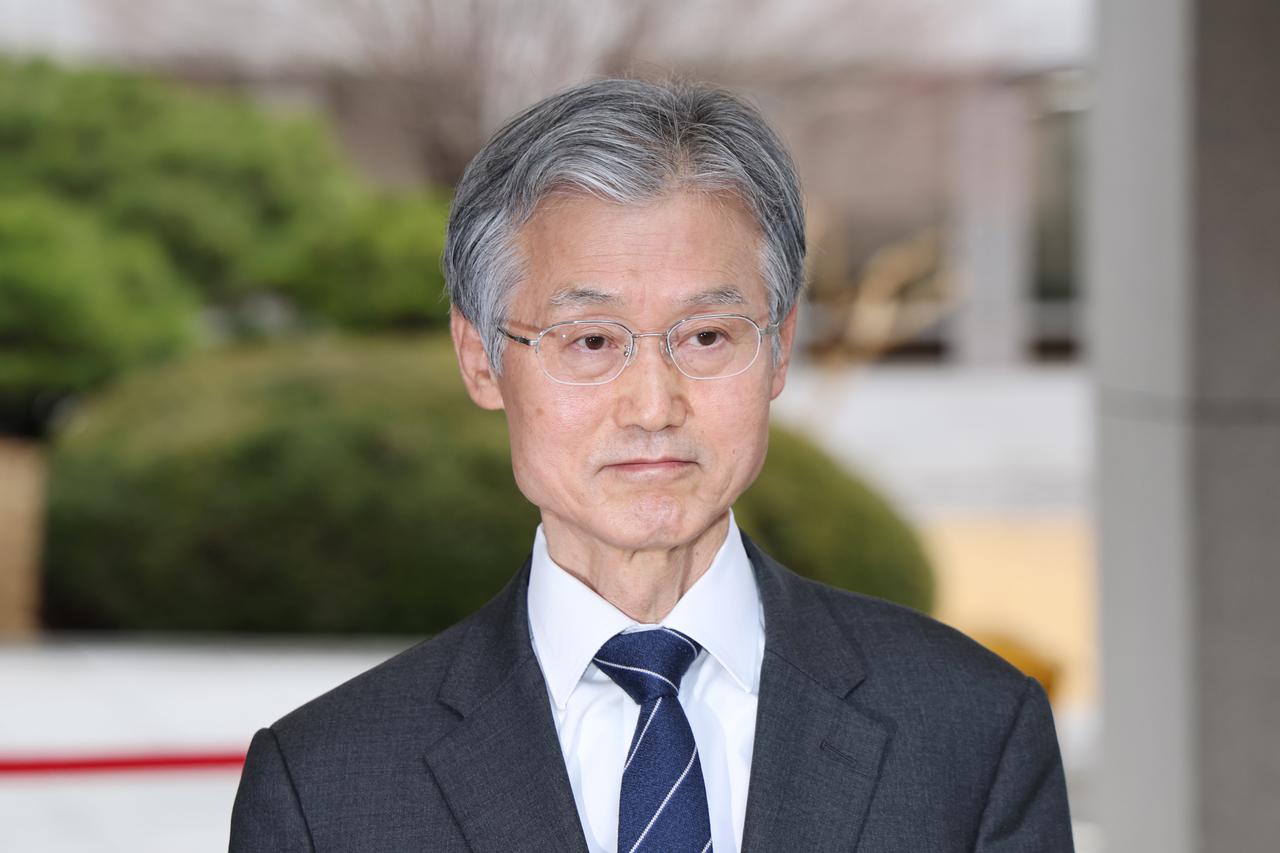
Supreme Court Chief Justice Jo Hee-de on Tuesday expressed concern over the recent passage of three judicial reform bills, urging the National Assembly to “carefully consider until the very end” whether the legislation contains any provisions that could harm the public.
Speaking to reporters outside the Supreme Court in Seoul, Jo said he “entirely respects the legislative activities of the National Assembly” and emphasized that the judiciary would fulfill its constitutional mission “under all circumstances.”
The remarks came after the Democratic Party of Korea-controlled legislature pushed through the bills in late February.
Under the measures, the number of Supreme Court justices will increase from 14 to 26, constitutional appeals of court rulings will be permitted, and a new offense of “legal distortion” will be instituted — a criminal charge targeting judges or prosecutors who wrongfully apply the law or manipulate evidence in criminal trials.
“I earnestly ask that the Assembly examine, once more, whether this sudden transformation will truly help the people, and whether the bills contain anything that may be detrimental,” Jo said.
He also rejected the ruling party’s argument that the reforms are necessary due to widespread public distrust of the judiciary. “Some cite low trust levels as the reason for reform,” he said. “But it is not desirable to disparage our system without basis or to demonize judges over individual cases.”
Referencing recent opinion surveys, Jo noted that trust in the US judiciary stands at around 35 percent, compared with 47 percent for South Korea, according to Gallup Korea. He stressed that trust levels must be interpreted in context, saying they often reflect the public’s expectations.
He added that international assessments consistently rate Korea’s civil court system among the top performers. “In the World Justice Project’s Rule of Law Index, Korea ranked 19th globally and fourth among countries with populations exceeding 50 million,” he said.
Jo declined to comment on whether he would ask President Lee Jae Myung to return the bills to the Assembly for reconsideration, saying only that the judiciary was working to address shortcomings within the system.
Reform bills and scrutiny
The top court chief's comments are in keeping with his opposition over the reform bills, with his earlier comment stressing that sufficient deliberation and public debate are necessary.
The Lee administration has accelerated the push for judicial restructuring since last year, while the ruling party has called on Jo to take responsibility for what it describes as public distrust in the courts.
Korean public's trust toward the justice system has been lower compared to other governments in the Organization for Economic Cooperation and Development. A 2021 report showed that 49.1 percent of Koreans trust the court and the justice system, lower than the OECD average of 56.9 percent, but higher than the National Assembly at 37.2 percent.
The main opposition People Power Party and judges across the country have expressed mounting concern. At a Feb. 25 meeting, chief judges of district courts nationwide voiced “grave concern” over the bills being brought to a plenary vote without sufficient public debate.
They warned of potential delays in legal proceedings following the introduction of constitutional appeals, and said the “legal distortion” clause is overly abstract and may allow for an excessively broad scope of punishment.
The People Power Party called the reforms a step toward “dictatorship” by the Lee administration. Rep. Song Eon-seog, the party’s floor leader, accused the government of attempting to tighten control over the judiciary and undermine democratic checks and balances.
“The Lee administration is dismantling the justice system in the name of reform and moving toward absolute power,” Song said during a speech at the National Assembly.
minsikyoon@heraldcorp.com