Vice Chair Chung Tae-young’s redesign turns brand power into financial strength
For years, Hyundai Card was regarded as a creative outlier whose brand cachet outpaced its earnings. Last year, the numbers caught up. Sustained profit growth lifted the company into the industry’s top three, validating Vice Chair Chung Tae-young’s strategy of rebuilding the business from its core.
Last year, Hyundai Card posted a net profit of 350 billion won ($243 million), up more than 10 percent on-year, marking a fourth consecutive year of growth. The performance lifted the company to third place by net profit, overtaking KB Kookmin Card for the first time.
Operating profit reached 440 billion won, extending its growth streak and rising roughly 40 percent from 2022.
In a market weighed down by falling fee income and margin compression, Hyundai’s results stood out for their resilience. Among the nation’s major card issuers, it was the only one to record earnings growth. Market leader Samsung Card posted a 3 percent decline, while second-ranked Shinhan Card saw profit fall 17 percent, extending a multiyear contraction.
Growth was not confined to headline earnings. Credit sales volume, a key gauge of core competitiveness, rose 6.2 percent on-year to 176.5 trillion won, maintaining the industry’s top position for 15 consecutive months through December. Membership increased by 1.6 million over the past three years despite an already saturated market. Overseas credit sales led the industry for a third consecutive year, while the delinquency rate remained stable.
In his New Year's address, Chung described the past year as the culmination of a “build-up” phase. “It was a year in which Hyundai Card and Hyundai Commercial delivered significant achievements across all areas, including growth and earnings,” he said, adding that the two financial units had “newly designed and reshaped the foundation, form and size” of their businesses.
Hyundai Commercial — Hyundai Motor Group’s lending arm, also overseen by Chung — followed a similar trajectory. Net profit rose 17 percent to 226 billion won in 2025 as assets and earnings expanded in tandem. Once centered on industrial finance, the company has broadened into corporate and investment finance under a "Balanced Growth" strategy, reducing concentration risk and diversifying revenue streams.
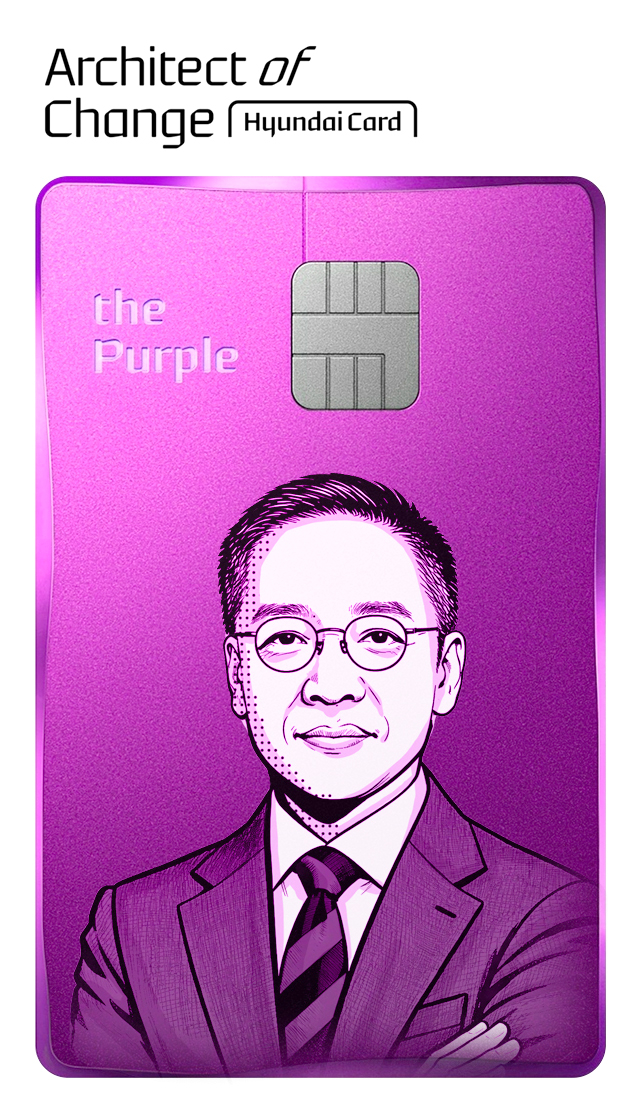
At Hyundai Card, Chung’s strategy has included streamlining products under the company’s “Architect of Change” framework, sharpening segmentation through data analytics and strengthening proprietary technology capabilities. As the card industry matures, he has emphasized differentiation through design, data and disciplined portfolio management.
Partnership-driven growth has reinforced that model. Hyundai Card has expanded its private label credit card portfolio with major corporate partners, embedding itself within retail ecosystems while deepening customer data integration. The early adoption of Apple Pay in Korea strengthened its digital positioning and accelerated younger customer acquisition.
The firm has built a proprietary analytics platform, Universe, that mines transaction data to refine pricing and customer targeting, applying behavioral insights to shape product architecture and marketing strategies to deliver tailored, long-term customer value. Domestically, Hyundai Card formed a 17-partner data alliance to provide analytics-based consulting and facilitate cross-industry collaboration. Internationally, it exported the platform to Japan’s Sumitomo Mitsui Card, marking the first overseas software export by a Korean financial firm.
“We’ve delivered steady quantitative and qualitative growth over the past three years by sharpening products around customers’ lifestyles, supporting balanced expansion across the business,” a Hyundai Card official said. “We will continue advancing the business to sustain profit growth while expanding our data science capabilities globally, where we have a clear competitive edge.”
This year, Chung signaled a shift in focus from redesign to refinement. If the past few years were about constructing the framework of the business, the next phase will test whether that structure can deliver sustained profitability amid tighter margins and external volatility.
“In 2026, sustaining growth and responding wisely to unexpected external variables will be the key challenge,” Chung said. “From here on, we must move to a stage of advancement that builds greater precision on top of simplicity.”
Chung is also working to extend Hyundai’s financial footprint beyond traditional card and captive finance models. Hyundai Alternative was launched last May with full capital backing from the group. By year-end, the asset manager had secured about 380 billion won in commitments, reflecting rapid early expansion.
jwc@heraldcorp.com