Mongolian vultures seek refuge from the cold at mass feeding sites in Paju and nearby regions

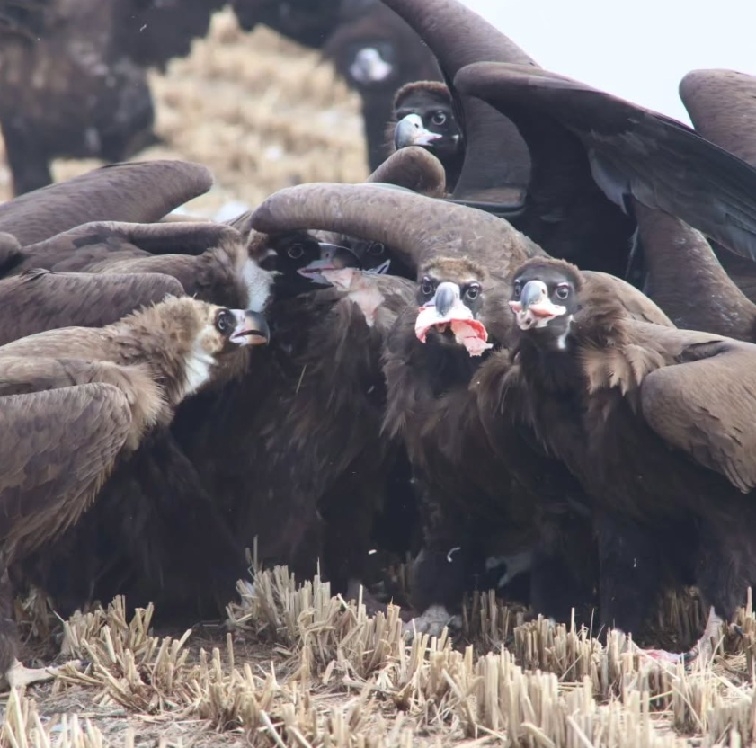
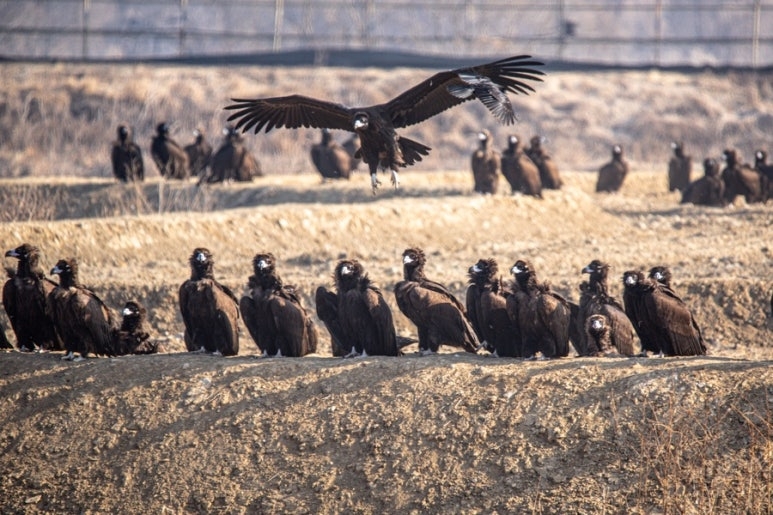
In a wintry rice field in Paju, Gyeonggi Province, a rare natural spectacle, almost straight out of a National Geographic documentary, unfolded Saturday morning. Nearly 500 vultures flocked to chunks of red meat.
The scene was part of a thrice-weekly feeding program, dubbed the “vulture restaurant,” organized by the Imjin River Ecological Conservation Association, a local group, since 2009.
“Our goal was not just to provide food, but to create a space where people and vultures can coexist. About 2,500 vultures visit Korea each winter, and up to 800 now return to this site annually,” an official from the group said.
The feast for the migratory birds is a byproduct of local cattle and pig slaughterhouses, procured by the group. On Saturday, about 500 kilograms were prepared to meet the intended portion of roughly 1 kilogram per bird.
According to the association, the birds fly roughly 3,000 kilometers from Mongolia each year and spend November through March in South Korea.
The “vulture restaurants,” like the one in Paju, have become a key wintering ground as the global population of vultures, an internationally endangered species estimated at around 20,000, the official added.
Intended to help the scavenging birds survive the Korean winter, where animal carcasses are becoming harder to find, the feeding program now takes place at 13 locations nationwide.
The sites have also become a popular spot not only for environmental groups but for photographers.
“It’s fascinating to watch the vultures sweep in as a group with powerful wingbeats, fight over food and kick up swirling clouds of dust. These are scenes that are difficult to fully capture on camera,” Kim Hee-jae, a freelance photographer in his 30s, told The Korea Herald.
The feeding ground also acts as an outdoor classroom for families.
“As we watched the vultures feed together, I explained to my children why they fly here and why they are endangered. I think it’s a meaningful activity where children can naturally learn about ecosystems,” said Lee, a Seoul resident in her 40s, in an interview with a local news outlet.
Open three times a week through the end of next month, the vulture restaurant in Paju welcomes visitors on Tuesdays, Thursdays and Saturdays from 9 a.m. The vultures typically finish feeding within about 10 minutes before flying off. Each session is limited to 30 visitors, with an admission fee of 10,000 won ($6.83).
The group’s feeding programs at other locations such as Cheorwon and Goseong in Gangwon Province also accept fees for those who want to observe the feeding scenes.
cjh@heraldcorp.com