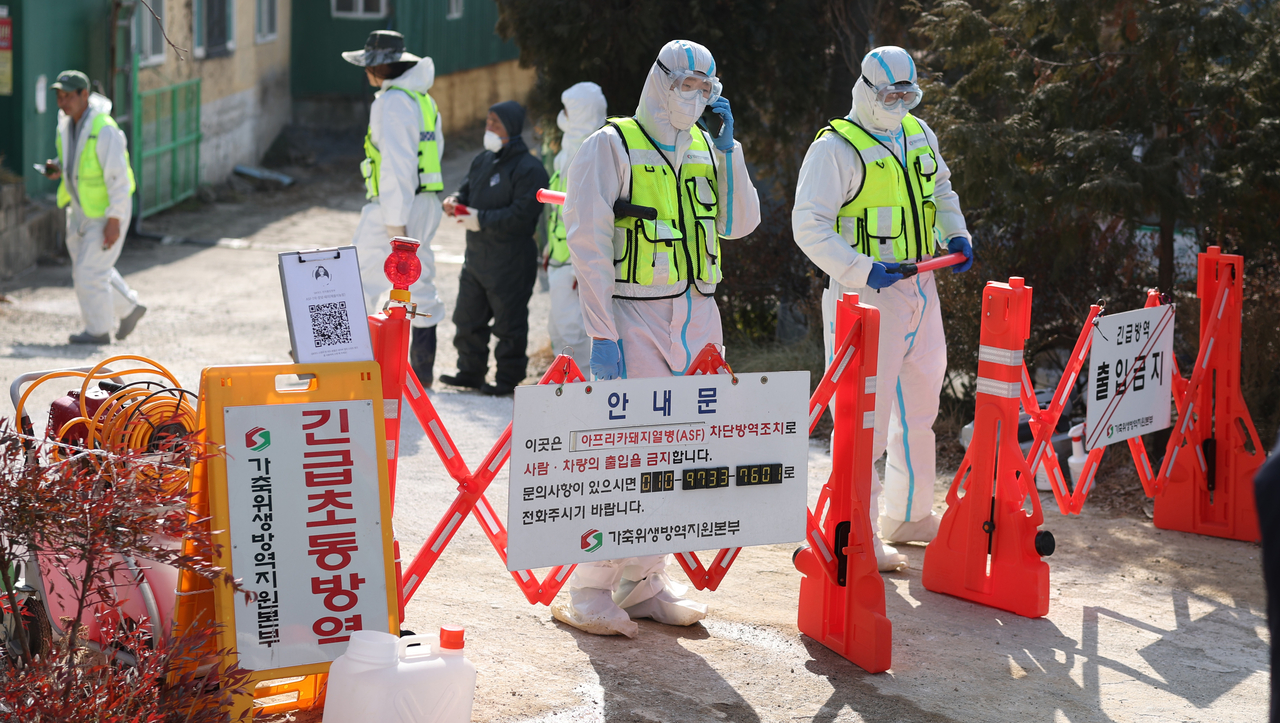
South Korean authorities on Sunday confirmed the ninth African swine fever case of the year in Hwaseong, Gyeonggi Province, as the government ordered strengthened efforts to combat the contagious disease.
According to the Central Disaster Management Headquarters for ASF, the virus was confirmed at a farm raising about 1,100 pigs. The facility is owned by the same operator whose farm in Anseong reported an ASF outbreak in January, officials said.
Prime Minister Kim Min-seok ordered full cooperation from all related government agencies to ensure swift culling operations, enhanced testing and intensive disinfection. He instructed the Ministry of Agriculture, Food and Rural Affairs to carry out all quarantine procedures under the country’s emergency Standard Operating Procedure without delay.
An initial response team and epidemiological investigators have been dispatched to the site, where authorities have restricted access by people, animals and vehicles. All pigs at the Hwaseong farm will be culled in line with ASF control guidelines.
Kim also ordered a thorough investigation into the source and transmission route of the infection. He called on the Ministry of Climate, Environment and Energy to strengthen searches for wild boar carcasses and check fencing around the affected area, as wild boars are considered a vector for the virus.
He also appealed to pig farmers to comply with administrative orders, including bans on gatherings among farm workers, restrictions on bringing in potentially contaminated materials and strict adherence to basic biosecurity rules.
“With ASF spreading nationwide, relevant ministries, local governments, agencies and pig farmers must remain alert and respond with maximum vigilance,” Kim said.
Separately, authorities issued a 24-hour standstill order for all workers and vehicles linked to livestock facilities, including pig farms and slaughterhouses in Hwaseong and five neighboring cities: Ansan, Suwon, Yongin, Osan and Pyeongtaek.
jychoi@heraldcorp.com



![[Survive&Thrive] Tips for getting around Seoul by subway (2)](https://wimg.heraldcorp.com/news/cms/2026/10/08/news-p.v1.20261006.1e7dee51d7f64cdba1a20b897d88cee6_T1.jpg?type=h&h=800)