Provision remains inapplicable to foreign students
A law revision was introduced Tuesday to lower the ceiling on annual college tuition hikes amid ongoing tensions between students and university administrations over this year’s tuition increases, according to education officials on Sunday.
The debate has also raised questions about the treatment of foreign students, whose tuition largely falls outside government regulations.
Democratic Party lawmaker Rep. Kim Moon-soo introduced the revision to the Higher Education Act that would limit tuition hikes to the average consumer price inflation rate over the past three years.
Under current law, private universities are allowed to raise tuition by up to 1.2 times the three-year average inflation rate — a reduction from the previous limit of 1.5 times, which was amended in July 2025.
“The amendment seeks to alleviate the economic burden on university students,” Kim said, adding that the current cap has contributed to rising education costs and could increase the financial burden on parents.
Kim also said the tuition cap for universities remains relatively high compared with the ceiling on kindergarten fee hikes, which are limited to levels similar to those proposed in the bill.
Deepening divide
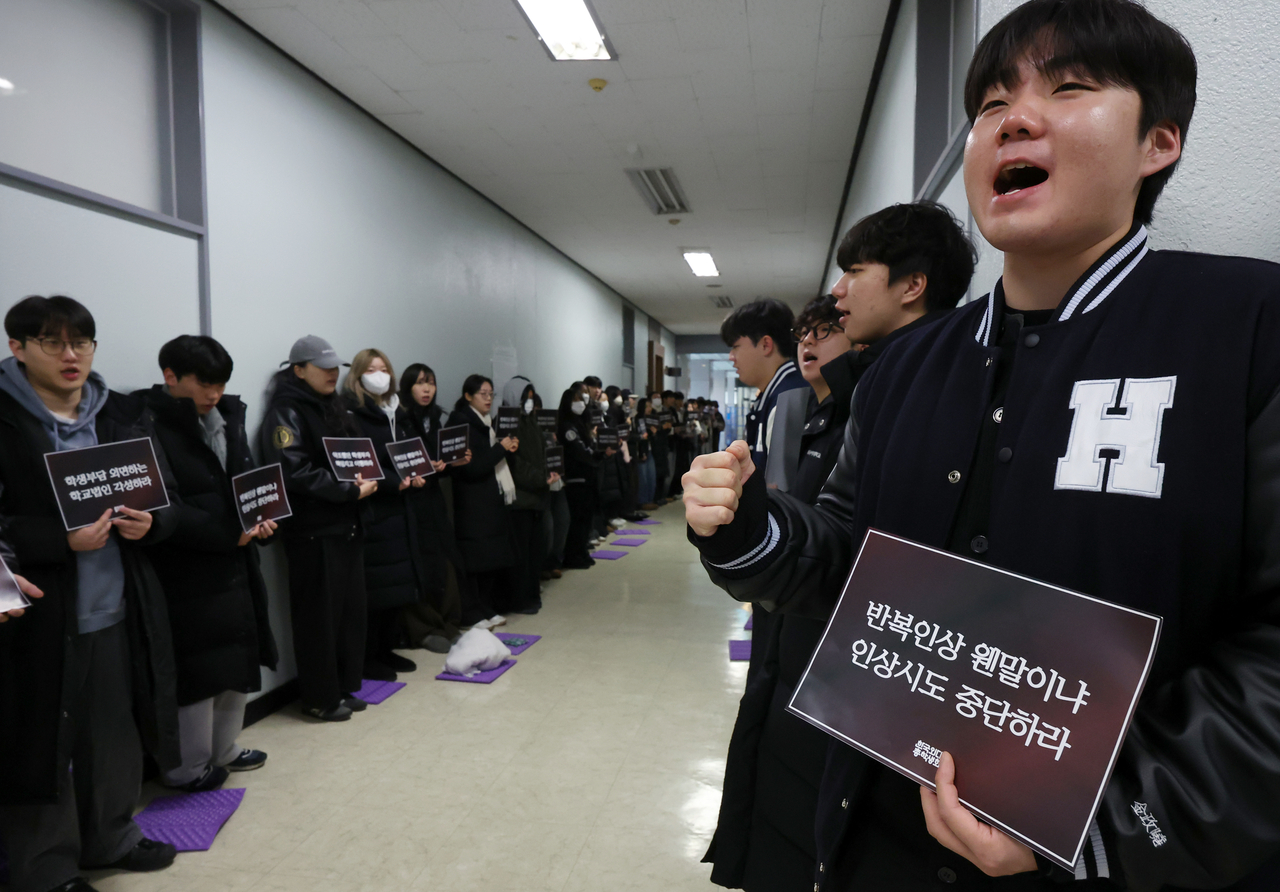
The amendment comes amid growing disputes between schools and student communities, with many universities raising tuition.
According to data from the Korean Association of Private University Presidents, 26.8 percent of all four-year universities in Korea have decided to raise tuition for the 2026 academic year.
Major private universities, including Yonsei University, Korea University and Hankuk University of Foreign Studies, said in January that they are seeking tuition increases of 3.19 percent — the maximum allowed this year.
“Many private universities are increasing tuition by around 3 percent,” the National University Student Council Solidarity Joint Action said at a press briefing on Feb. 2. “The burden feels heavier for students because these increases compound year after year.”
Experts have noted that tuition hikes in 2025 influenced the consumer price index, warning that similar effects could be seen in 2026.
Private universities, however, have cited declining student populations, limited government funding and rising operating costs as reasons tuition hikes are unavoidable.
They argue that the tuition cap undermines competitiveness by worsening financial conditions and restricting investment in education and infrastructure, warning that many institutions are struggling to cover personnel and operating costs as tuition has failed to keep pace with inflation.
The Korean Association of Private University Presidents said in December that it plans to file a constitutional complaint challenging government regulations capping private university tuition.
“They don’t provide sufficient funding to private universities, but regulate them as if they were public institutions,” secretary-general of the association Hwang In-sung told The Korea Herald.
Foreign students kept in the dark
Meanwhile, concerns are mounting that international students are being sidelined in the tuition cap debate.
Current provisions do not apply to foreign students, who are often admitted outside of enrollment quotas, effectively placing them beyond the scope of government regulations.
The Ministry of Education does not require universities to submit calculation standards on international student tuition or disclose how such tuition is used, and their tuition is not subject to mandatory public disclosure.
As of Jan. 26, Sogang University has decided to raise tuition for international students by 7 percent, while keeping the hike for domestic students at 2.5 percent. Yonsei University and Sungkyunkwan University have each raised international student tuition by 6 percent, while Hanyang University, Chung-Ang University and Kyung Hee University have implemented increases of 5 percent.
Korea University, meanwhile, is reportedly considering raising international student tuition by as much as 11 percent.
seungku99@heraldcorp.com