Decision to file complaint comes after Education Ministry announced easing of tuition control on Friday
An umbrella group representing presidents from 154 private universities nationwide said Tuesday it will file a complaint challenging the constitutionality of government regulations capping private university tuition.
“We are preparing to file a constitutional complaint toward the end of this year, or by early next year at the latest,” said Hwang In-sung, secretary general at the Korean Association of Private University Presidents.
The complaint centers on Article 11 of the Higher Education Act, which sets a statutory ceiling on tuition hikes, limiting increases to 1.2 times the average inflation rate over the previous three years. The cap was lowered from 1.5 times after the National Assembly passed an amendment in July, with the revised rule set to take effect in 2026.
KAPUP will ask the court to rule on the constitutionality of this clause. The organization claimed that the cap infringes on the private universities' right to autonomy.
"They don't give private universities the funding but they regulate them like public universities," Hwang told The Korea Herald.
"Internal deliberation committees, which are statutory bodies composed of faculty and students, decide on each year's tuition based on each university's needs," he added. "Imposing regulations on that is unlawfully infringing on the university's autonomy."
Private universities argue that the tuition cap undermines their competitiveness by worsening their financial conditions and restricting key investments in education and infrastructure. They warn that many institutions are struggling to cover personnel and operating costs as tuition has failed to keep pace with inflation.
According to the Korean Council for University Education, inflation-adjusted tuition at private universities fell 22.5 percent, from 8.85 million won ($6,000) in 2011 to 6.86 million won in 2023.
Data from the Korea Foundation for the Promotion of Private Schools showed that while tuition revenue at private universities rose just 0.5 percent in 2024, fixed costs accounted for 103.8 percent of revenue.
"Public universities get a lot of funding, but private universities don't receive that and their tuition is capped. But the private universities end up in competition with the public universities,” Hwang said. "They tie the hands of private schools to keep public institutions alive."
According to KAPUP, the organization had been preparing to file the complaint since October. Initially, it had planned to raise problems with the Type II National Scholarship — a program that allocates government funds to universities that freeze or lower tuition and expand their own scholarship spending.
However, the group decided to expand their complaint after the Education Ministry announced it would abolish the scholarship program by 2027.
KAPUP said the linkage between tuition policy and the scholarship program was legally problematic, arguing that it is inappropriate for a lower-level regulation that ties tuition to the National Scholarship to restrict a higher-level law, namely the Higher Education Act.
"(The ministry) is taking tuition hostage to withhold scholarships from the students. That doesn't fit the program's purpose," Hwang noted.
The association is also calling on the government to abolish the Type II National Scholarship starting next year, rather than in 2027 as planned.
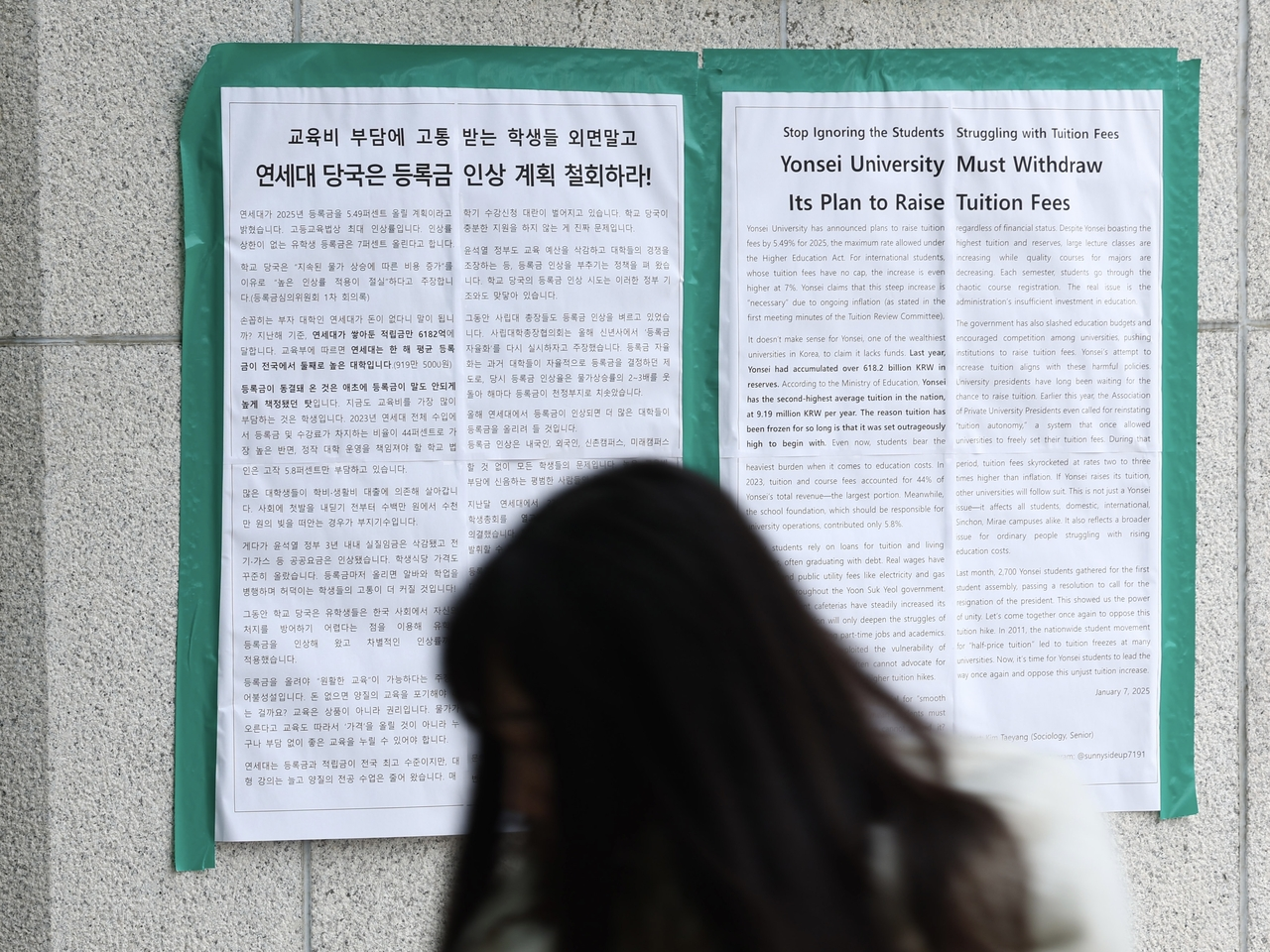
However, concerns remain that loosening tuition regulations could lead to sharp fee increases. According to the Higher Education Research Institute, the average annual tuition per student at four-year universities reached 7.1 million won this year, up 4.1 percent from a year earlier. Of the country’s 215 four-year universities, including branch campuses, 106 raised tuition by around 5 percent — close to the government-set legal ceiling of 5.49 percent.
Students have also raised concerns about the possibility of steep tuition hikes.
“Tuition is still a factor many consider when applying to universities,” said Kim, 26, a graduate student at a public university in Seoul. “I think many students, especially those from underprivileged backgrounds, will end up steering away from private universities.”
KAPUP dismissed those claims, arguing instead that higher tuitions can help improve the university's educational quality and attract more students.
seungku99@heraldcorp.com