George Kurian says Korea's AI push risks stalling as firms focus on infrastructure over data
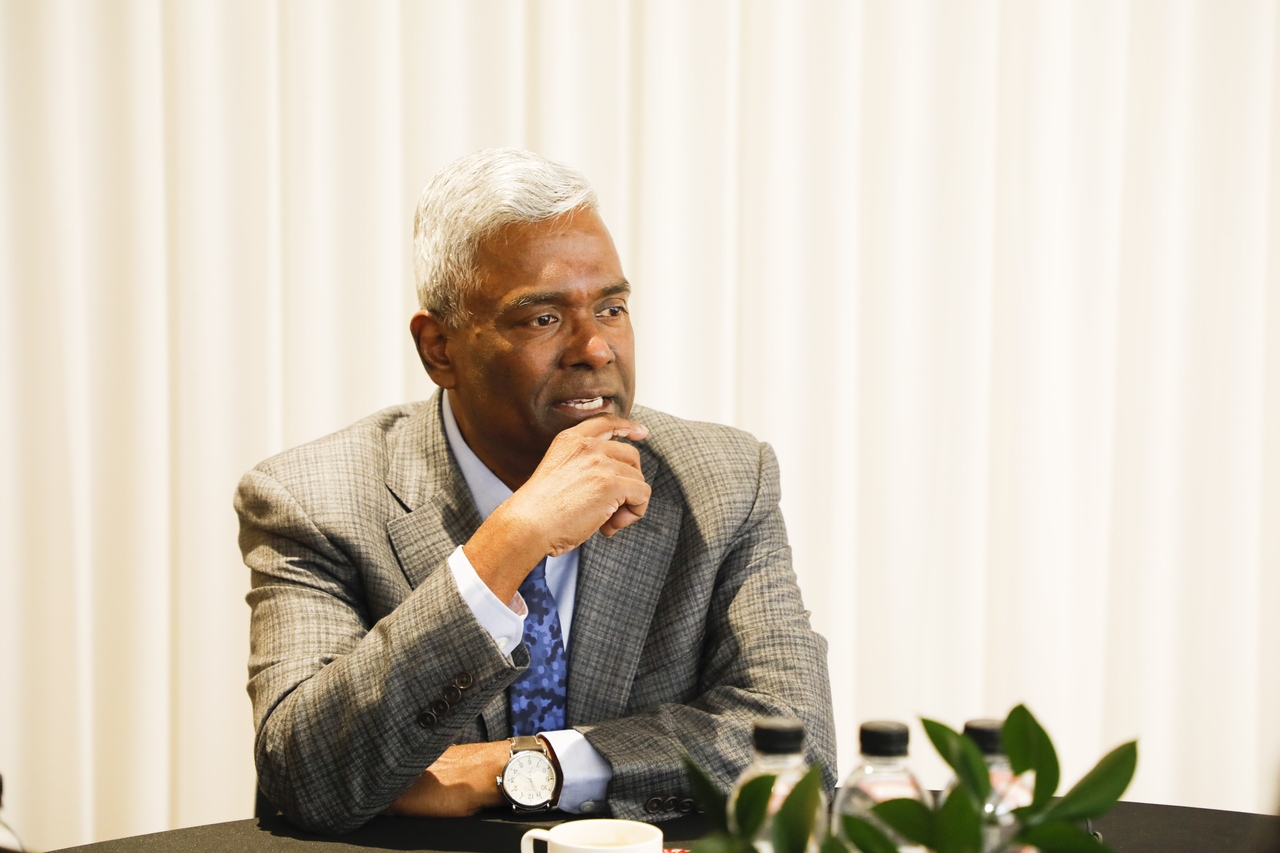
As South Korea doubles down on artificial intelligence, one of Silicon Valley's longest-running enterprise data CEOs says most organizations are overlooking the real bottleneck.
"Eighty-five percent of the time in an AI project is spent finding, organizing and preparing data, before you even start working on the solution," said George Kurian, chief executive of NetApp, a US-based firm that builds the infrastructure behind enterprise data platforms. Speaking with The Korea Herald during a visit to Seoul marking 25 years in Korea for NetApp, Kurian argued that companies chasing model performance or graphics processing unit capacity are "starting in the wrong place."
The warning was clear: AI success depends less on compute and more on whether data is usable, accessible, and governed across the organization.
"AI relies on high-quality data to deliver accurate results," he said. "The question is not just how advanced your model is, but whether your data is usable across your organization."
With operations in more than 40 countries, NetApp has positioned itself as a key enabler of enterprise AI, helping organizations structure the vast datasets modern models depend on. "We are the data platform that all AI models interact with to predict the outcome," he said.
The company supports core workloads for hyperscalers like AWS, Microsoft Azure and Google Cloud, and works with many of the world's largest banks, chipmakers and research institutions. In Korea, NetApp serves major telecom and financial firms, as well as manufacturers, automakers and health care providers. Since entering the market in 2001 with a small client base, NetApp Korea now supports over 5,000 organizations across industries.
These sectors, Kurian noted, face similar obstacles when trying to scale AI.
Why AI pilots fail to scale
"There are two challenges," he said. "One is the complexity of the project itself — especially the data preparation required upfront. The second is moving beyond a successful pilot to full deployment."
"That requires human change management," he added. "Engineers now need to learn how to review code written by AI rather than writing it all themselves."
While not singling out Korea, Kurian acknowledged the country's strengths, especially its speed of adoption and what he called "very creative" public-private partnerships. But he said execution remains a hurdle.
"Korean companies are actually very good at adopting new trends quickly," he said. "The real challenge is having a data strategy ... data is a companywide asset, not just a departmental one."
That point is especially relevant as Korea ramps up public AI investment, from national foundation model initiatives to expanded GPU infrastructure. Kurian called the pace "encouraging," but added, "It's time to assess the cost-effectiveness of those investments."
To move forward, he offered three priorities. "First, experiment fast; the organization that learns fastest wins," he said. Firms also need to align their technology stack with clear business goals and bring together fragmented internal and external data to create a full, actionable picture.
But his sharpest closing point circled back to the early premise.
"A common mistake is thinking AI is an infrastructure problem," Kurian said. "When it's actually a data problem."
mjh@heraldcorp.com