Online lender returns with scaled-back deal, pitches digital finance, stablecoins as growth engines
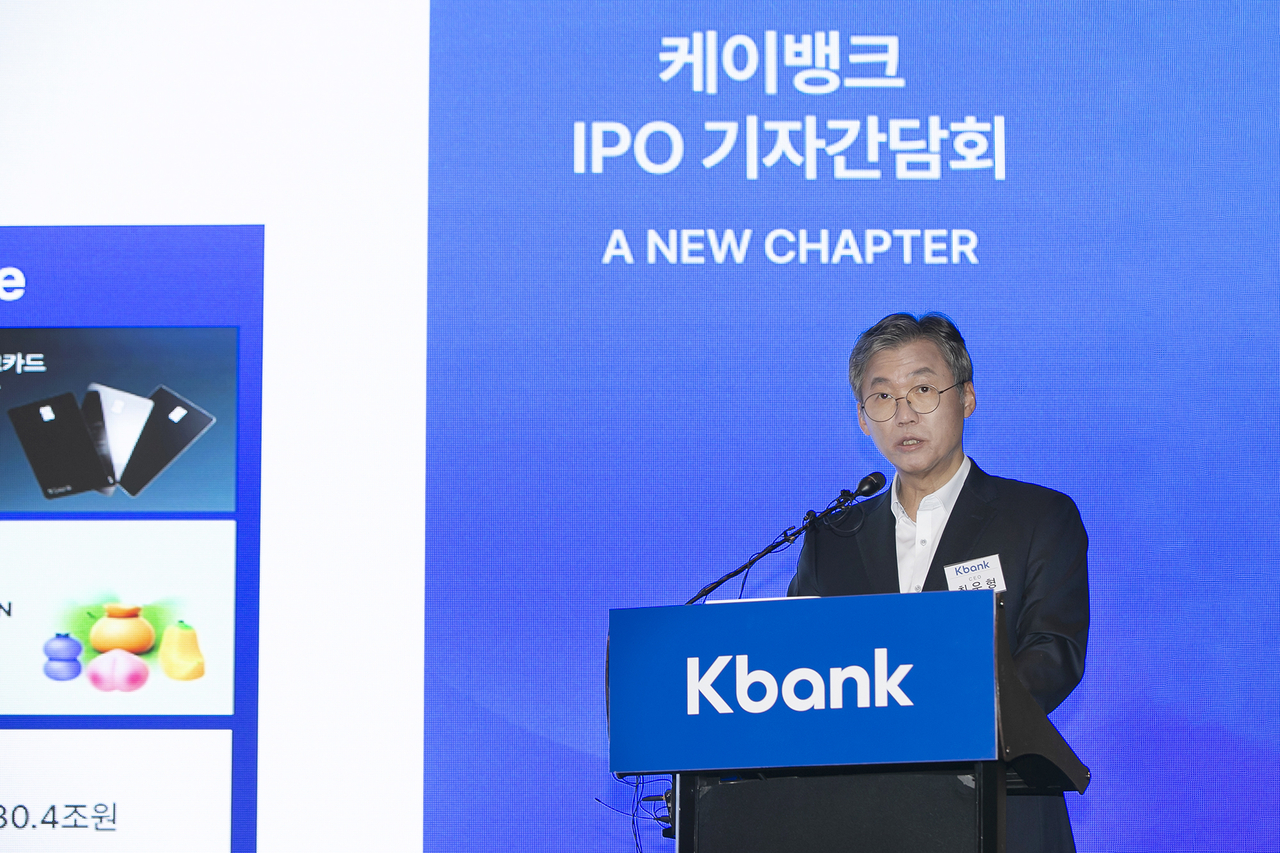
K bank is set to go public on March 5 as the first listing on the benchmark Kospi this year, pitching digital finance and blockchain-based services as key growth engines following its market debut
The internet-only lender on Thursday unveiled its IPO plans at a press conference in Seoul.
“We plan to leverage this initial public offering to expand in the retail and small business segments and lay the foundations for our platform business, while accelerating our competitiveness in the digital asset sector,” CEO Choi Woo-hyung said during the event.
A weeklong institutional investor bookbuilding process will run through Feb. 10, followed by public subscription on Feb. 20 and Feb. 23.
The offering marks K bank’s third IPO attempt since 2022, following a 2024 bid that stalled from weak investor appetite.
This time, the lender has returned with a scaled-back deal, planning to float 60 million shares, 22 million fewer than previously, while cutting the price range to 8,300 won to 9,500 won ($5.70-$6.50) per share from 9,500 won to 12,000 won.
The revised terms imply a market valuation of around 3.5 trillion won, down from about 5 trillion won sought previously.
The latest attempt is tied to a July deadline pledged to financial investors, with failure to list by then potentially triggering repayment of their 725 billion won investment.
Upon listing, that capital will be recognized as regulatory capital, adding to the roughly 570 billion won expected from the offering itself and bringing total capital inflows from the IPO to about 1 trillion won, the company said.
Choi highlighted stablecoins as one of several post-listing growth priorities, positioning K bank to take a leading role as regulation takes shape.
“The stablecoin market is expected to see explosive growth, and K bank, which has served as a key gateway in the digital asset market in Korea, will be the biggest beneficiary,” he said, adding the lender plans to lead a bank-led consortium to issue won-denominated stablecoins once legislation is finalized.
The broader strategy is aimed at taking K bank beyond domestic banking, transforming it into a digital finance platform supporting cross-border payments and remittances.
K bank has been the exclusive banking partner of Upbit, Korea’s largest cryptocurrency exchange, since 2020, cementing a dominant position in the digital asset deposit market with about a 70 percent share and the largest number of corporate digital asset accounts.
The lender plans to use the proceeds of the IPO to build a stablecoin-based cross-border payment and remittance network by leveraging the domestic payment infrastructure of BC Card, its major shareholder, along with partnerships with overseas banks and global digital asset firms. Pilot projects are already underway with partners in markets including Thailand and the United Arab Emirates.
Expanding its small and medium-sized enterprise business is another pillar of K bank’s mid- to long-term growth strategy. The lender plans to gradually rebalance its loan portfolio toward corporate lending, targeting an equal split between household and SME loans by 2030.
Choi said the bank will prioritize growth over shareholder returns immediately after listing. “For the time being, we plan to focus on growth with a target return on equity of 15 percent,” he said, adding shareholder returns such as dividends will be reviewed once ROE reaches double digits. K bank’s ROE stood at 6.5 percent as of September 2025.
Launched in 2016 as Korea’s first internet-only bank, K bank turned profitable in 2021 and posted a record net profit of 128 billion won in 2024. As of the end of 2025, it had 15.53 million customers, with loan and deposit balances of 18.4 trillion won and 28.4 trillion won, respectively, both posting industry-leading average annual growth over the past five years.
jwc@heraldcorp.com