Global Thinkers: Leadership Excellence
Cities competing for global relevance are increasingly working to link advanced industry, cultural scale and international mobility — a dynamic already embedded in Incheon's urban structure.
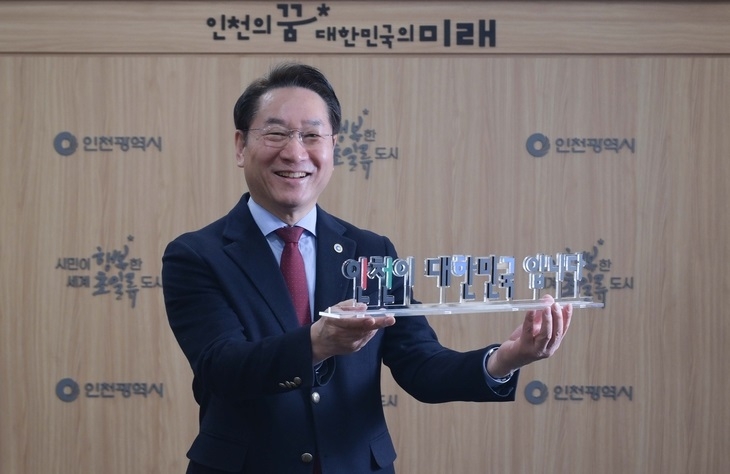
“What matters is whether a city can show cultural demand and the ability to scale. Incheon already meets those conditions,” Incheon Mayor Yoo Jeong-bok said during an interview with The Korea Herald, outlining a vision in which the city seeks not symbolic elevation but measurable functionality.
His confidence comes as the Ministry of Culture Sports and Tourism prepares its feasibility review for a proposed national K-Culture Arena.
Incheon sees the process not as a competition to be won but as an opportunity to show that many of the characteristics associated with globally connected cities are already operating in its industrial districts, logistics network and cultural economy.
Within the Global Thinkers framework, the city has two areas that demonstrate its readiness: Its advanced manufacturing and bio-health ecosystem, supported by airport-based mobility, earns it the Global Economic Connector badge; its hosting capacity, with rising foreign visitor spending, supports the Global Culture Gateway category.

Global Economic Connector — Industrial Scale Supported by Aviation and Integrated Growth
Incheon’s claim to global economic competitiveness begins with the Incheon Free Economic Zone, a composite industrial geography incorporating Songdo, Yeongjong and Cheongna.
These districts have accumulated a dense concentration of high-value industries, including biopharmaceuticals, artificial intelligence, semiconductors and advanced materials, creating one of the country’s most advanced urban industrial ecosystems.
Songdo anchors a full-cycle biomanufacturing system in which research, development, production and commercialization occur within a single district. This allows global firms to shorten production timelines and manage end-to-end operations without leaving the metropolitan economy.
The structure mirrors innovation clusters in major global hubs and is one of the strongest practical bases for Incheon’s claim to the Global Economic Connector badge.
The airport amplifies this effect. As home to Incheon Airport, now ranked No. 3 worldwide in international passenger traffic, the city has an unmatched mobility platform compared to other Korean municipalities. The airport’s scale allows high-tech sectors to circulate people and products at global speed, and the city is working to strengthen this advantage.
The mayor emphasizes the city’s focus on sustainable growth rather than one-time investment totals.
“Incheon places policy emphasis on building an industrial base and business environment where companies can actually settle and grow sustainably rather than achieving short-term investment results,” he said.
This direction reflects the city’s strategy of attracting firms that build multidecade operations rather than short-term projects.
Yoo frames this year as decisive for industrial positioning. “In 2026, we will actively attract major competitive public projects in the bio and advanced technology sectors to Incheon,” he said, adding that the city aims to ensure “global firms can trust Incheon as an investment base and continue long-term growth.”
Governance remains a central theme in Incheon’s economic narrative. Yoo has been one of the strongest critics of the government’s administrative integration proposals involving other regions. He has argued that the integrated special city plan was nothing more than a political calculation and that the promised funding will ultimately place a large burden on the people living in the capital.
He has also warned that uniform metropolitan regulations do not suit Incheon’s specific functions.
“It is wrong to impose uniform regulations on the whole capital region, and a responsible central government should try to look at people on the map, not just administrative boundaries,” he said.
Within this context, the city argues that its industrial geography, strong aviation-based logistics and policy orientation collectively form the basis for recognition with the Global Economic Connector badge.

Global Culture Gateway — Demonstrated event demand and strengthening visitor economy
Alongside its industrial breadth, Incheon is presenting a parallel cultural engine built around significant hosting capacity and a measurable shift in foreign visitor behavior. The city’s cultural argument does not rest on projections but on a track record visible in its two major venues.
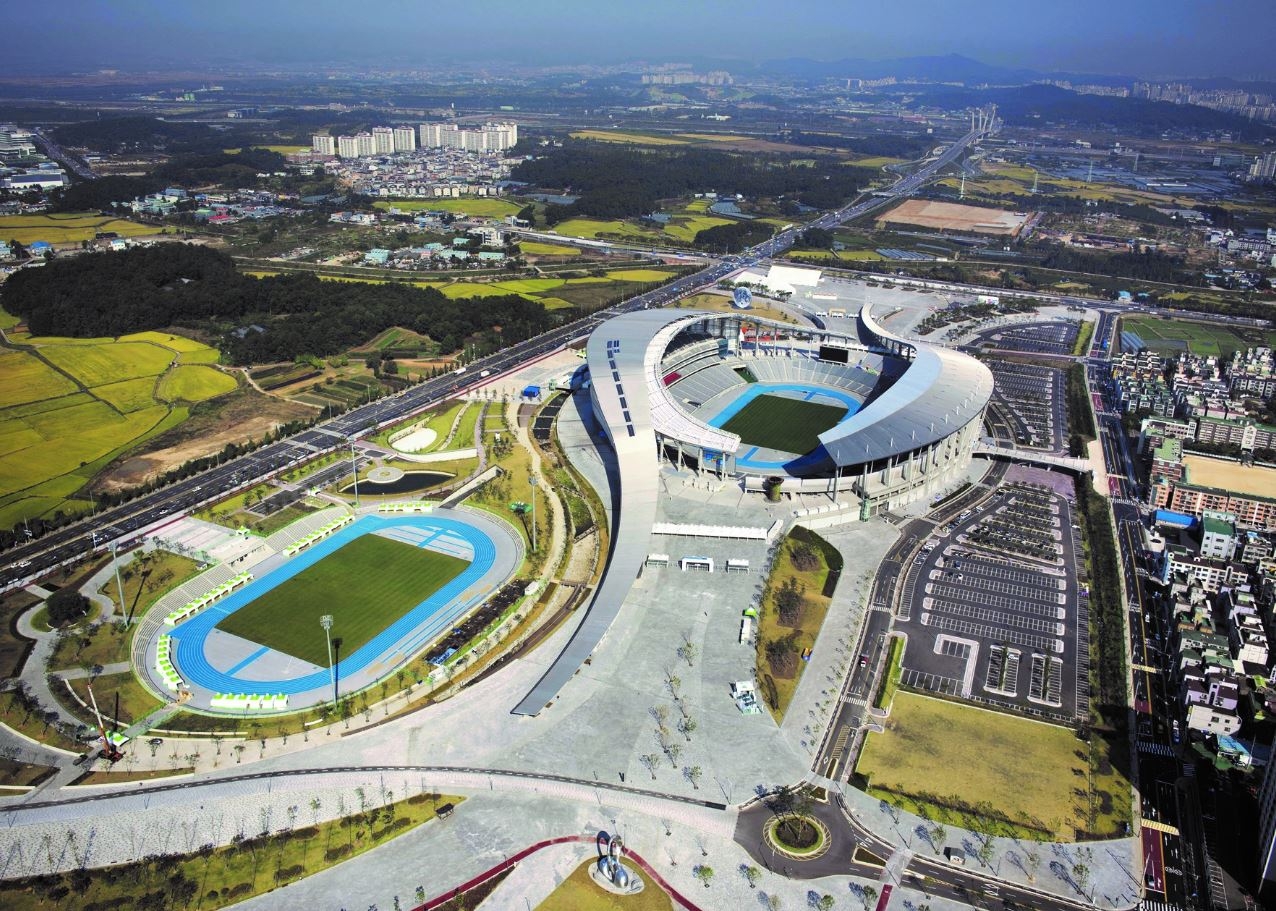
The 50,000-seat Incheon Munhak Stadium and the 30,000-seat Incheon Asiad Main Stadium have already hosted sold-out concerts. Yoo notes that this performance demonstrates existing arena scale demand rather than anticipated demand.
The city is now promoting the venues for K-Arena status from the Culture Ministry, which would provide support to upgrade the facilities and the surrounding area.
“If the 50,000-seat Munhak Stadium or the 30,000-seat Incheon Asiad Main Stadium were designated as K-Arena venues, we could reduce the initial financial burden and enter the market in a short period of time," Yoo said.
He noted that past events have proven the demand for such a designation, saying, “The main stadium attracted various concerts and sporting events, and the Asiad Main Stadium also successfully filled thirty thousand seats for large-scale concerts."
Foreign visitor spending patterns reflect the same trajectory.
Data from the Fiscal Reform Institute shows that per capita foreign tourist spending in Incheon has increased more sharply than in Seoul, Busan or Jeju between 2019 and 2025 and has more than doubled over that period.
City officials interpret this as evidence that international visitors are shifting from transit behavior to destination-oriented consumption, including lodging, restaurants, shopping and performance-driven stays.
The city contends that an arena would further intensify this pattern by converting large-scale cultural inflows into sustained tourism revenue.
Yoo said that if an Incheon venue achieved K-Arena status, it would increase tourism spending, revitalize local businesses and generate added cultural value.
The city has already conducted internal studies on ways to optimize and modernize its public stadiums in preparation for the feasibility review. Yoo said the city believes Munhak Stadium has excellent infrastructure and access, including proximity to a subway station.
Incheon’s case for the Global Culture Gateway badge rests on the intersection of these factors. The city’s large venues have already shown arena-level demand, and foreign visitor spending is rising at one of the fastest rates in the country.
Airport accessibility enables the rapid conversion of international arrivals into cultural tourism. These elements together form an argument that Incheon’s cultural economy is not emerging but already maturing.
Incheon’s Integrated Global Orientation
With its industrial clusters and aviation infrastructure forming one pillar and its cultural economy and visitor spending forming the other, Incheon presents a two-part model of global functionality. The city argues that its strengths are not dependent on future construction schedules but are already embedded in its current operations.
Yoo believes that the city’s aim is not comparative expansion but practical relevance.
“Incheon is not trying to be bigger than other cities. We are trying to be more globally functional.”
The Korea Herald, in collaboration with Herald Business, examines the present and future of local governments in a new series titled "Global Thinkers: Leadership Excellence," an assessment and certification program evaluating the international competitiveness of local governments.
Participating municipalities are recognized with badges representing five core elements used to gauge excellence: attracting investment, incubating talent, fostering tourism, improving living standards and strengthening connections with other global cities. — Ed.
hnpark@heraldcorp.com
gilbert@heraldcorp.com








