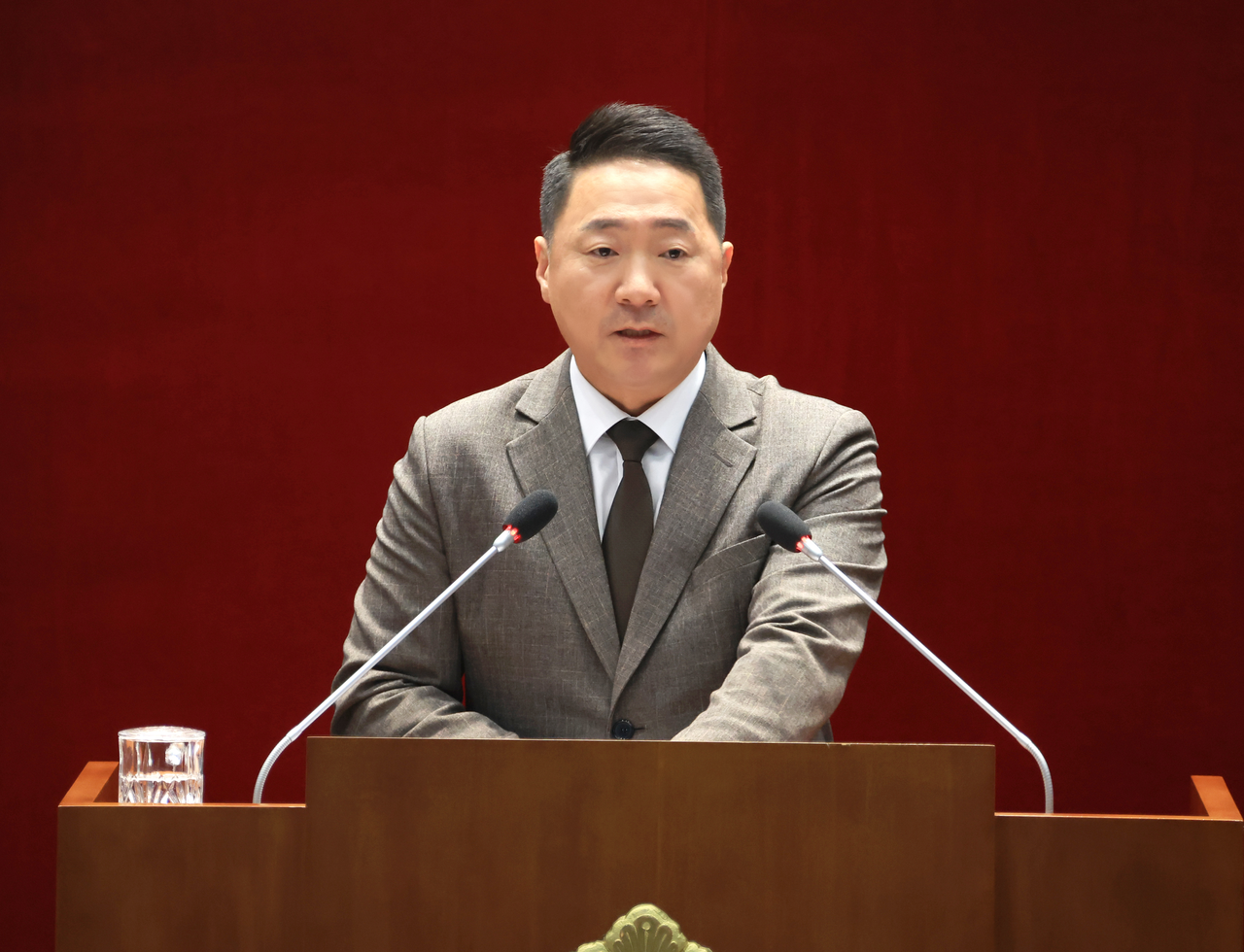
The Seongnam City Council on Monday passed a resolution urging the government to pursue institutional reforms to strengthen public accountability for foreign schools and better safeguard students at unaccredited international schools.
The resolution was introduced by People Power Party council member Jeong Yong-han, who argued that Article 60-2 of the Elementary and Secondary Education Act, which grants special exemptions to foreign schools, no longer reflects current educational environments. It has been alleged that the lack of government supervision creates a blind spot, leading to potential lax management of school officials and insufficient student protection.
The current provision outlines around 30 exemptions for foreign schools, including requirements to submit school accounting data, oversight by district superintendents and participation in government-administered academic assessments. The article was introduced in 2000 to help attract foreign investment in the aftermath of the Asian Financial Crisis.
The proposal claimed that the exemptions and loose government oversight have effectively allowed some schools to operate without meaningful accountability.
It cited a 2023 embezzlement case involving Seoul International School in Seongnam, Gyeonggi Province, in which a school official invested over 22 billion won ($15 million) of school funds in private equities, turning a loss of 13.2 billion won.
The resolution noted that the Gyeonggi Metropolitan Office of Education was unable to impose penalties because the school fell outside its jurisdiction. It also called for new legislation to better regulate unaccredited schools.
The resolution noted that a growing number of students from affluent districts in Seoul are opting out of the public education system to attend unaccredited international schools.
These institutions are not accredited by the Ministry of Education. Instead, many are accredited by overseas bodies such as the US-based Middle States Association and operate largely beyond Korean government oversight.
This ambiguous legal status has meant that laws such as the School Violence Prevention Act do not apply, leading to a rise in disputes involving students and parents who lack adequate legal protection.
"In order to solve instances of school bullying, the schools must implement a School Violence Countermeasures Committee. Current institutions omit the (unaccredited) school's responsibility to do that," Jeong told The Korea Herald on Wednesday.
Jeong also argued that the exemption clause on foreign schools excludes provisions essential to education policy stakeholders, including students and parents.
“The damages from this institutional neglect will ultimately fall on the students and parents,” he added.
Seongnam is home to two foreign school campuses and several unaccredited international schools.
“The Ministry of Education and education offices must actively fulfill their responsibility to ensure the universal right to educational safety that all Korean citizens deserve,” Jeong added.
The resolution will be forwarded to the National Assembly, the Ministry of Education and the Gyeonggi Provincial Education Office.
seungku99@heraldcorp.com