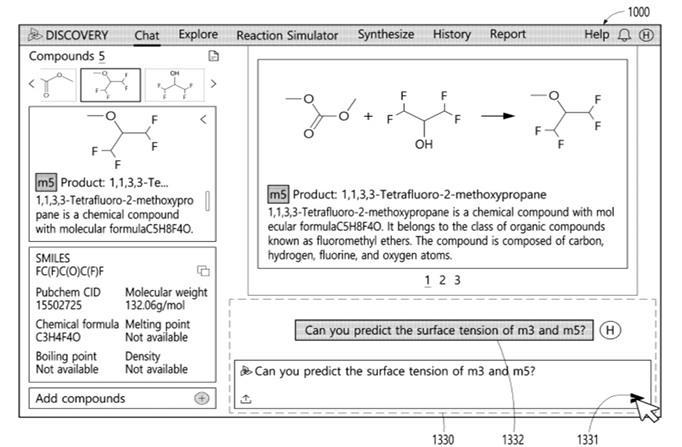
LG AI Research said Tuesday it has registered a patent for Exaone Discovery, a generative AI platform designed to speed up the discovery of new materials and pharmaceuticals.
Unlike conventional AI systems that rely on pre-structured databases, Exaone Discovery uses multimodal AI to directly analyze unstructured scientific data — including chemical formulas, molecular structures, charts, and images embedded in academic papers and patent documents — without prior data standardization, the company said.
What sets the patent apart is its broad, workflow-level scope. Rather than covering individual algorithms or software modules, the patent protects the entire AI-driven research process, from extracting molecular structures in documents to generating experiment designs in response to researcher queries and predicting the physical and chemical properties of candidate substances.
LG AI Research said the approach is intended to secure the core end-to-end workflow of AI-based materials and drug discovery, making it difficult for competitors to replicate similar processes without infringing on the patented framework.
The company plans to further develop Exaone Discovery into a chemical agentic AI — a system capable of autonomously proposing and refining new materials — for use in industries such as batteries, semiconductors and pharmaceuticals. The platform is already being applied at LG Household & Health Care to identify potential cosmetic ingredients.
“AI model performance evolves rapidly, but patents that protect core discovery processes provide lasting technological and legal safeguards,” said Yoo Kyung-jae, an intellectual property leader at LG AI Research.
sunblessyou@heraldcorp.com