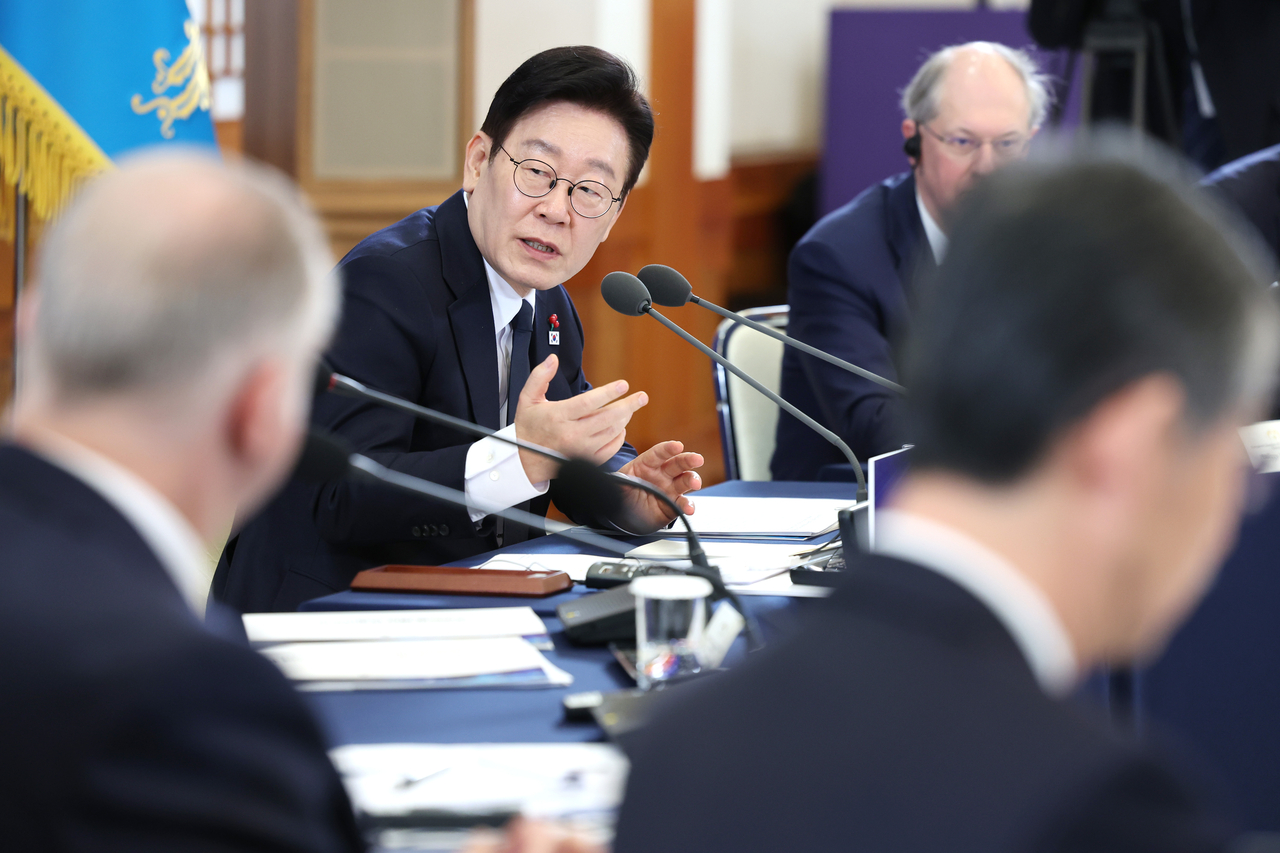
President Lee Jae Myung on Wednesday pledged to make South Korea “the world’s best investment destination,” seeking to reassure foreign investors about the country’s economic fundamentals, market transparency and geopolitical stability as the benchmark Kospi index surged past the 5,000-point mark for the first time.
Speaking at a meeting with foreign-invested companies and representatives of seven foreign chambers of commerce at the presidential office in Seoul, Lee said foreign investment has been “a core pillar” of South Korea’s economic growth and will remain critical going forward.
“The government will provide full support so that your investment in Korea becomes a success,” Lee said, adding that his administration would create “objective conditions” to enhance Korea’s appeal as a global investment hub.
Lee described the recent rally in the stock market as a “normalization process,” arguing that Korean assets had long been undervalued relative to the country’s fundamentals.
“What had been evaluated below Korea’s original economic strength is finally being properly recognized,” he said. “Korea is far more attractive as an investment destination than many may think.”
The Kospi closed Monday at 5,084.85, marking its first-ever close above the 5,000 mark. Lee said he himself was surprised by the speed of the rally.
“I expected this to happen eventually, but it came much faster than anticipated,” he said, drawing laughter as he recalled urging investors during a Wall Street visit last year to follow the lead of Korean retail investors — only to see foreign inflows arrive first.
Lee sought to ease concerns over geopolitical risk on the Korean Peninsula, telling investors there was “no need to worry.”
“There will be no unnecessary military confrontation with North Korea or escalation of tensions,” he said. “Even if we make some concessions, we will maintain stability, and geopolitical risks on the peninsula will disappear.”
The president also emphasized sweeping reforms to corporate governance and market oversight.
“Just as the people are the owners of the state, shareholders should be the owners of companies,” Lee said. “We will reform corporate governance so shareholders are properly respected.”
He vowed to eliminate unfair practices, saying, “Stock manipulation is a national embarrassment. From now on, there will be none of that,” adding that he was confident in ensuring “fairness and transparency in the stock market.”
On industrial policy, Lee outlined priorities including balanced regional development, fair growth across large firms and small and medium-sized enterprises, startup support, and a major shift toward advanced technology industries.
“Korea is undergoing a major transformation centered on advanced technologies,” he said. “At the core of that transition are artificial intelligence and renewable energy.”
Lee also urged foreign firms to look beyond the Seoul metropolitan area, pledging to concentrate fiscal resources on regional development and attracting talent.
“The most serious problem Korea faces today is excessive concentration in the capital region,” he said. “We will devote as much fiscal support and opportunity as possible on the regions.”
To address difficulties in recruiting talent outside Seoul, Lee said the government would support regional universities and allow international schools in provincial areas if needed.
“If necessary, we will permit international schools at the elementary, middle and high school levels,” he said, adding that investment in cultural and residential infrastructure would also expand.
Foreign business leaders welcomed the government’s message but called for further reforms. James Kim, chair of the American Chamber of Commerce in Korea, said Korea and the United States would find win-win solutions, noting the country’s growing momentum. He noted that Singapore hosts about 5,000 regional headquarters, Hong Kong 1,500 and Shanghai 900, while Korea has fewer than 100, which he said underscores the need for tax and labor reforms if Korea seeks to become a key regional hub.
Lee agreed, saying, “I fully share the view that Korea could attract far more global headquarters,” and pledged to work toward improving conditions for foreign investors.
The president also said the government is preparing to establish a presidential advisory committee on regulatory rationalization, encouraging companies to submit concerns regularly for review.
“KOTRA will focus on positive industrial and economic cooperation,” Lee said, “while regulatory and support matters should be handled by the government. What matters most is maintaining open communication so foreign investors feel supported.”
Wednesday's meeting was attended by representatives of seven foreign chambers of commerce: James Kim, chair of the American Chamber of Commerce in Korea; Gao Chen, head of the China Chamber of Commerce in Korea; Philippe van Hoof, chair of the European Chamber of Commerce in Korea; Tetsuya Matsuura, chair of the Seoul Japan Club; Antonio Randazzo, president of the German Chamber of Commerce in Korea; Shaun Blakeley, head of the British Chamber of Commerce in Korea; and David-Pierre Jalicon, president of the French Chamber of Commerce and Industry in Korea. Executives from 31 foreign-invested companies were also present.
mkjung@heraldcorp.com