South Korea is entering final-stage talks with Google and Apple over long-pending requests to export what the government classifies as high-resolution map data, with officials signaling that a split decision is on the table — one that might grant Apple conditional approval while continuing to defer Google.
The Transport Ministry is holding another round of consultations with both companies this week, according to industry sources. The focus remains on the export of 1:5,000 scale topographic data, which includes precise building shapes and narrow alleyways, and is classified as sensitive under Korean law due to its potential use in military targeting or surveillance when combined with satellite imagery.
The government has laid out three conditions for approval: redaction of sensitive imagery, suppression of coordinate data and the use of a domestic data center. Apple has said it can meet all three.
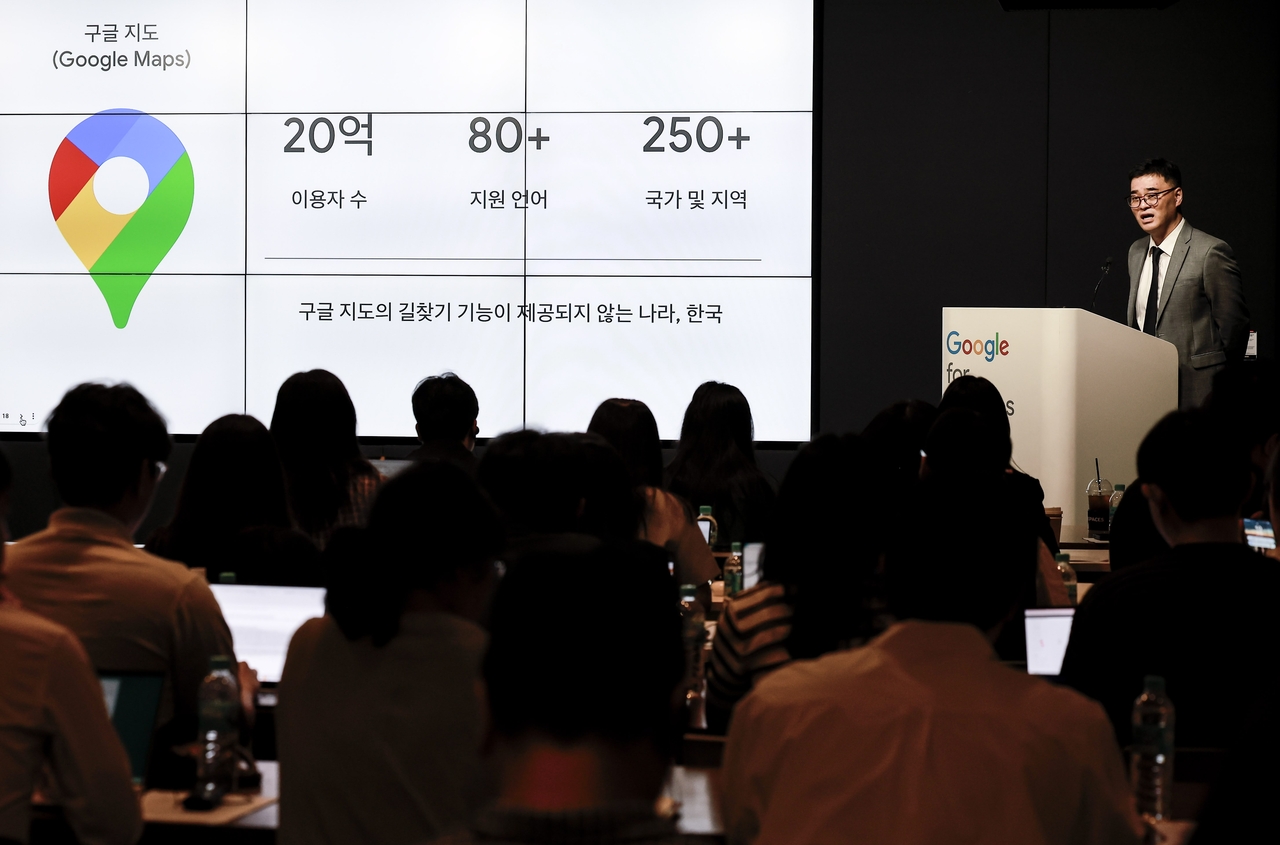
Google has agreed to the first two but continues to reject the server requirement, which is a long-standing flashpoint in a debate that dates back to its first export request in 2007.
That divergence has created a possible pathway for different outcomes. But Apple’s compliance now faces its own scrutiny, particularly over the credibility of its domestic hosting. Apple has not confirmed whether its Korean infrastructure is company-owned or leased. Government officials and experts are raising concerns that if map data is routed through a third-party local facility and processed elsewhere, South Korea would have little meaningful oversight.
Under national regulations, sensitive spatial data must be handled in physically isolated environments disconnected from external networks.
Recent developments have added urgency. Earlier in January, both Google and Apple were found to be displaying high-resolution satellite images of Cheong Wa Dae, the presidential compound, without masking. This prompted the government to summon both firms and announce that formal security reviews will become mandatory for map services later this year.
Apple has since applied partial masking to its imagery, while Google’s imagery remains visible.
The dispute comes after more than a year of incremental negotiations and multiple deferrals. Google submitted its third export request in February last year, and has until Feb. 5 to file supplemental documentation addressing the government's conditions. Apple previously requested more time in December, but no new deadline has been set.
Google has consistently framed global processing as essential for navigation features, while Korean officials are concentrating on whether the government can actually audit and supervise the data flow.
mjh@heraldcorp.com