Industry sources see potential shifts in HBM supply terms and customer relationships, while projects championed by Huang face uncertain priorities under new leadership
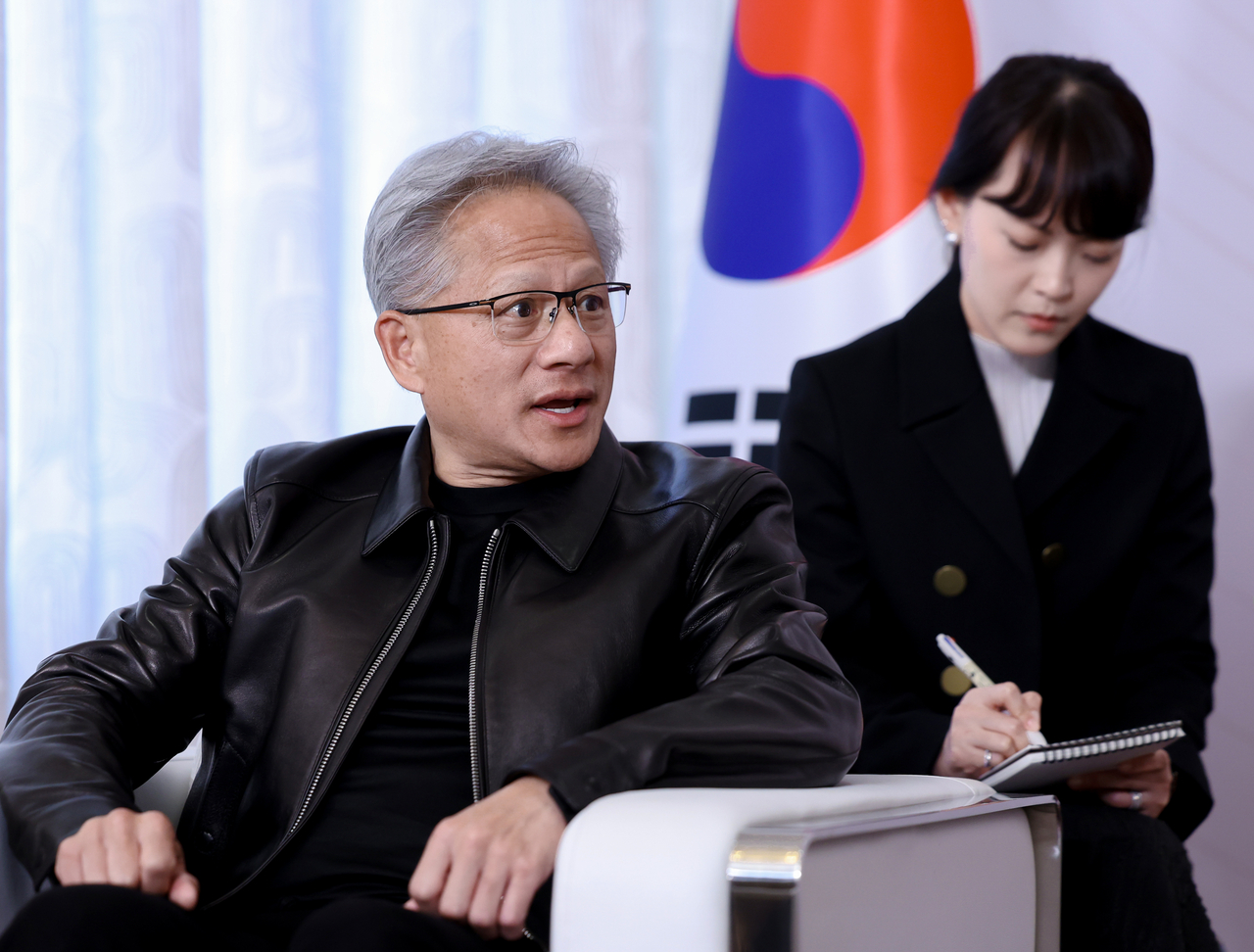
Jensen Huang's abrupt resignation from Nvidia could give South Korean memory chipmakers greater leverage in future supply negotiations, even as his departure raises questions over the fate of AI ventures he personally championed, industry sources and analysts say.
Huang, who co-founded Nvidia in 1993, resigned Thursday following revelations of extramarital affairs, including one with a woman suspected by US officials of being a Chinese spy. Nvidia named Chief Financial Officer Colette Kress interim CEO and pledged to maintain customer commitments and product plans.
For Korean memory makers, the leadership shake-up could even bring opportunities if Nvidia loses ground to rivals.
"It could actually be better for us," Ahn Ki-hyun, executive vice president of the Korea Semiconductor Industry Association, told The Korea Herald. "If another company fills the gap left by Nvidia, it will still need our HBM."
Ahn argued that Huang's personal relationships with Korean business leaders mattered less than Nvidia's reliance on a handful of memory suppliers.
"To change suppliers, Nvidia needs alternatives. But where are those alternatives?" he said.
SK hynix, Samsung Electronics and US-based Micron are the three major manufacturers of high-bandwidth memory, essential for Nvidia's AI accelerators.
"Instead of concentrating supply on one customer, we could spread it across several. That could actually be better for us," Ahn said.
Nvidia's supply advantage at risk
The shift toward rival chipmakers was already expected. LS Securities estimated Nvidia would account for 57 percent of global HBM demand in 2026, down from 66 percent in 2025. Morgan Stanley projected its share would fall to 37.3 percent in 2027, with Google reaching 36 percent.
Nvidia's future bargaining power may also change. Research firm SemiAnalysis said Friday that Huang personally secured memory capacity in South Korea and chipmaking capacity in Taiwan.
"That stranglehold is personal," said Dylan Patel, the founder and CEO of SemiAnalysis, an independent research and consulting firm specializing in the semiconductor supply chain
SemiAnalysis estimates SK hynix could charge Nvidia $3 to $3.30 per gigabit for HBM4 in 2027, compared with $3.70 to $4.10 for other major customers, including AMD, Broadcom, Amazon and Google.
Patel also believes there is an "implicit understanding" between the two sides. SK hynix gives Nvidia preferential access to the memory needed for its AI chips, while Nvidia prioritizes GPU supplies to the broader SK Group for its AI infrastructure business. SemiAnalysis expects Nvidia's preferential treatment to weaken without Huang, potentially freeing up HBM capacity for competitors.
New AI investments face questions
An official at a South Korean company with business ties to Nvidia expressed greater concern about projects Huang personally championed in AI factories, physical AI and robotics.
"What worries me more are the new businesses," the official told The Korea Herald, requesting anonymity. "Huang personally pushed some of these projects. The question is whether they can move forward at the same pace without him."
The official expects existing contracts to hold, but sees greater uncertainty for projects requiring years of investment before generating profits.
"Those businesses could see their priorities change under a new CEO," the official said. "That doesn't necessarily mean investment cuts. The new leadership could continue the same strategy."
Meritz Securities analyst Hwang Soo-wook warned that more cautious financial commitments could also affect AI infrastructure financing. Nvidia has helped data center operators raise capital through investments, long-term capacity commitments and revenue guarantees. "If the next management team takes a more conservative approach to new financial support, it could affect the pace of neocloud expansion and their financing conditions," Hwang said.
Samsung Electronics and SK hynix declined to comment on Nvidia's leadership situation.
mjh@heraldcorp.com