During a 10-day trip to Hyundai's key markets, Chung Eui-sun met with chiefs of CATL, Sinopec, Nvidia and Qualcomm
Kicking off the new year, Hyundai Motor Group Executive Chair Chung Euisun shuttled between China, the US and India, in the automaker’s renewed push to secure an edge in future technologies ranging from electric vehicles to artificial intelligence and robotics.
Chung traveled to Beijing on Jan. 4-5 as part of a South Korean business delegation accompanying President Lee Jae Myung on a state visit to China, marking Chung's first trip to the country in eight months, since attending the Shanghai Auto Show last May.
During the visit, Chung met Zeng Yuqun, chair of battery giant CATL, to discuss cooperation on electric vehicle batteries. The two last met at the Asia-Pacific Economic Cooperation CEO Summit in Gyeongju, South Korea, in October. Chung also exchanged views on hydrogen projects with Hou Qijun, chair of China’s state-owned energy giant Sinopec.
He also met Zhang Naiwen, chair of Jiangsu Yueda Group, Kia’s joint-venture partner in China, signaling both sides’ intent to deepen cooperation.
From China, Chung headed to Las Vegas for the Consumer Electronics Show, held Jan. 6-9, during which Hyundai affiliate Boston Dynamics showcased its humanoid robot Atlas, one of the event's most talked-about demonstrations.
On the sidelines, Chung met with Nvidia CEO Jensen Huang and Qualcomm COO Akash Palkhiwala, deepening ties with US tech partners.
Hyundai Motor Group and Nvidia are pursuing an expanded partnership, with Nvidia supplying 50,000 Blackwell GPUs to the automaker. The two sides are also working to establish an Nvidia AI Technology Center and Hyundai’s Physical AI Application Center in South Korea, as part of broader efforts to build a domestic physical AI ecosystem spanning autonomous driving, robotics and manufacturing productivity.
In Las Vegas, the automaker also convened its Global Leaders Forum, a closed-door meeting of the group’s senior executives to align on mid- to long-term strategy and future technologies.
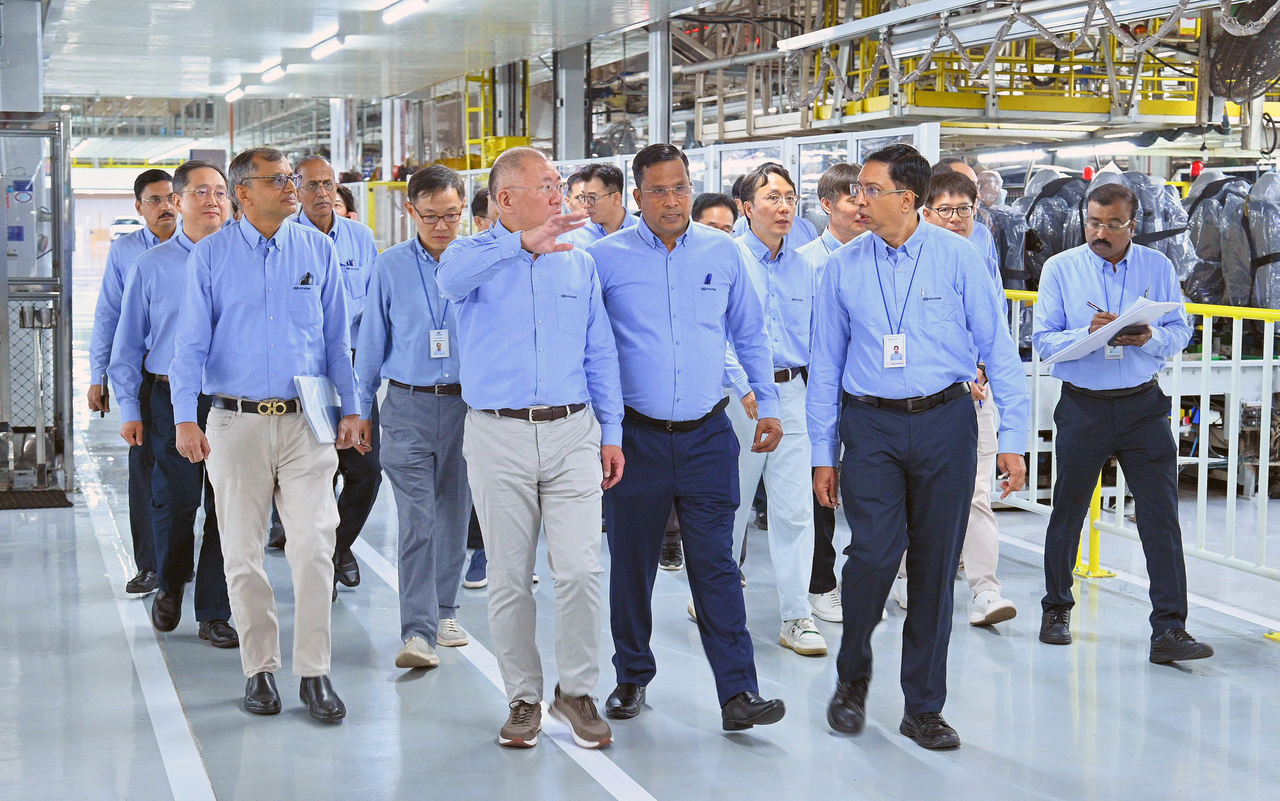
Chung’s final stop was India, where he visited the group's three plants over two days to review operations and assess growth strategy.
Hyundai entered the Indian market in 1996 and now holds a market share of about 20 percent, ranking second in the country. In 2024, Hyundai’s Indian unit went public on the country’s stock exchange, providing fresh capital to expand its product lineup and strengthen research and development.
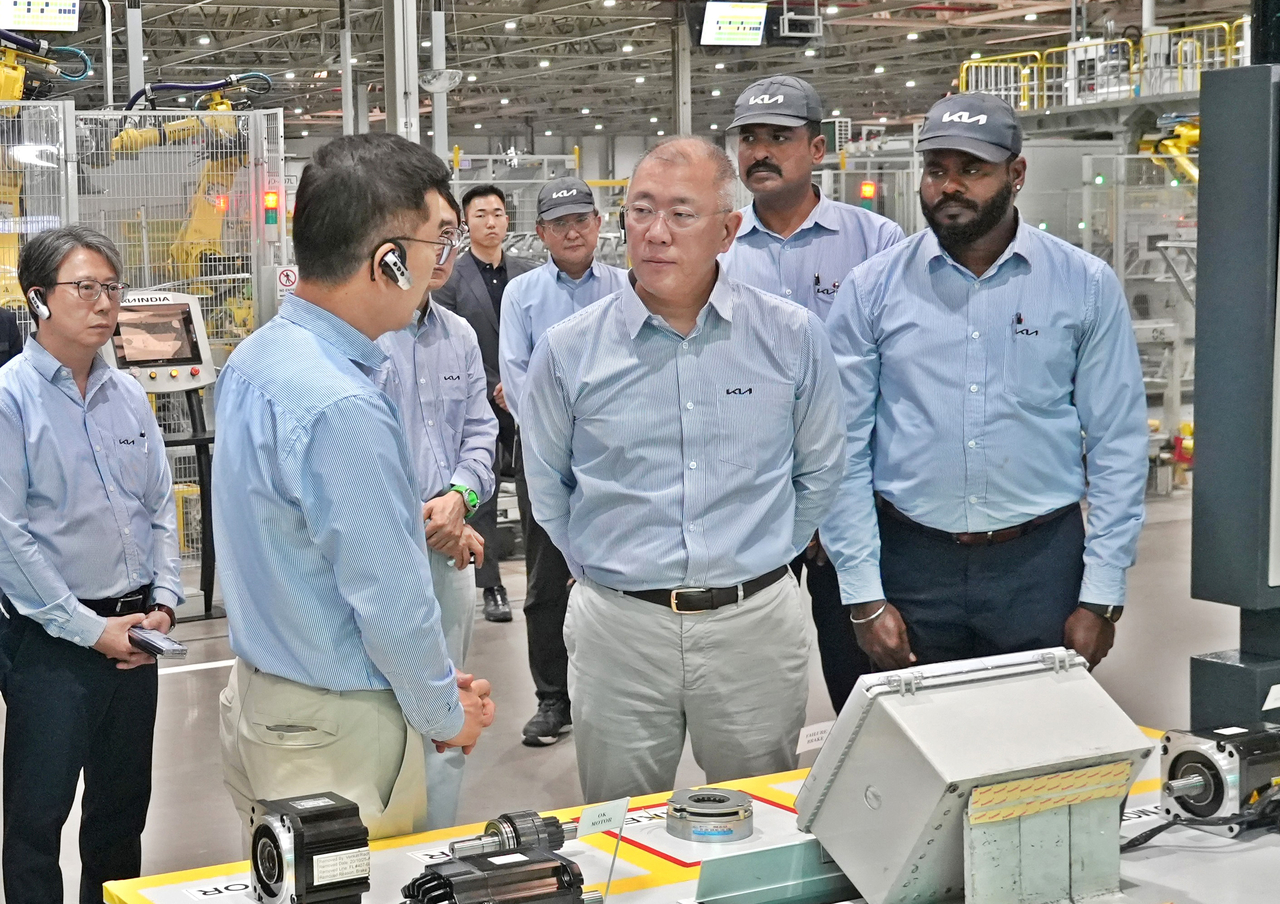
On Monday, Chung visited Hyundai Motor’s plants in Chennai and toured the Creta production line as well as Hyundai Mobis’ battery system assembly factory.
“Hyundai Motor has grown thanks to the support of the Indian people,” Chung was quoted as saying. “We must now pursue a home-brand strategy that looks ahead to the next 30 years, so that Hyundai can truly become a national brand in India.”
The same day, Chung visited Kia’s manufacturing plant in Anantapur district to review production and sales strategy.
“As Kia has only eight years of operations in India, and has great growth potential and opportunities ahead, we must set ambitious goals and strive to become the top choice for Indian customers in terms of brand, product competitiveness and quality,” said Chung.
On Tuesday, Chung toured Hyundai’s plant in Pune, inspecting production quality of the new Venue model and stressing the facility’s growing role as a strategic manufacturing hub supporting regional economic development.
Hyundai’s Pune plant, which began production last October, will ramp up Venue output and introduce new SUV models such as Seltos and Sorento to capture rising demand. The company is also moving to localize production of key EV components, including battery cells, battery packs and power electronics, to prepare for mass EV adoption and secure an early foothold in the Indian market.
sahn@heraldcorp.com