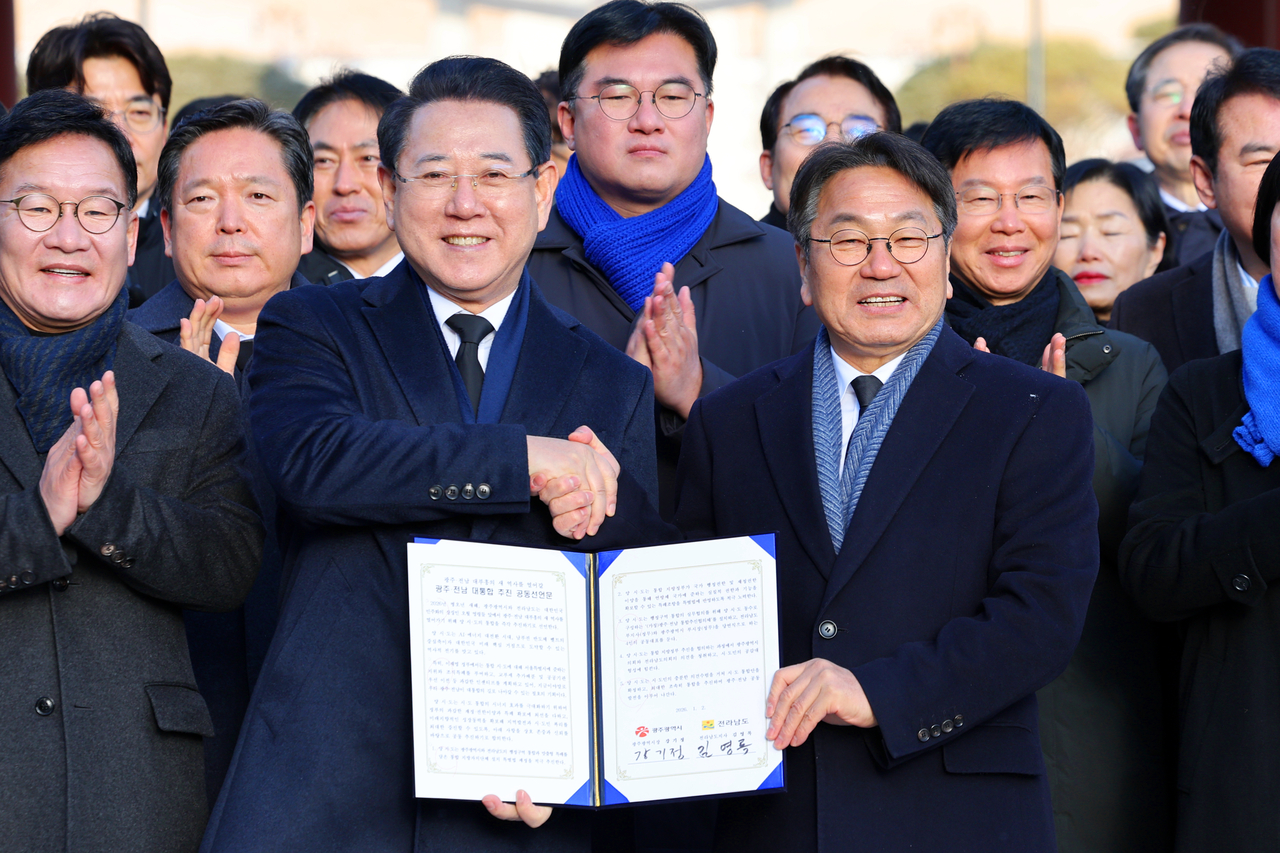
The plan to merge Gwangju City and South Jeolla Province is moving ahead unusually quickly, as the two seek to become a single administrative unit ahead of the June local elections.
The push was made official last Friday, when the Gwangju mayor and South Jeolla Province governor jointly announced their intent to integrate the two local governments.
Since then, the proposal has rapidly advanced from a political declaration to a concrete timetable tied to legislation, elections and the formal launch of a new regional authority.
Under the plan, the two governments aim to establish an integrated local government through a special law, which is to be submitted to and passed by the National Assembly by the end of February.
Once the legal framework is in place, a unified head of the merged administration will be elected by voters in the June 3 local elections, replacing the separate posts of Gwangju mayor and South Jeolla governor.
If completed, the merger would create a single local government with a population of about 3.2 million, making it one of the largest regional administrations in Korea.
The integrated entity is expected to take the form of either a "super-metropolitan special self-governing province" or a "special metropolitan city," depending on the final wording of the legislation.
The formal launch of the merged administration is targeted for July, following the election and post-election transition period.
Many operational details remain undecided despite the accelerated schedule, prompting concerns about the process being rushed without sufficient public debate or institutional preparation.
Gwangju Mayor Kang Gi-jung and South Jeolla Province Gov. Kim Yeong-rok are expected to visit the presidential office on Friday with regional lawmakers to discuss the integration plan with President Lee Jae Myung.
Officials said the talks are expected to focus on legislative coordination and central government support rather than candidate selection.
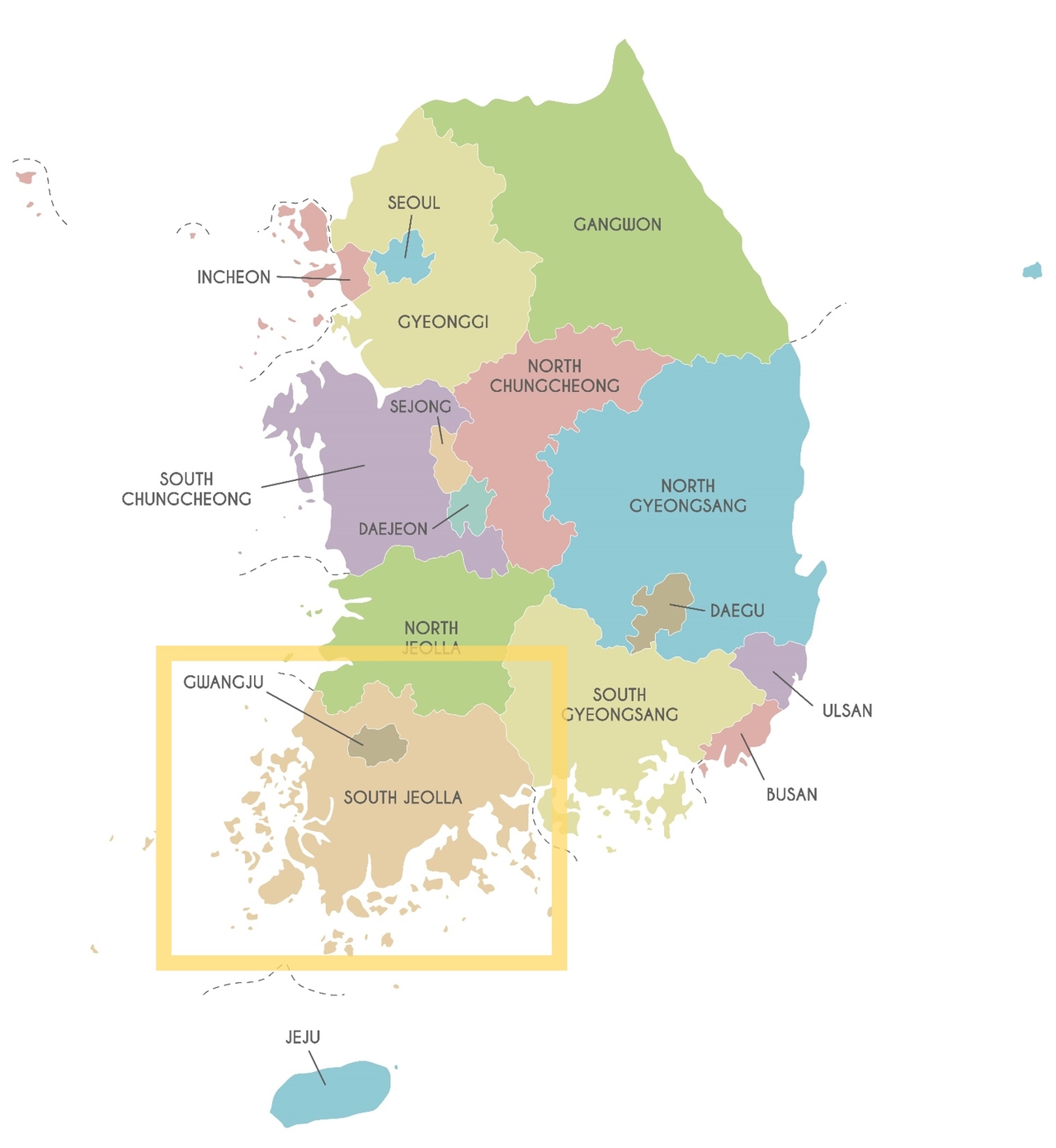
Attempts to merge Gwangju and South Jeolla Province are not new. Since Gwangju was administratively separated from the province in 1988, several similar initiatives have been proposed, all of which eventually stalled due to lukewarm backing from central governments and difficulties reconciling competing interests across the province’s cities and counties.
This time, the push is gaining momentum from Seoul. President Lee has advocated to reorganize Korea’s 17 metropolitan and provincial governments into eight larger regions as part of a broader strategy to promote more balanced national development.
“We are tying our schedule to the local elections on June 3 because integration will become much more difficult if we miss this window,” Kang said Tuesday at a city council meeting. “Current conditions are definitely different from the past. We should never lose this chance.”
Supporters argue that a merged administration would strengthen the region’s ability to secure large-scale national projects and attract investment by speaking with a single, unified voice.
The government has also signaled the possibility of exceptional administrative and fiscal support, including organizational autonomy, financial incentives and additional central government transfers.
“South Jeolla Province faces serious demographic and economic challenges, and Gwangju appears to be confronting similar issues,” an official from the Citizens’ Coalition for Economic and Justice said. “Integration could become a turning point to address population decline, stagnant industrial development and chronic fiscal constraints.”
Recent surveys suggest favorable public sentiment. Korea Research International reported Monday that 67 percent of Gwangju residents and 70 percent of South Jeolla residents said integration is necessary.
To meet the tight schedule, local authorities plan to rely on approval of the city and provincial councils for democratic legitimacy, rather than holding a separate resident referendum, officials said.
The approval in local councils is expected to be relatively smooth, as more than 90 percent of city and provincial council members belong to the ruling Democratic Party of Korea, as do the current president, mayor and governor.
The integrated administration also plans to submit special legislation to the National Assembly, detailing governance structure, fiscal arrangements and central government support measures before the end of February, including provisions on decentralizing certain powers and coordinating industrial and public service policies.
“Financial integration could reduce overlapping expenditures and free up additional resources for regional investment,” said Ju Chang-bum, a professor of public administration at Dongguk University. “Incentives from the central government are also likely.”
Still, critics warn that moving too quickly could result in a merger that changes form without resolving deeper structural imbalances.
“There is concern that this could end as a merger in name only if everything is rushed to meet election deadlines,” said Shim Cheol-eui, a lawmaker in the Gwangju city council. “Potential negative effects and implementation risks must be carefully examined.”
Experts also caution that careful coordination will be needed to prevent excessive concentration of population and industry in Gwangju at the expense of surrounding areas.
“The push may partly reflect the political calculations of local leaders preparing for elections,” Ju said. “But hasty integration carries the risk of accelerating centralization. A carefully articulated design will be essential to avoid that outcome.”
forestjs@heraldcorp.com