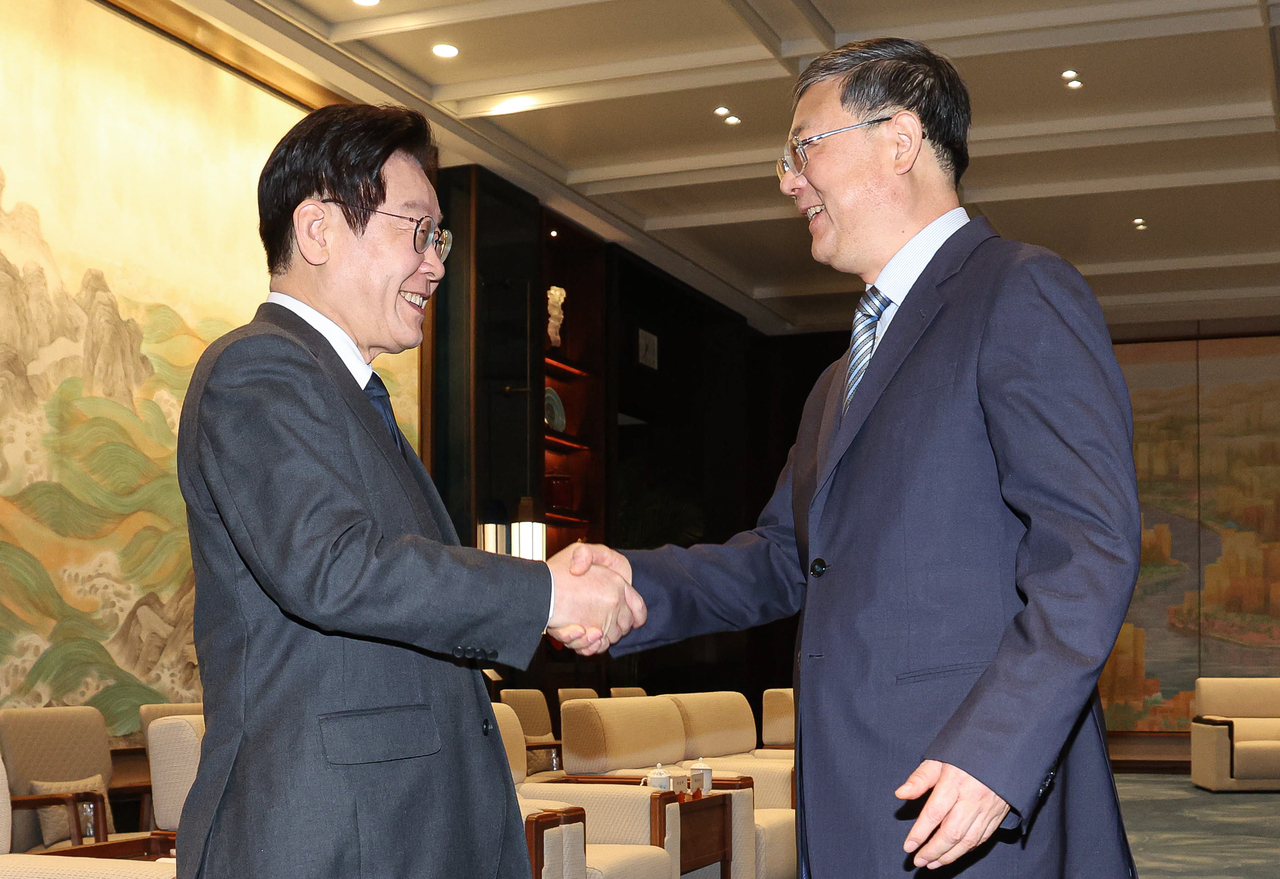
SHANGHAI — President Lee Jae Myung on Tuesday called for a reset in public sentiment between South Korea and China as he opened the Shanghai leg of his state visit with a meeting with Chen Jining, the city’s Communist Party secretary.
During the meeting, Lee underscored the importance of strengthening the economic partnership and addressing the deterioration in mutual perceptions in Shanghai, the heart and most vibrant hub of people-to-people exchange between South Korea and China.
“Beyond the economic sphere, there are many areas in which Korea and China can cooperate — from people-to-people exchanges and culture to, looking further ahead, even military and security cooperation,” Lee told Chen ahead of a dinner banquet.
“However, among these, the most immediate and practical issue is cooperation in the economic field, which is directly linked to the livelihoods of our people.”
Lee further explained that South Korea seeks to not only contribute to China’s implementation of the 15th five-year economic development plan from 2026 to 2030 but also discover new opportunities for South Korea’s own growth and development.
Lee concurrently underscored that “what is truly essential is a spirit of good-neighborly friendship between the peoples of our two countries in resolving such economic and material issues.”
“Over a considerable period of time, unfounded and unnecessary misunderstandings, distortions, and misguided perceptions have taken hold, leading to a general deterioration in how Koreans view the Chinese people, and vice versa,” Lee told Chen. “This, in many respects, has hindered the development of our bilateral relationship.”
During the meeting, Lee repeatedly underscored the importance of improving public sentiment, which has deteriorated since bilateral ties hit rock bottom in the aftermath of China’s ban on cultural imports following South Korea’s deployment of the THAAD battery.
“From this point forward, I hope we can minimize such groundless and unnecessary misunderstandings, revive and strengthen the spirit of friendship between our peoples, reduce points of friction where they exist, and instead maximize areas of cooperation and mutual benefit — moving forward together as truly good and indispensable neighbors.”
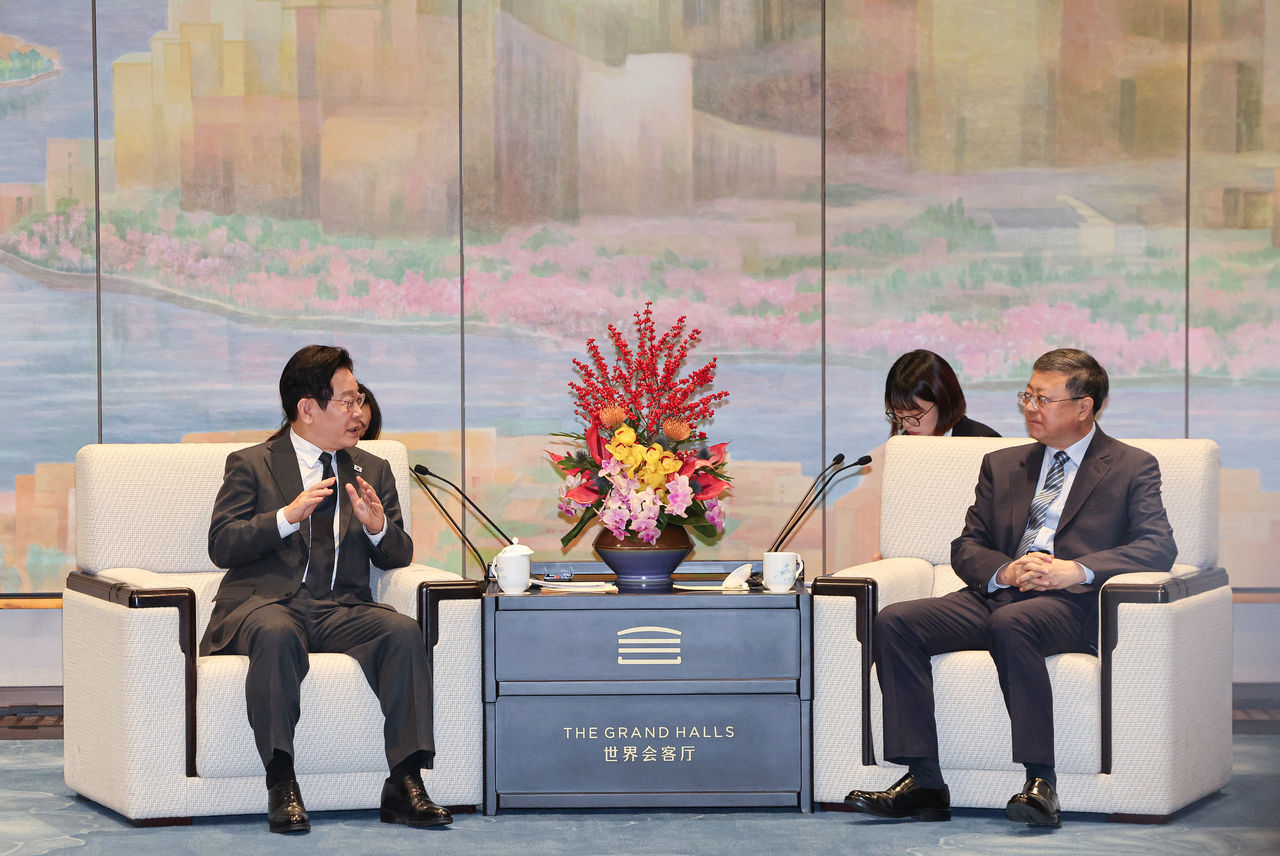
Chen also underlined the significance of cultural exchanges between Seoul and Beijing, noting that Lee and Chinese President Xi Jinping “engaged in-depth discussions on advancing bilateral relations and promoting cultural exchanges between the peoples of our two countries” during their second summit on Monday.
“Shanghai plays a particularly important role in China–Korea relations,” Chen told Lee.
According to Chen, trade between Shanghai and South Korea accounts for roughly 10 percent of total bilateral trade. Currently, around 3,200 South Korean companies operate in Shanghai, with approximately 27,000 South Korean nationals residing here. In addition, about 3,700 South Korean students are studying in Shanghai.
Each week, roughly 400 flights operate between Shanghai and South Korea.
“People-to-people exchanges between Shanghai and South Korea are also exceptionally close,” Chen said. “At the local-government level, we will continue to work together in line with the shared understanding reached by the two leaders to advance bilateral cooperation.”
During the meeting, Lee also highlighted Shanghai’s historical importance for South Korea, where the Provisional Government of the Republic of Korea in Shanghai was established by Korean independence movement activists. Lee is set to visit the place the following day.
“From long ago, Shanghai served as an important hub of exchange between the Korean Peninsula and the Chinese mainland,” Lee said. “It also holds deep historical significance for us, as it was a base where our forebears fought for liberation and independence during the period when Korea was deprived of its sovereignty.”
Lee said this year is especially meaningful, as it marks the 150th anniversary of the birth of Kim Koo and the 100th anniversary of the establishment of the Provisional Government of the Republic of Korea in Shanghai.
“I believe that clearly illuminating and passing on these historical records — of our shared, hard-fought struggle to defend national sovereignty — will serve as valuable lessons not only for our generation today but also for future generations,” Lee told Chen.
“Looking ahead, I am confident that this visit to China will not only elevate Korea–China relations to an entirely new stage, but also serve as an opportunity to resolve the lingering frictions that have existed between us.”
dagyumji@heraldcorp.com