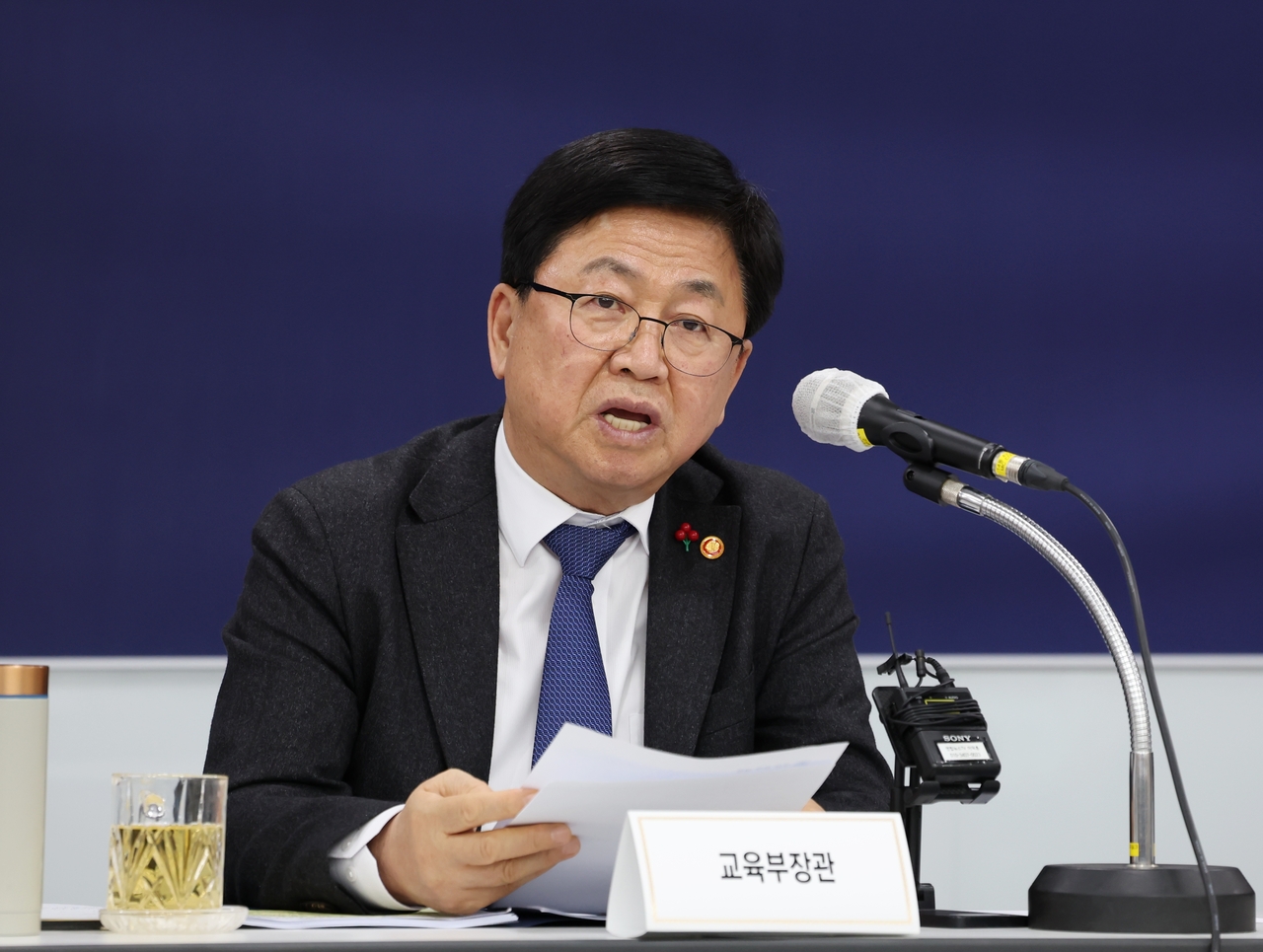
Education Minister Choi Kyo-jin said he wants to grant teachers greater political rights and expand school autonomy, arguing that South Korea cannot strengthen democratic citizenship education while educators remain tightly restricted.
“What we really want to do is complete school autonomy, and what must precede it is restoring the school community,” Choi said at a meeting with reporters marking 100 days since he took office Monday.
“There are many teachers who have worked in the name of school innovation, and it is our responsibility to organize their work and spread it across schools.”
The Lee Jae Myung administration has set “restoring the school community” as its top education goal, saying policymaking must better reflect the realities of classrooms.
To achieve this, the ministry plans to reinforce democratic citizenship and history education, expand mental-health support for students, protect teachers’ authority and push for greater political rights for educators.
The ministry said students must be equipped with critical thinking skills to grow into “democratic citizens who practice the Constitution’s values.”
The ministry added it had already provided teachers with workshops and materials on constitutional education, and plans to work with other government departments to develop teaching resources on elections, global citizenship, unification, digital literacy and climate change.
However, Choi explained that meaningful democratic citizenship education is difficult when teachers’ political rights remain restricted.
Current South Korean law requires teachers to remain politically neutral to prevent classrooms from becoming arenas for partisan influence. Educators argue the rule has been interpreted so strictly that it infringes on their own political rights, including joining or donating to political parties.
"The teachers have to teach democratic citizenship, and half of high school seniors are eligible voters," Choi said. "Teachers have to teach how to vote and how to read policies."
Choi acknowledged there were concerns about politics possibly entering the classroom, saying he too was "concerned" when the president told him last week to "put more effort" into guaranteeing teachers' political rights.
However, he said teachers expressing political thought outside their workspace would not affect the students.
"I don't think a teacher liking political content on social media would influence the child," he said.
Currently, bills to expand teachers’ political rights have been introduced at the National Assembly, but discussions remain stalled. The Ministry said it would work with the National Educaiton Committee to create social consensus, while creating new guidelines and principles.
To better protect teachers, Choi said the ministry will introduce a new online system for parents to file complaints, with local education offices responding directly to malicious submissions.
He added that the ministry would seek legal revisions to make it easier for local offices to report abusive parents and impose fines, and is also considering allowing schools to record malicious acts by students against teachers in the perpetrating student’s academic transcript.
Addressing rising teenage suicides, Choi said the ministry would increase the number of counselors, and that it was considering conducting psychological autopsies of students to better identify underlying causes.
Choi also said the number of AI-focused schools will double from 1,000 next year. These schools are allowed to allocate more instructional hours to information science and related subjects than regular schools. The ministry aims to expand the program to 2,000 schools by 2028.
On college admissions reform, Choi said he shared concerns with Seoul Superintendent Jung Geun-sik about over-competition — but remained cautious about abolishing the Suneung, stressing stability.
“While it is possible to discuss a long-term direction toward scrapping the exam in 2040, the College Scholastic Ability Test is more than just an exam — it is a system tied to social trust,” he said. “Pushing changes too quickly without public consensus could instead create greater confusion.”
Jung, the Seoul education chief, had previously proposed scrapping the Suneung by 2040.
The minister also outlined measures to curb excessive private education, particularly for young children, saying the ministry will continue monitoring early childhood private education through a dedicated task force and pursue sustained policy responses rather than short-term measures.
"I hope to change the ministry's character by listening to the voices of teachers, students and parents in (the educational) field, respecting them, and directly designing, implementing and reporting policies based on them," Choi told reporters.
seungku99@heraldcorp.com