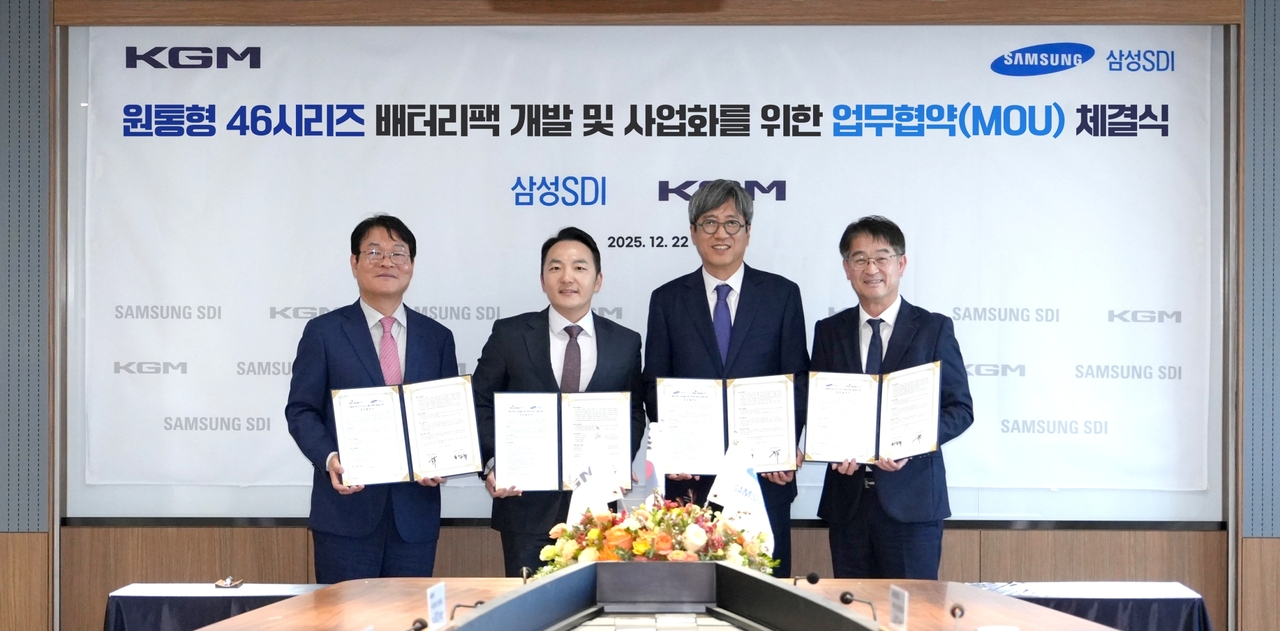
Samsung SDI and KGM have agreed to jointly develop advanced cylindrical electric vehicle battery pack technology, marking their first strategic partnership on next-generation batteries.
Under the agreement, the two companies will co-develop battery pack systems based on Samsung SDI’s 46-millimeter cylindrical cells and expand technological cooperation for future battery innovations. The battery packs are expected to be installed in KGM’s upcoming EV models, including large SUVs.
The companies will also pursue a mid- to long-term collaboration through joint R&D, information exchange on global battery markets and broader technological cooperation.
Industry watchers say the deal represents a first-of-its-kind partnership, giving Samsung SDI a commercial testbed for its 46-series cylindrical batteries while helping KGM pivot from its previously China-reliant EV supply chain.
Samsung SDI’s advanced cylindrical batteries, which offer higher energy density, enabling longer driving range and faster charging than existing smaller products, began mass production in March for micromobility applications.
Following a slowdown in EV demand and a pullback in US electrification initiatives, the battery maker is expanding its 46-series battery supply as part of a two-track strategy that maintains prismatic batteries as its core business while scaling up cylindrical products as a next-generation growth engine.
In addition to BMW, a major global customer for its advanced cylindrical battery cells, securing KGM as a domestic client is expected to help Samsung SDI diversify its revenue base.
The partnership also underscores KGM’s effort to diversify its passenger EV lineup, which had largely relied on BYD and other China-made battery cells for price competitiveness. Challenged by Hyundai Motor Group’s dominance in Korea’s EV market, KGM has focused on niche positioning — pricing the midsize Torres EVX well below comparable Hyundai and Kia models and rolling out the Musso EV pickup, a segment the group has yet to enter.
For this reason, KGM’s cooperation with Korean battery companies had been largely limited to electric buses and commercial vehicles.
“Our flagship EVs, such as Musso EV, have primarily adopted lithium iron phosphate batteries,” said a KGM official. “We are now looking to adopt advanced battery technologies, including nickel-cobalt-manganese cells, to support longer range and higher performance in premium models.”
Meanwhile, Samsung SDI’s 46-series cylindrical battery uses high-capacity nickel-cobalt-aluminum cathodes and a proprietary silicon carbon nanocomposite anode to reduce swelling and extend battery life. Its tabless design shortens current paths to lower resistance, boosting power output and fast-charging performance, while improved thermal diffusion enhances safety.
hyejin2@heraldcorp.com