Three-term mayor argues Seoul has world-class potential but lacks clear direction
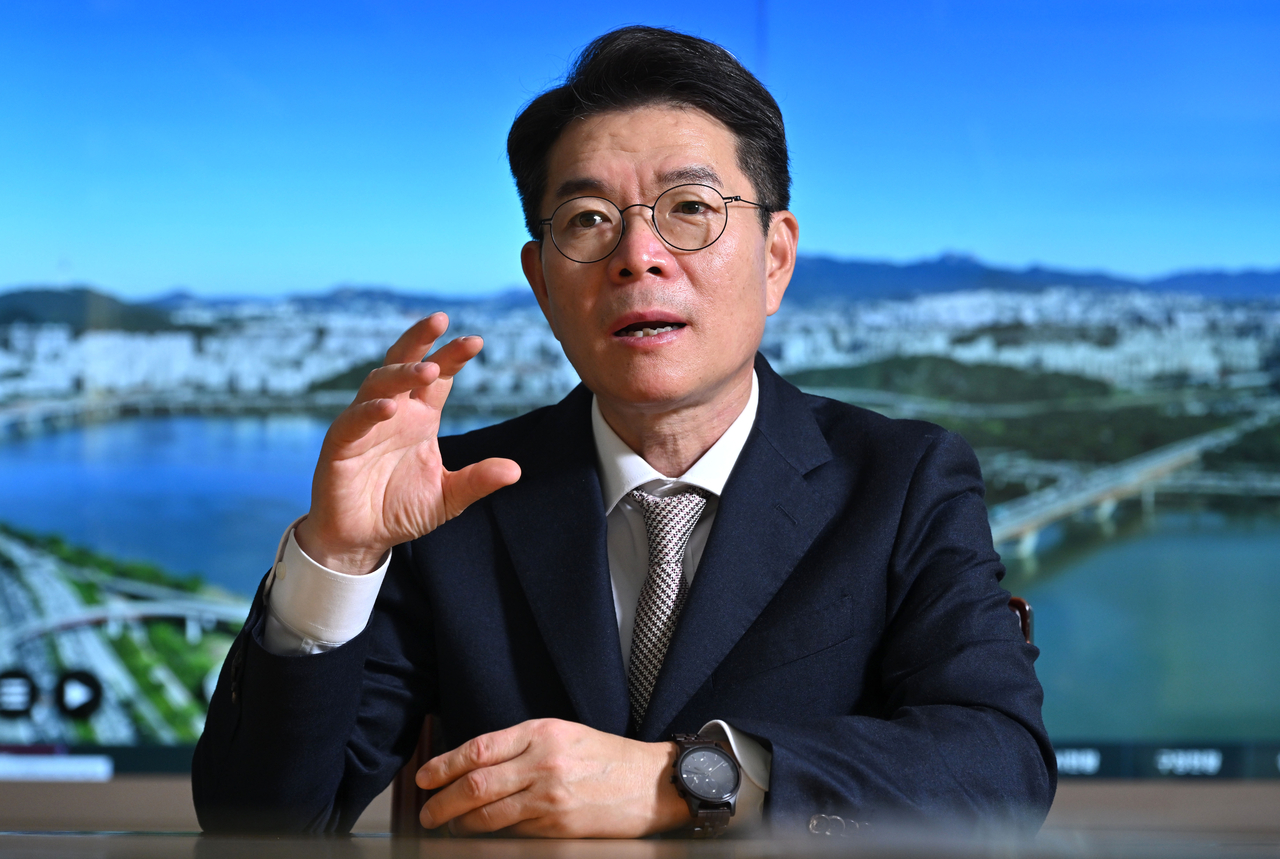
In Seoul’s Seongsu-dong neighborhood, Chong Won-o has built a reputation as a district mayor whom residents trust and recommend, a standing shaped by 12 years of hands-on governance in Seongdong-gu.
That record -- reinforced by President Lee Jae Myung’s public praise on social media -- has lifted Chong’s profile beyond the district and placed him among the leading contenders for Seoul’s next mayor.
In an interview with The Korea Herald, Chong said the capital’s next chapter should be defined not by eye-catching projects, but by a clear, shared urban vision -- one ambitious enough to make Seoul a true global counterweight in Asia as one of the world's top two cities, or "G2," alongside New York.
“Rather than focusing on achievements that look good on the outside,” Chong said, “we need to put more energy into policies that fundamentally improve residents' everyday quality of life.”
“Policies that citizens can directly feel and empathize with are what ultimately change a city’s future,” he added.
For Chong, the critique is not simply about individual projects, but about a perceived absence of direction at City Hall.
“More than anything, what I find most disappointing is that, from an urban perspective, it’s not clear where Seoul is trying to go or what the city’s goals and vision are,” he said. “Seoul is a big city, but in reality it is essentially stagnant.”
He points to global rankings as shorthand for that gap between capabilities and lived reality.
Citing Kearney’s Global Cities Index, Chong argued that Seoul is underperforming relative to its potential.
“In Kearney’s GCI, Korea’s ranking ended up at 12th this year,” he said, attributing the slide to what he described as declining “quality of life for citizens.” By contrast, he noted, Kearney’s assessment of urban potential places Seoul near the very top.
“The potential is world-class, and the capabilities of citizens and companies are excellent, but the reality is that we’re staying outside the top 10.”
To Chong, the answer is competition — not in the narrow sense of branding, but in the harder work of building a city that attracts talent, investment and ideas while remaining livable for ordinary residents.
He then pushed the ambition further, framing Seoul as a city that can rise even if Korea as a nation cannot. “In Asia, Seoul’s urban competitiveness is overwhelming,” Chong said. “Even if the country cannot realistically become G2, I believe there’s a strong possibility that, as a city, Seoul can become G2.”
That argument is not abstract in Chong’s telling. He repeatedly returns to Seongsu-dong — once a declining industrial area, now one of Seoul’s most recognizable cultural and commercial districts — as evidence that a city changes fastest when it first agrees on what it wants to become.
“Seongsu-dong, which went from a run-down factory zone to one of the world’s most notable hot places, is also the result of recognizing a city’s potential, establishing it as a clear vision, and having the city’s members share that vision and goal,” he said.
“Under this shared vision, rather than creating artificial landmarks, we preserved the district’s identity, symbolized by red-brick buildings,” he said, arguing that the neighborhood’s rise came as “young artists and startups” naturally gathered around that preserved character.
The shorthand he offered — “Korea’s Brooklyn” — was not an attempt to replicate New York, he stressed, but a reference point that allowed residents to imagine “a future that has not yet been realized.”
That same philosophy, Chong said, also shaped how he governed Seongdong — particularly through what he describes as detail-oriented, technology-backed administration.
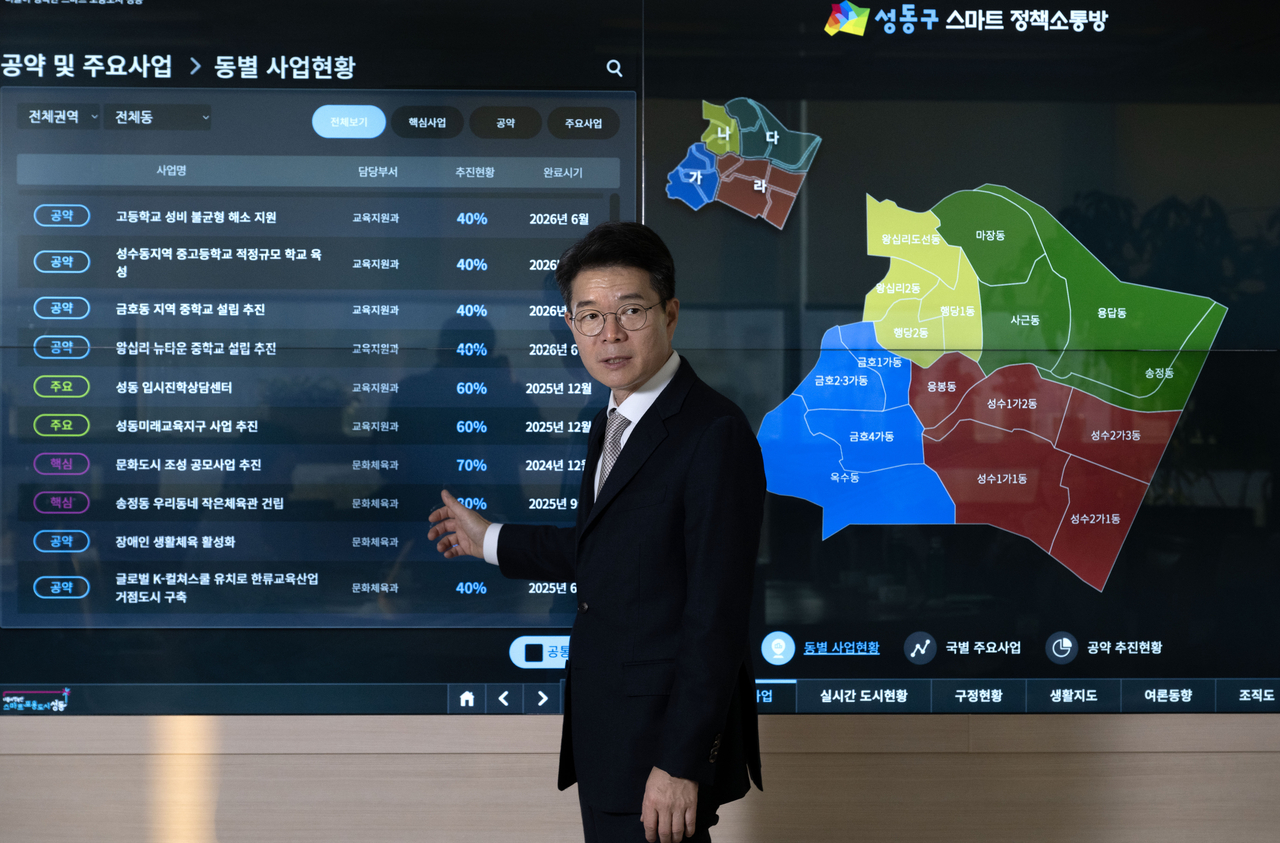
During the interview, Chong pointed to a digital dashboard he uses to monitor policy progress, budget execution and unresolved bottlenecks across the district.
“In public administration, what goes well gets reported. What doesn’t -- often doesn’t,” he said. “If the top official only finds out after something blows up, it’s already too late.”
The system allows him to identify stalled projects and intervene early, from redevelopment timelines to neighborhood-level issues such as snow removal or waste collection. “You don’t need to check everything every day,” Chong said. “But you do need to know where things stop moving.”
Among Seongdong residents, that approach has earned Chong an unusual nickname: the “idol of Seongdong.”
The label did not emerge from rallies or slogans, but from word of mouth — residents who experienced his policies firsthand and urged others to “try him” as a mayor. Chong himself has described his rise as the result of “reviews” rather than promotion, saying Seongdong residents “used him first and then discovered him.”
For Chong, that attention to detail is not micromanagement, but the basis of public trust.
He recalled projects that could have been forced through by majority approval but instead took years of persuasion to resolve local opposition. “Administration isn’t about pushing things through,” he said. “Even if 70 percent agree, the remaining 30 percent still live there. You have to persuade them.”
He described the governing principle behind Seongdong-gu as a “smart inclusive city,” with a shared objective of using technology to expand inclusiveness.
Because that vision was clearly communicated and broadly shared -- from district officials to residents -- policies could be designed and executed in alignment rather than isolation, he said.
Chong’s pitch for Seoul is a citywide extension of that same approach.
“If Seoul embraces a clear vision such as becoming a ‘Global G2’ city, and if citizens and institutions share it,” he said, “the synergy across the city would be enormous.”
jychoi@heraldcorp.com