Celebrating its 80-year history, Kia reflected on its transformation — from a maker of bicycle parts to a global top three automaker alongside Hyundai Motor Co. — highlighting the leadership milestones behind its reinvention.
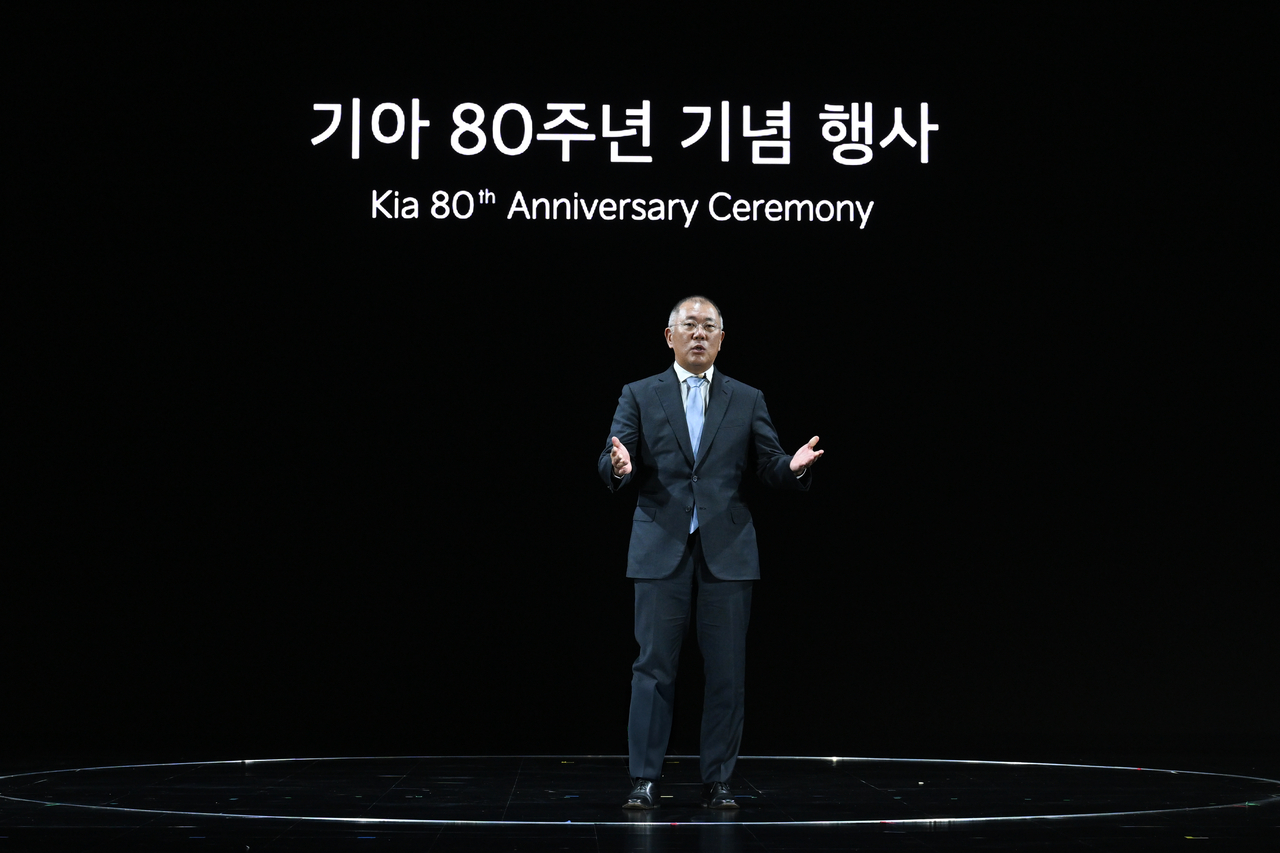
The company held its 80th anniversary event in Yongin, Gyeonggi Province, on Friday, attended by key figures, including Hyundai Motor Group Executive Chair Chung Euisun, Kia CEO Song Ho-sung and Karim Habib, executive vice president of design at Kia.
Founded in 1944 by Kim Cheol-ho, Kia has evolved from a small machine manufacturer into a global mobility brand, having survived two bankruptcies along the way. The 1997 financial crisis forced the company into court receivership, but Hyundai’s acquisition in 1998 restored stability and set the stage for a swift turnaround.
In his congratulatory remarks, Chung said, “Kia’s history is not only the story of a company. It’s a unique and invaluable chapter in the history of Korean industry.”
Chung paid tribute to founder Kim for pioneering Korea’s mobility era and producing the nation’s first passenger car — from localizing the engine to steering Kia’s evolution from bicycles and motorcycles to three-wheelers and, ultimately, to building Korea’s first integrated automobile plant.
“Hyundai founder Chung Ju-yung also built the broader mobility ecosystem — from roads to ships and industrial infrastructure — that enabled Korea’s industries to grow together,” Chung said. He added that honorary Chair Chung Mong-koo’s “quality-first management” provided the blueprint for Hyundai and Kia’s push toward Chung’s long-held ambition of becoming a global top-five automaker.
Song underscored that Chair Chung has reshaped Kia through design-driven leadership and a focus on future mobility, advancing the company’s vision and leading innovation in the eco-friendly mobility era.
As Kia’s CEO in 2005, he led a turnaround through “design-led management,” returning the company to profitability. After becoming chair, he accelerated this shift by launching a sweeping rebrand in 2021 — updating Kia’s logo and slogan and introducing the “Opposites United” design language.
Chung also expanded Kia’s electric vehicle lineup beyond its flagship EV6 and EV9 to include mass-market models such as the EV3, EV4 and EV5. This year, Kia marked another milestone with the launch of its first purpose-built vehicle, the PV5, as part of its efforts to lead the emerging era of hyperpersonalized mobility. The PV5 will be produced at a Kia plant in Hwaseong, Gyeonggi Province, with an initial annual capacity of 100,000 vehicles, slated to reach 250,000.
Building on his father’s global expansion initiative, Chung led Kia’s overseas push, establishing its first standalone plant in Zilina, Slovakia, in 2004, followed by a US plant in Georgia in 2006. The Georgia facility later built the K5, a signature K-series model that helped boost Kia’s market share in the US.
Lee Chang-kyu, an adviser for “80 Years of Kia” — the company’s first historical publication since joining Hyundai Motor Group — said during a panel talk, "few companies devote this much interest and support to recording their own history. This book is far more than a corporate chronicle — it is closely intertwined with Korea’s industrialization and economic development."
Lee noted that Chung’s key request was to document the company’s history with complete honesty, including not only its achievements, but also its challenges and failures.
Kwon Yong-ju, an automotive engineering professor at Kookmin University, noted that few global cases match Kia’s dramatic revival.
“In the global auto industry, many companies have merged, collapsed or been acquired, but almost none have returned from bankruptcy to become a leading global brand. The integration of Hyundai and Kia will be remembered as one of the industry’s most symbolic turning points.”
Kia also unveiled its future concept car, the Vision Meta Turismo, designed to showcase the company’s direction in next-generation mobility. The concept blends dynamic performance with a spacious interior, redefining mobility beyond transportation and into a space for relaxation, communication and immersive experiences.
Meanwhile, Chung addressed Hyundai Motor Group’s autonomous driving technology, noting, “Although Motional (the company’s self-driving joint venture in the US) is making strong progress, we are still somewhat behind, while Chinese companies and Tesla are moving quickly. But closing that gap is less important than ensuring safety, which will remain our top priority.”
hyejin2@heraldcorp.com