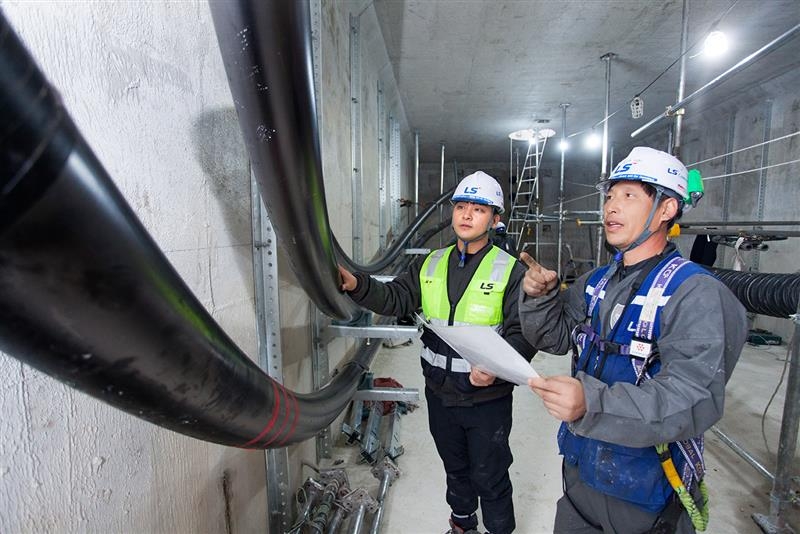
South Korean cable giant LS Cable & System announced Monday that it has officially commenced construction on the nation's largest high-voltage direct current, or HVDC, project, utilizing the world's highest-capacity cable technology.
The East Coast-Singapyeong project features the world's first commercial application of a 500-kilovolt, 90-degree Celsius HVDC cable.
The East Coast-Singapyeong line is the first phase of the East Coast-Capital Area Project, designed to transmit power generated on the east coast to the Seoul metropolitan area. The project aims to stabilize the national power supply and demand.
The cable used in this project received official certification from Korea Electric Power Corp. in June. By raising the allowable conductor temperature to 90 C, compared to the standard 70 C, the new cable increases transmission capacity by up to 50 percent.
LS Cable & System, the only Korean company with experience in both undersea and underground HVDC projects, will supply transmission lines for most sections of the project. The company has previously executed major domestic projects, including the Jeju-Jindo, Jeju-Wando and North Dangjin-Godeok lines.
"Based on our commercialization experience, we will contribute to securing the stability of the power grid," said Kim Hyung-won, head of LS Cable’s Energy and Construction Business Division. "We plan to actively expand participation in major projects at home and abroad, including the West Coast HVDC Energy Expressway and Europe's TenneT project."
According to LS Cable, HVDC is considered a key technology for the global energy transition due to its low transmission loss compared to HVAC or high-voltage alternating current. The market globally is projected to grow from 1.8 trillion ($1.2 billion) won in 2018 to approximately 41 trillion won by 2030.
sunblessyou@heraldcorp.com