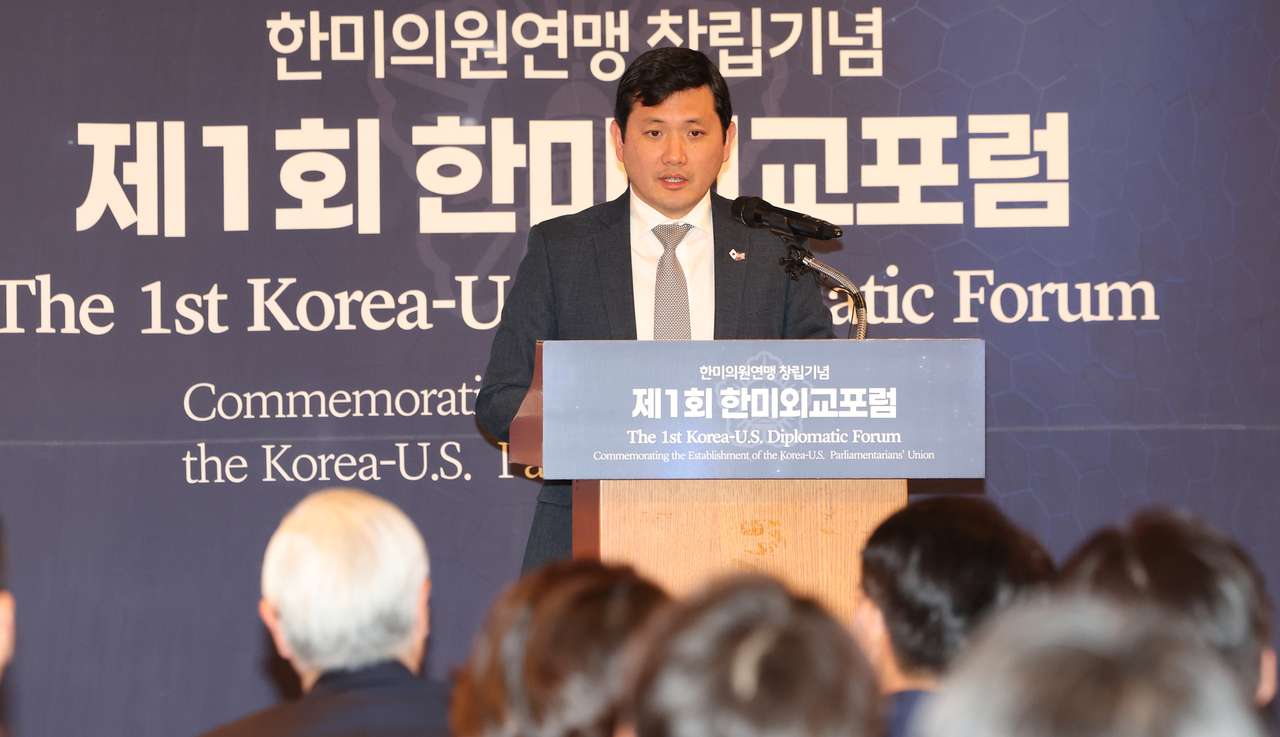
US Acting Ambassador to South Korea Kevin Kim suggested Thursday that China’s activities in the West Sea are among the reasons for pushing “alliance modernization,” including Seoul’s pursuit of nuclear-powered submarines.
Kim said the allies’ mutual prosperity rests on a “stable security environment,” stressing the point in a keynote address at the inaugural Korea-US Diplomatic Forum in Seoul.
“At the heart of that stability in the Korean Peninsula and the Indo-Pacific region is our alliance, and we all know that our security challenges are evolving both in the peninsula and the region,” Kim said. “We must work together to address those common challenges. Look no further than what has happened in the Yellow Sea recently.”
Kim did not elaborate on incidents in the West Sea or Yellow Sea, but he appeared to be referring to China’s activities there, including Beijing’s unilateral installation of structures in the Provisional Measures Zone in the West Sea.
Though Seoul and Beijing agreed to jointly administer the PMZ under the 2000 Korea-China Fisheries Agreement, Chinese vessels have blocked South Korean marine survey ships in the PMZ.
Kim believes this is why President Lee Jae Myung and US President Donald Trump "agreed to modernize the US-ROK alliance, increase Korea's defense spending, and seek new capabilities such as nuclear-powered submarines" during their second summit on Oct. 29 in Gyeongju, North Gyeongsang Province. The Republic of Korea is the official name of South Korea.
In the joint fact sheet, which was issued in mid-November to document the outcome of the second Lee-Trump summit, the allies set out tasks to be fulfilled for alliance modernization, including South Korea’s plan to increase its defense spending to 3.5 percent of gross domestic product.
Notably, the US stipulates its approval for South Korea to build nuclear-powered attack submarines and its willingness to work closely with Seoul to advance the requirements for this shipbuilding project, including avenues to source nuclear fuel.
“These new opportunities are possible because Korea is a model ally: an ally that is willing to spend on its own defense, an ally that is willing to shoulder its own burdens, an ally that continues to support an enduring American presence on the Korean Peninsula,” Kim said during the forum.
This is not the first time a US official has said South Korea’s nuclear-powered submarine could be used to help counter China.
In a group interview on Nov. 14, the day of the release of the joint fact sheet, US Chief of Naval Operations Adm. Daryl Caudle said that “Utilization of that submarine to counter China ... is a natural expectation.”
The alliance modernization, especially Seoul’s plan to acquire a nuclear-powered submarine, has irked China, which has voiced concerns that the scope of modernization could extend beyond the Korean Peninsula.
China’s Ambassador to South Korea Dai Bing urged Seoul to proceed “prudently” with the plan during a news conference on Nov. 13. Dai said China considers it a matter of “the international nonproliferation regime as well as stability on the Korean Peninsula and in the broader region.”
dagyumji@heraldcorp.com