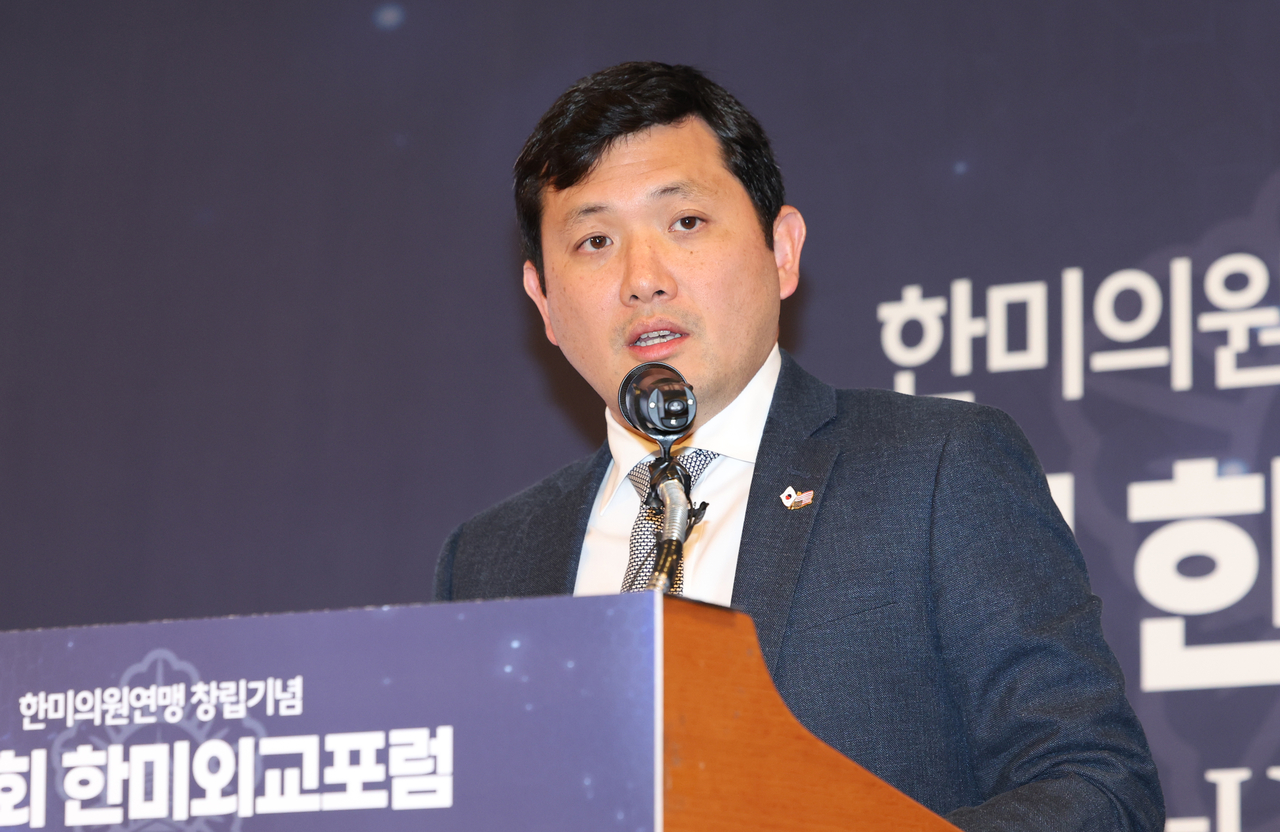
Acting US Ambassador Kevin Kim said Thursday that the joint South Korea-US fact sheet marks a turning point for the alliance, signaling that the two countries’ futures are now inseparable as they move to expand cooperation across strategic industries and security.
Kim underscored the importance of the joint fact sheet on the allies’ agreement in economic and security arenas, which was issued in mid-November, more than two weeks after President Lee Jae Myung and US President Donald Trump met for their second summit on Oct. 29 in Gyeongju, North Gyeongsang Province.
“That historic document highlights the comprehensive nature of our relationship, touching on every facet of the US-ROK alliance,” Kim said during the first Korea-US Diplomatic Forum in Seoul, referring to South Korea by its official name, the Republic of Korea.
The joint fact sheet lays out one of the most sweeping expansions of the US-ROK alliance in decades — spanning trade, investment, critical technologies, supply chains, “modernization” of the partnership, nuclear cooperation and regional security coordination.
“Together we will focus on rebuilding and expanding our cooperation in strategic industries — including shipbuilding, semiconductors, pharmaceuticals, critical minerals and the technologies of tomorrow,” Kim said. “This is a simple recognition that America’s future depends on Korea, and Korea’s future depends on America.”
Kim also highlighted the importance of parliamentary diplomacy at the forum, which was held to commemorate the establishment of the bipartisan Korea-US Parliament Union at South Korea’s National Assembly in March, with the participation of 168 lawmakers in the 300-seat Assembly.
“What an important time for our respective lawmakers to play such a critical role in strengthening the US-Korea relationship,” Kim said.
“In both countries, broad political support for US-ROK relations across all parties provides a steady political foundation for all of our work together. This is what makes US-ROK relations special at its core.”
Citing his career as a professional staff member on the Senate Armed Services Committee before joining the US State Department, Kim said, “I certainly witnessed that support from members of the US Congress on a day-to-day basis.”
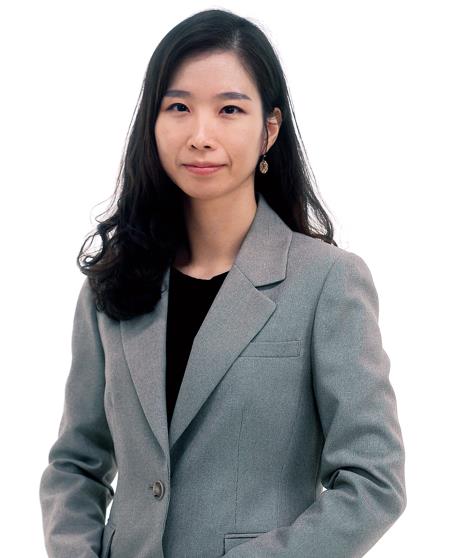
Speaking at the forum, First Vice Foreign Minister Park Yoon-joo also said close coordination between South Korea’s National Assembly and the US Congress has become more imperative than ever
“Moreover, in recent times, not only shifts in the US’ foreign policy but also changes in its domestic policies have exerted significant ripple effects on our industries, economy and everyday livelihoods,” Park said.
“It is a moment when closer communication with the US Congress — the center of American politics and the economy — is more essential than ever.”
Kim Sung-hwan, chair of the East Asia Foundation, co-host of the forum and former foreign minister, said, “The role of parliamentary diplomacy is becoming ever more important amid multifaceted challenges.”
“When diplomacy between governments is confined to short-term coordination of interests, dialogue and exchanges between legislatures perform the function of institutionalizing continuity in foreign policy and fostering a social consensus by enabling the direct participation of the people’s representatives,” Kim said.
“In particular, the more complex a global issue is, the more its policies must be pursued on the foundation of national consensus and bipartisan understanding.”
dagyumji@heraldcorp.com