Deputy PM Ekniti Nitithanprapas outlines vision for expanded cooperation in EVs, semiconductors, health care, tourism
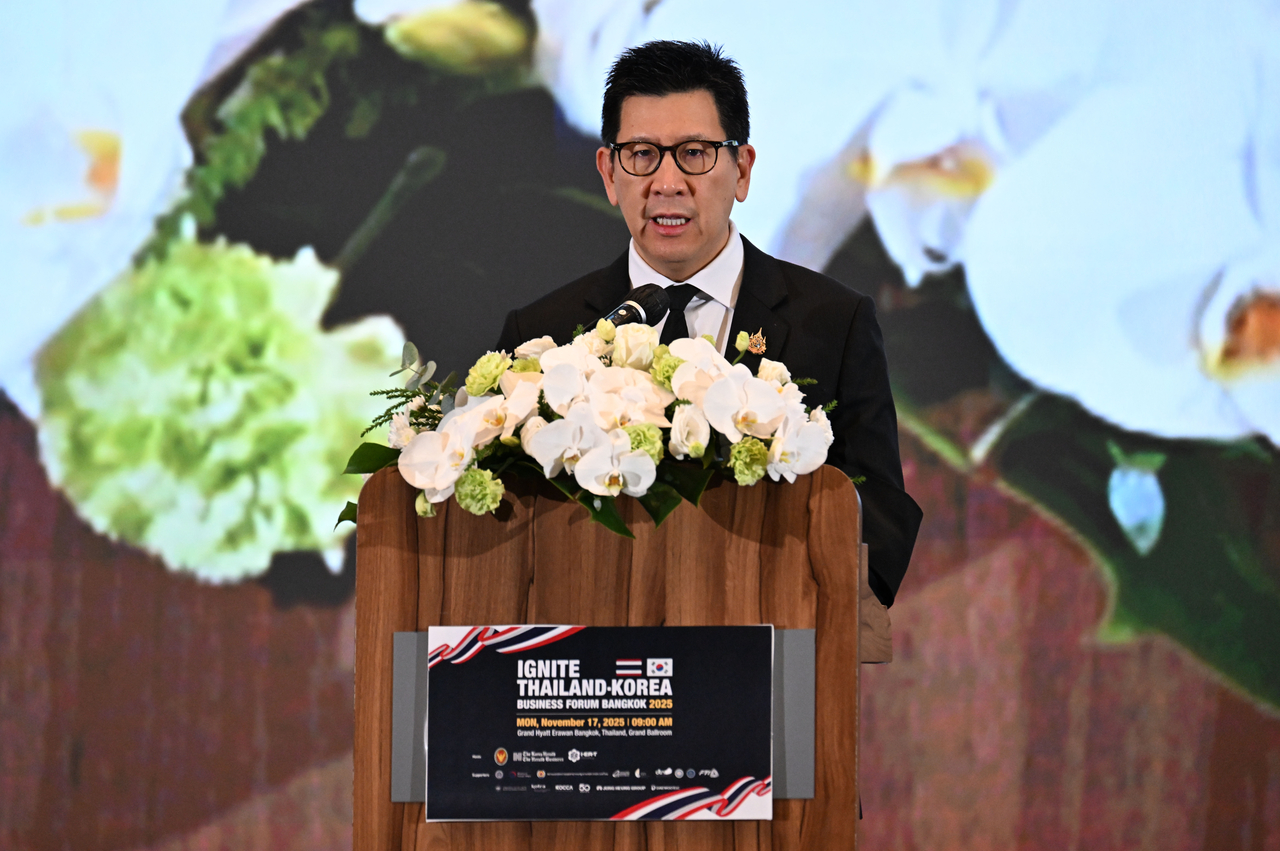
BANGKOK — Thailand cast its economic future as increasingly intertwined with South Korea’s, with Finance Minister and Deputy Prime Minister Ekniti Nitithanprapas saying shared priorities and complementary strengths point to broader cooperation across manufacturing, energy, health care, tourism and culture.
“The two countries show a very high resemblance in politics, strategy, economy and culture,” Ekniti said in his keynote address at the Ignite Thailand-Korea Business Forum on Monday, calling Korea a “natural strategic partner” for Thailand’s next stage of development.
He recalled a recent visit to Korea for the APEC Finance Ministers’ Meeting last month. “There, I learned about Korea’s strategic vision to move into new industries, especially AI, where Korea has made remarkable progress,” he said. “Thailand, too, is developing new industries in response to global changes.”
Ekniti eased into the topic of cooperation, turning first to food. “Thai and Korean cuisines, like tom yum goong and kimchi stew, each have their unique strengths,” he said. “We should work together so that people around the world can enjoy the food cultures of both countries.”
He then shifted to the larger picture, saying cooperation must ultimately center on future-driven industries. “Collaboration at both the government and corporate levels will benefit both countries,” he said.
Electric vehicles are one such area, he added, noting Thailand’s ambition to cultivate the sector: “Both countries have strong automotive foundations. Many Thais use Korean cars, and I have as well. Their progress has been remarkably fast.”
Semiconductors, which Thailand hopes to build into a future pillar of its electronics sector, were another area he highlighted for deeper collaboration. “Thailand has a foundation in electronics and digital industries, while Korea is strong in semiconductors,” he said, adding, “Combining the two countries’ industrial strategies, especially in AI and automation, can produce far greater results than if we worked separately.”
Beyond industry, he pointed to complementarities in services, citing Thailand’s strengths in wellness and medical tourism and Korea’s prominence in cosmetics and aesthetics — sectors supported by strong two-way tourism.
Cultural cooperation is also widening, he said, noting that “K-pop and T-pop are sharing mutual influence,” and pointing to Blackpink’s Thai member, Lisa, as symbolic of the two cultures’ close ties.
Looking back on similarities in the two countries’ economic development, from the 1997 Asian Financial Crisis to the pandemic shocks, Ekniti said those parallels extend to the present. “Both Thailand and Korea are currently facing challenges from geopolitical risks, export-related uncertainties and tariff issues,” he said. “In such circumstances, we must expand trade with each other and strengthen cooperation.”
Ekniti emphasized strategic alignment. “The question is how we can make the strategy of Korea and the strategy of Thailand, one plus one, equal three, not just two,” he said.
“As the forum’s name reflects, we must ignite our partnership so that both economies can grow and advance together in a rapidly changing world.”
jwc@heraldcorp.com