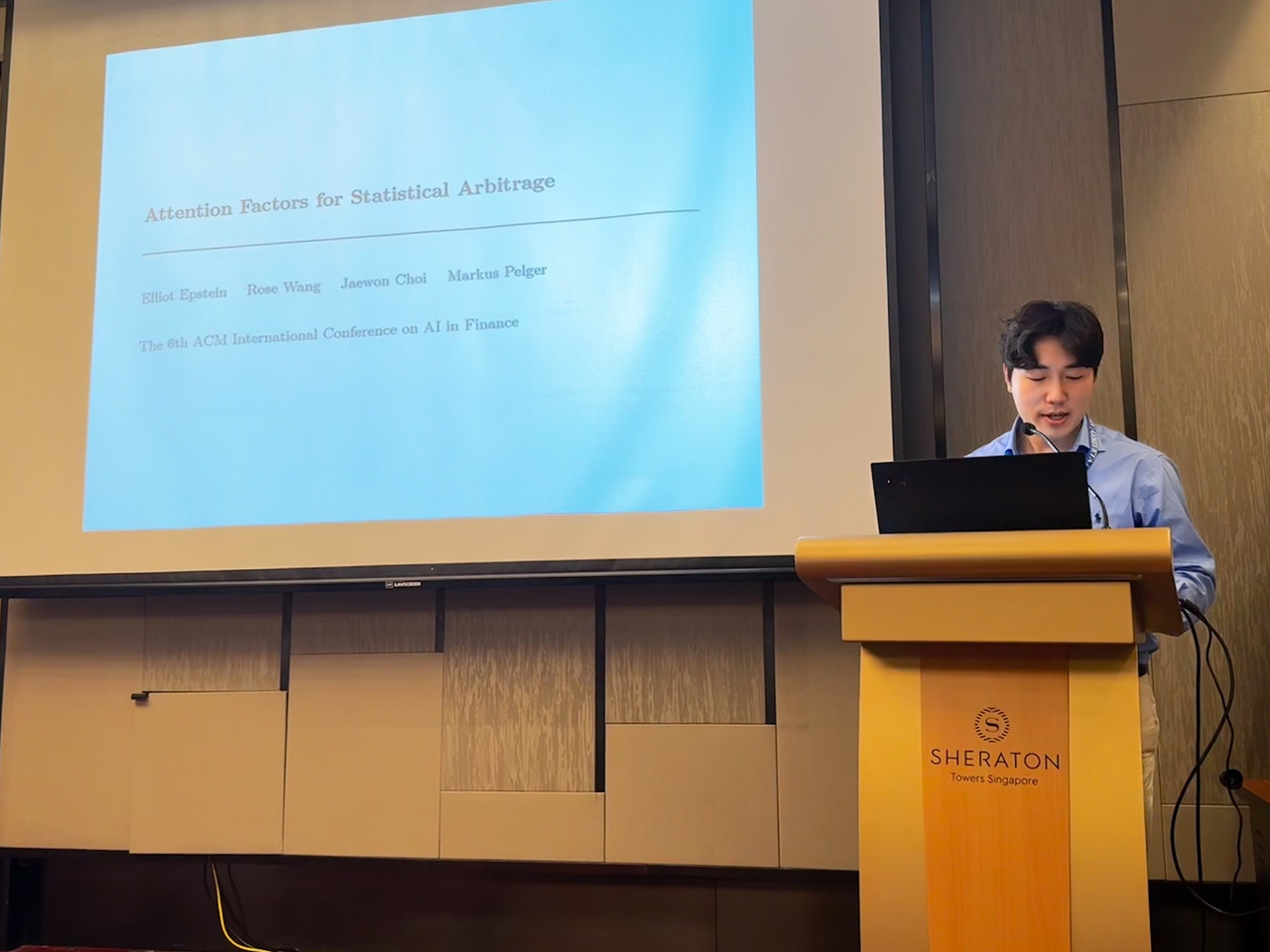
Hanwha Life said Wednesday it presented joint research with Stanford University’s Institute for Human-Centered AI on an AI-driven statistical arbitrage model at the International Conference on AI in Finance 2025 in Singapore last week.
The conference — hosted by the Association for Computing Machinery — is one of the world’s largest forums on artificial intelligence in finance, drawing participation from global institutions including JPMorgan, Morgan Stanley and BlackRock, as well as leading universities.
The paper, titled “Attention Factors for Statistical Arbitrage,” adapts the “attention” mechanism used in generative AI for application in financial factor modeling, a core framework for identifying common drivers of stock-price movements. By using attention to sift for meaningful signals within massive datasets, Hanwha Life said the model delivered strong performance in back-testing on historical US equity data.
The research team also applied deep-learning techniques to forecast residual time series, price discrepancies between stocks that traditionally move together, and optimize portfolio rebalancing. The insurer said the model improved realized returns even after transaction costs, demonstrating practical potential for real-world trading strategies.
Conference judges described the work as “a key achievement that lays the groundwork for broader advances in financial AI research.”
“This study shows that AI can detect subtle signals that conventional financial models often overlook, revealing new investment opportunities,” a Hanwha Life official said. “We will continue to expand the institute’s influence through applied research with measurable outcomes.”
Hanwha Life said it will broaden global collaboration by publicly releasing the work. The model, developed with Stanford professor Markus Pelger’s team, will be published on GitHub with accompanying code and sample data, and the full paper is available on the open-access repository arXiv.
andreahaneu@heraldcorp.com