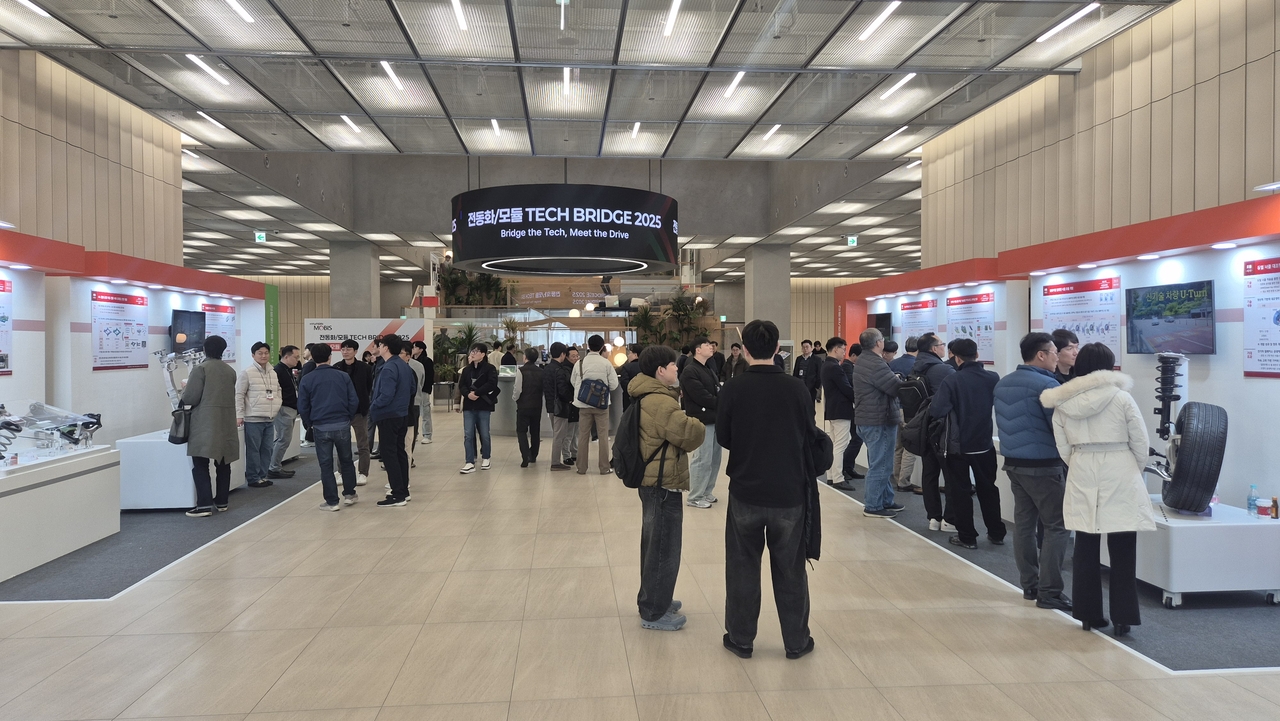
Hyundai Mobis, the parts-making arm of Hyundai Motor Group, has showcased 50 of its latest mobility technologies to global automakers and suppliers, highlighting advances in electrification and modular systems.
The two-day “Tech Bridge 2025: Bridge the Tech, Meet the Drive” exhibition kicked off Monday at Hyundai Mobis’ Electrification Research Center in Uiwang, Gyeonggi Province, marking the first time the company has combined its electrification and module showcases into a single large-scale event.
The company said bringing the two divisions together enhances synergy between its electric vehicle core components and large-module technologies, strengthening its competitiveness in global sourcing bids.
At the exhibition, Hyundai Mobis presented 28 electrification technologies, including new battery and e-drive solutions, as well as 22 module innovations spanning chassis modules, cockpit systems, interior lighting and exterior components.
A highlight was the company’s newly developed 120-kilowatt power electric system for compact urban EVs. The integrated drive unit — which combines the motor, inverter and reducer — broadens Hyundai Mobis’ e-drive lineup from mid- and large-size EVs to cover the full EV lineup. Designed for urban logistics models, the system adopts a low-profile structure that reduces overall volume while increasing usable cargo space.
Hyundai Mobis also introduced a next-generation 22-kilowatt integrating charging control unit, capable of nearly doubling EV charging speed. The system continuously monitors battery voltage and temperature even during rapid charging, using an adaptive control algorithm to optimize both charging performance and safety.
In the chassis module lineup, the company applied low-floor technologies aimed at maximizing interior space. Its functional low-floor module replaces conventional steel coil springs and hydraulic shock absorbers with composite plate springs and an electric rotary damper, enhancing ride comfort while reducing weight. The development led to five patent applications.
Cockpit technologies included a low-power LED mood-lighting controller that achieves high brightness while minimizing energy consumption. The company also highlighted manufacturing innovations such as its wire arc additive manufacturing-based mold production technology — a metal additive process similar to 3D printing that improves productivity and manufacturing competitiveness.
“Electrification systems and modular components are a comprehensive barometer of a parts supplier’s capabilities,” Hyundai Mobis said, noting that supplying megasized components such as battery systems and modules requires not only large-scale investment but also advanced design, manufacturing technology, quality control and mass-production expertise.
Leveraging these capabilities, the company has ranked sixth globally for three consecutive years in the “Top 100 Global Suppliers” list by Automotive News, a US-based automotive industry publication.
Hyundai Mobis has filed 49 patents for this technology and secured more than 7,500 new patents over the past three years, including over 3,000 related to EVs, autonomous driving and connectivity.
hyejin2@heraldcorp.com