Lee vows crackdown on hate speech, calls shift to carbon-neutral society an 'inevitable path'
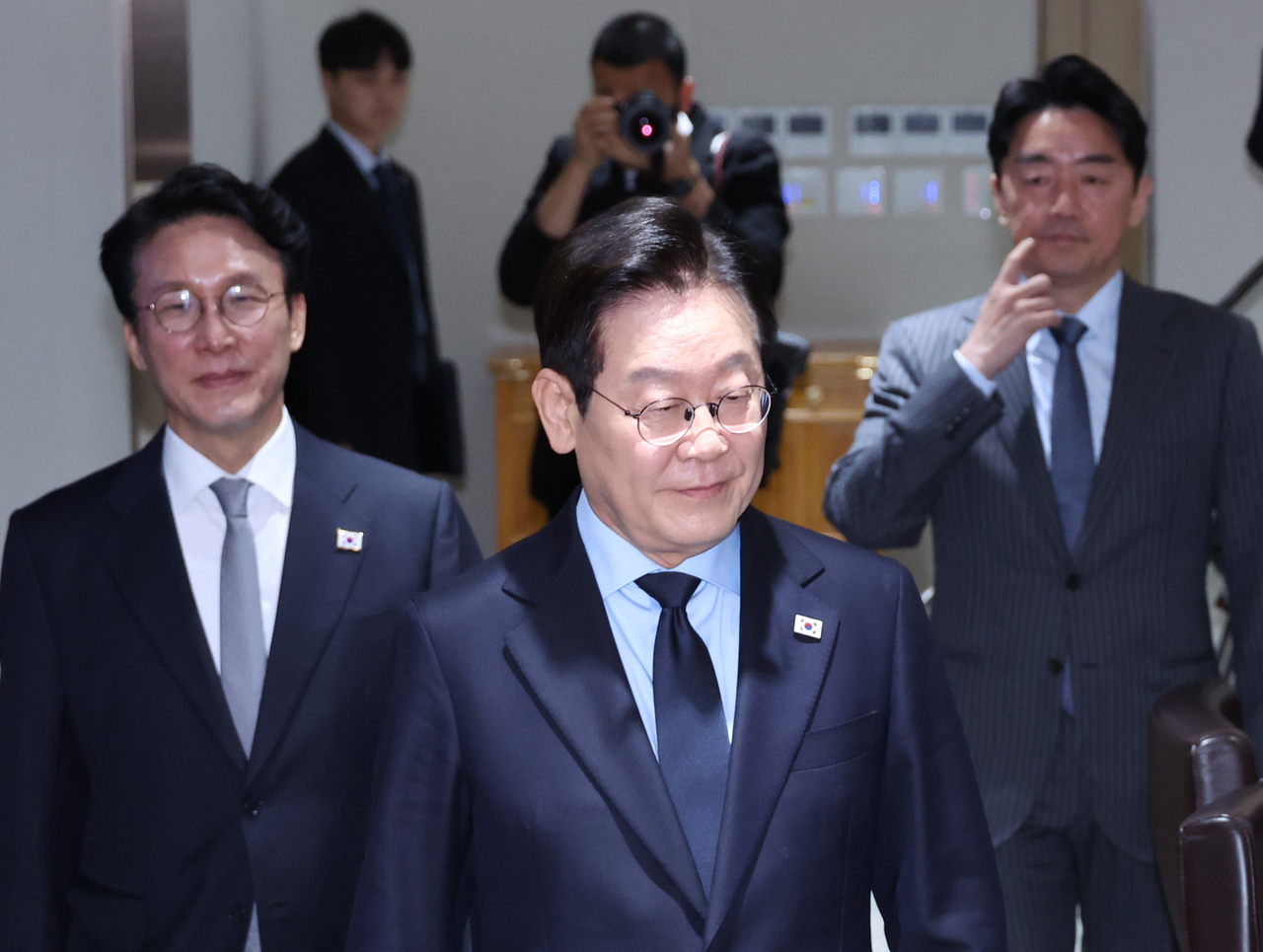
A pangovernmental investigation into civil servants allegedly involved in former President Yoon Suk Yeol's declaration of martial law is set to be launched after President Lee Jae Myung agreed to a proposal from the prime minister on Tuesday.
Prime Minister Kim Min-seok proposed that the investigation be completed by January and undertaken by a "task force to respect the Constitution and innovate the government." Kim added that the task force will come up with follow-up measures before Seollal, or Lunar New Year, celebrations in February.
"Those who were involved in the martial law imposition (in December) or collaborated with its perpetrators will face swift internal investigations as we are trying to secure the legal grounds for disciplinary actions commensurate with their actions," Kim said at a Cabinet meeting at the presidential office in Seoul, which Lee presided over.
He also said the launch of the in-house probe could "safeguard the Constitution, resolve internal conflict among civil servants and restore public trust in the government."
In response to the surprise proposal, Lee said the separate investigation is "something that must be done."
"(Those involved in Yoon's) insurrection should face consequences — either through criminal punishment after the special counsel investigation, administrative punishment or career disadvantages — depending on the gravity of their involvement (in the martial law imposition)," Lee said.
"We should not rely on the special counsel for this. It should be done independently," Lee also said.
The Prime Minister's office later announced Tuesday that the probe into the officials' involvement in martial law during the 10 months from June 2024 to April 2025 will be led by Yoon Chang-ryeol, minister of government policy coordination. It will target all 49 state bodies, especially the military, the prosecution, police, fire authorities, the coast guard and the prime minister's office, as well as the Finance Ministry, Foreign Ministry, Justice Ministry, Defense Ministry, Interior Ministry and Culture Ministry.
Kim's proposal came as ongoing special counsel probes and criminal trials into Yoon and his aides have "lingered on, which prevents (the country) from overcoming the fallout from the insurrection," Kim said.
Kim highlighted the recent case of military officers who were to be promoted in October despite being suspected of involvement in Yoon's imposition of martial law and in operations to arrest election authority officials while the short-lived martial law decree was in effect.
In a Cabinet meeting in October, Lee stressed the need to determine whether the officers were involved in wrongdoing, as a minister's decision to block an officer's promotion without sufficient cause could be seen as abuse of power.
All eyes are on a possible personnel shakeup within the liberal Lee administration as the internal investigation begins, prompting speculation that any changes could affect officials who were promoted during Yoon's tenure.
Tuesday's Cabinet meeting also revolved around ways to combat hate speech rampant in South Korea, primarily by far-right anti-China protests. At the meeting, Lee called for swift measures to ensure criminal punishment for those spreading hate speech, deport foreign nationals convicted of hate speech, revise the Political Parties Act to reduce the number of street banners carrying hate speech, and strengthen the obligation of online platform operators to contain the spread of hate speech.
Lee condemned such hate speech "based on race, country of origin or nationality," calling them crimes that threaten democracy. Citing a recent racism scandal involving the Korean Red Cross chief, he urged police to act decisively, saying that hate speech “can no longer be tolerated” and must be punished without delay.
The meeting also approved the country's plan to reduce greenhouse gas emissions by up to 61 percent from 2018 to 2035, with the president calling the shift to a carbon-neutral society an “inevitable path” for sustainable growth.
The finalized goal will be presented at the UN COP30 climate summit in Belem, Brazil, which runs through Nov. 21. South Korea last updated its nationally determined contribution in 2021, pledging a 40 percent cut by 2030 under the Paris Agreement.
consnow@heraldcorp.com